Ciri dan struktur
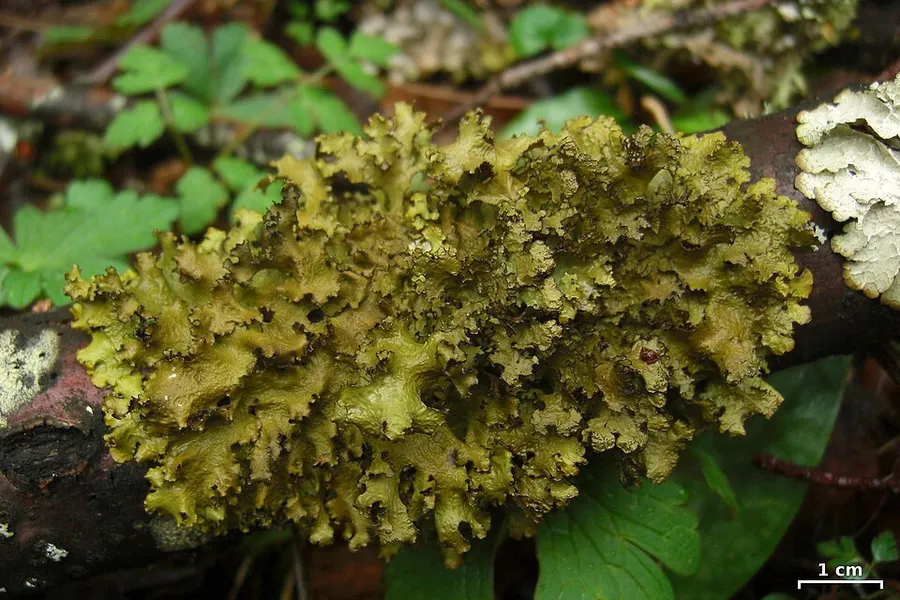
Tuckermannopsis ciliaris is a foliose lichen that typically forms loosely attached, irregular to rosette-shaped growths, reaching up to about 8 cm in diameter. Its colour ranges from olive-green to greenish-brown. The comprising the thallus (the main body of the lichen) are elongated and range from 1 to 4 mm in width, with a slightly wrinkled surface. These lobes often have scattered, long, black, hair-like structures called along their edges; the cilia are (unbranched), and measure up to 7 mm long. The upper surface of the thallus varies in color from pale to dark greenish-brown, and it lacks pseudocyphellae, which are tiny pores sometimes found in lichens. The medulla is white. The lower surface of the thallus ranges in color from brown to blackish and has a somewhat wrinkled texture. There are simple brown rhizines (small, rootlike structures) in the central part of the thallus that measure 1.5–3 long. The reproductive structures of the lichen, the apothecia, are found along the edges and sides of the lobes and can grow up to 3 mm in diameter. These apothecia produce spores that are roughly spherical and measure 4 to 5 μm in both length and width. Additionally, Tuckermannopsis ciliaris has small, black, protruding structures along the margins called pycnidia, which produce conidia (asexual spores). The conidia are dumbbell-shaped and measure approximately 5 μm in length and 1 μm in width.
Habitat dan peran ekologis
Tuckermannopsis ciliaris is distributed across a wide range of regions. In North America, it is found from southeastern Canada to the Lake States and south throughout the Appalachian Mountains and associated foothills. It is generally common in appropriate habitats in northern North America, except for the Great Plains region. In the Old World, it is distributed from Finland through Russia to Japan. In Finland, it is considered rare or possibly extinct, and has a conservation status of "regionally extinct" in the Finnish red list. It was reported as new to India in 2022, where it is considered rare. The species typically grows on the trunks and branches of pines and other conifers. In the Nordic countries, it has only been recorded growing on birch bark.
- Habitat atau konteks temuan
- Informasi belum tersedia pada sumber rilis ini.
- Substrat
- Informasi belum tersedia pada sumber rilis ini.
- Peran atau konteks
- Pembentuk liken
Reproduksi
The lower surface of the thallus ranges in color from brown to blackish and has a somewhat wrinkled texture. There are simple brown rhizines (small, rootlike structures) in the central part of the thallus that measure 1.5–3 long. The reproductive structures of the lichen, the apothecia, are found along the edges and sides of the lobes and can grow up to 3 mm in diameter. These apothecia produce spores that are roughly spherical and measure 4 to 5 μm in both length and width. Additionally, Tuckermannopsis ciliaris has small, black, protruding structures along the margins called pycnidia, which produce conidia (asexual spores). The conidia are dumbbell-shaped and measure approximately 5 μm in length and 1 μm in width.
Catatan identitas dan cakupan
- Nama diterima mengikuti Catalogue of Life Base2026-09-11; uraian mempertahankan konsep dan nama sumber aslinya.
- Original geographic, specimen and life-cycle scope retained; source import awaits individual editorial review.
- Impor dan terjemahan otomatis belum diperiksa editorial per profil. Struktur reproduktif yang disebutkan tidak membuktikan seluruh siklus hidup diketahui.
- Pengukuran pada uraian mengikuti spesimen, kultur, dan metode sumber; angka tidak diperluas ke semua populasi.
Catatan distribusi dalam narasi mengikuti sumbernya. Dokumentasi spesimen atau foto mengikuti catatan sumber. Bukti wilayah Indonesia dan penilaian konservasi tidak disimpulkan dari gambar.
Melihat dengan konteks
Dokumentasi Tuckermannopsis ciliaris dari Wikimedia Commons. Cabin Cove, Smokies, North Carolina, 20110412 Identifikasi mengikuti record berkas sumber.
- Jenis
- Fotografi
- Kredit
- Jason Hollinger
- Lisensi
- CC BY 2.0
- Sumber media
- Buka entri sumber
Sumber profil
- [1] Tuckermannopsis ciliaris — Wikipedia (en)
- [2] Catalogue of Life Base2026-09-11 — Tuckermannopsis ciliaris
- [3] Dokumentasi visual — Tuckermannopsis ciliaris
Rujukan halaman ini
Fungi. Tuckermannopsis ciliaris. Rilis data fungi-2026-10-12-expansion-2. https://fungi-atlas.mgadib.chatgpt.site/jamur/tuckermannopsis-ciliaris/.
Status: impor sumber; pemeriksaan editorial per profil belum selesai. Untuk klaim biologis, gunakan rujukan pada bagian terkait dan periksa konteks sumber aslinya.