Ciri dan struktur
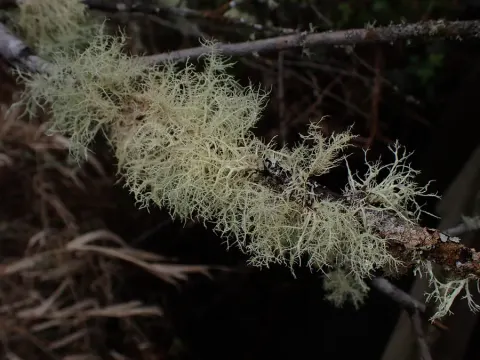
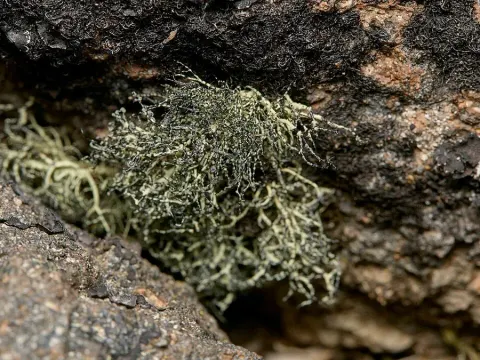
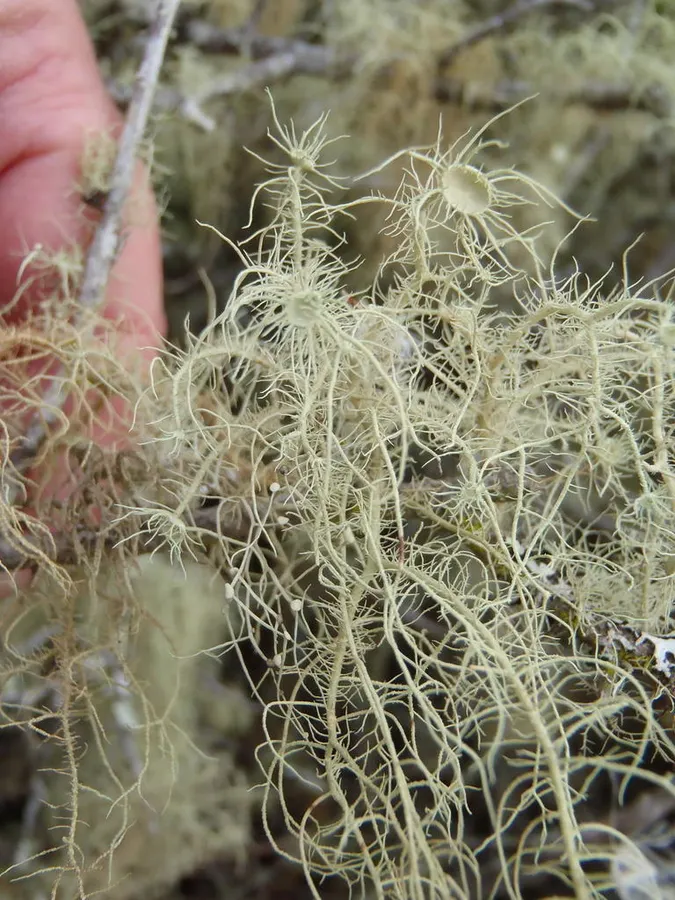
Usnea florida is a shrubby (), upright lichen typically growing to heights between 2 and 5 cm, though occasionally reaching up to 10 cm. It often forms compact, bush-like clusters. The main branches of its thallus—the vegetative body of the lichen—are relatively slender, about 1 mm in diameter, and are frequently curved or irregularly twisted. These branches may show subtle, ring-like markings known as annulations. The thinner secondary branches are often distinctly contorted, giving the lichen a tangled appearance. The overall colour of the thallus is a grey-green shade, gradually darkening to black near its base. Covering the primary branches are numerous tiny projections called , which are short and densely packed, giving a slightly roughened texture. Additionally, longer, hair-like structures called extend outward from the branches. These fibrils typically reach lengths up to 1 cm and usually emerge at right angles from the branches before becoming gently curved or curled, enhancing the tufted appearance of the species. Reproductive structures, known as apothecia, commonly appear at the tips of the main and larger side branches. These apothecia are initially concave measuring from 0.5 to 1 cm across, later flattening as they mature. The surfaces of these reproductive discs can range from smooth to somewhat wrinkled. Prominently surrounding each disc are numerous slender, fibril-like extensions, often branching themselves, and growing up to 5 mm long, giving a fringed look to the apothecia. Microscopically, the spores (ascospores) of Usnea florida are oval or ellipsoid, typically measuring from 8.5 to 11 micrometres (μm) long and 5.5 to 7 wide.
Habitat dan peran ekologis
In the United Kingdom, Usnea florida predominantly colonises smaller branches and twigs in the upper canopy of broad-leaved trees, rarely appearing on trunks. Occasionally, this lichen establishes itself on shrubs, wooden fences, or fence-posts. It thrives particularly in open, light-abundant environments. While locally common in certain regions, populations are experiencing decline, potentially due to elevated atmospheric ammonia concentrations. Its geographical range centres mainly on southern and western Britain, with isolated occurrences in southern Scotland, where it is considered scarce. Studies have confirmed the presence of Usnea florida in the Polish Eastern Carpathians within the Bieszczady National Park, where it grows epiphytically (on tree bark) at elevations ranging from 800 to 880 metres. Although historically reported from additional localities nearby, these older records were not rediscovered in modern surveys. In Italy, U. florida is adapted to cooler climates, typically inhabiting mountain forests that experience frequent fog. It primarily grows on small branches and twigs, thriving particularly well in the upper montane and subalpine zones. Its Italian distribution stretches widely, ranging from the Alps in the north all the way down through the peninsula to the mountainous regions of Sicily.
- Habitat atau konteks temuan
- hutan
- Substrat
- Informasi belum tersedia pada sumber rilis ini.
- Peran atau konteks
- Pembentuk liken
Reproduksi
Reproductive structures, known as apothecia, commonly appear at the tips of the main and larger side branches. These apothecia are initially concave measuring from 0.5 to 1 cm across, later flattening as they mature. The surfaces of these reproductive discs can range from smooth to somewhat wrinkled. Prominently surrounding each disc are numerous slender, fibril-like extensions, often branching themselves, and growing up to 5 mm long, giving a fringed look to the apothecia. Microscopically, the spores (ascospores) of Usnea florida are oval or ellipsoid, typically measuring from 8.5 to 11 micrometres (μm) long and 5.5 to 7 wide. Chemically, the medulla—the innermost layer of tissue within the thallus—responds distinctively to certain chemical spot test reagents, turning yellow when potassium hydroxide solution (K) is applied, and orange with p-phenylenediamine (Pd).
Catatan identitas dan cakupan
- Nama diterima mengikuti Catalogue of Life Base2026-09-11; uraian mempertahankan konsep dan nama sumber aslinya.
- Original geographic, specimen and life-cycle scope retained; source import awaits individual editorial review.
- Impor dan terjemahan otomatis belum diperiksa editorial per profil. Struktur reproduktif yang disebutkan tidak membuktikan seluruh siklus hidup diketahui.
- Pengukuran pada uraian mengikuti spesimen, kultur, dan metode sumber; angka tidak diperluas ke semua populasi.
Catatan distribusi dalam narasi mengikuti sumbernya. Dokumentasi spesimen atau foto mengikuti catatan sumber. Bukti wilayah Indonesia dan penilaian konservasi tidak disimpulkan dari gambar.
Melihat dengan konteks
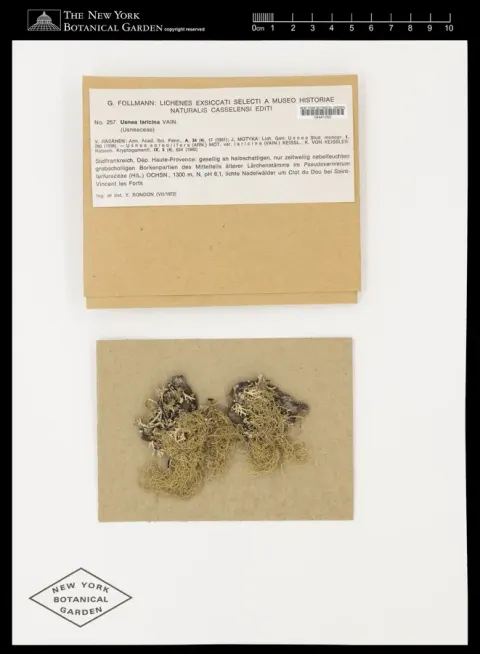
Dokumentasi Usnea florida menurut asosiasi foto pada record takson iNaturalist. Kredit: Nicola van Berkel. Identitas mengikuti sumber; bukan penentuan spesimen independen.
- Jenis
- Fotografi
- Kredit
- (c) Nicola van Berkel, some rights reserved (CC BY-SA), uploaded by Nicola van Berkel
- Lisensi
- CC BY-SA 4.0
- Sumber media
- Buka entri sumber
Sumber profil
- [1] Usnea florida — Wikipedia (en)
- [2] Catalogue of Life Base2026-09-11 — Usnea florida
- [3] Dokumentasi visual — Usnea florida
Rujukan halaman ini
Fungi. Usnea florida. Rilis data fungi-2026-10-12-expansion-2. https://fungi-atlas.mgadib.chatgpt.site/jamur/usnea-florida/.
Status: impor sumber; pemeriksaan editorial per profil belum selesai. Untuk klaim biologis, gunakan rujukan pada bagian terkait dan periksa konteks sumber aslinya.