01 / Morfologi

Ciri dan struktur

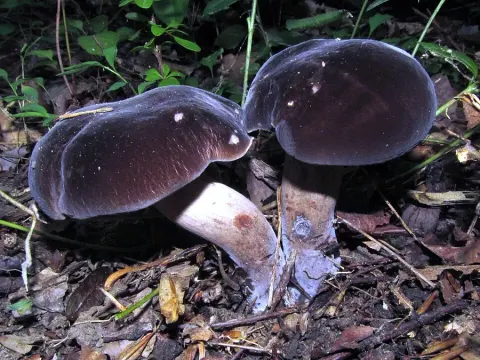
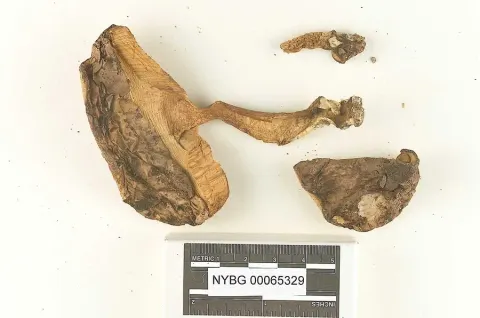
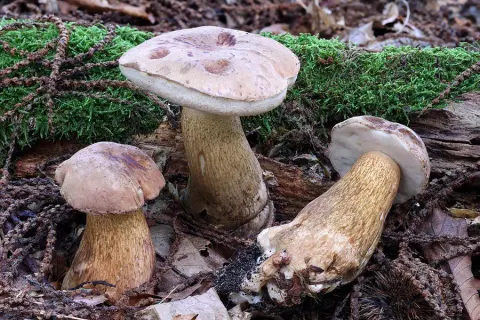
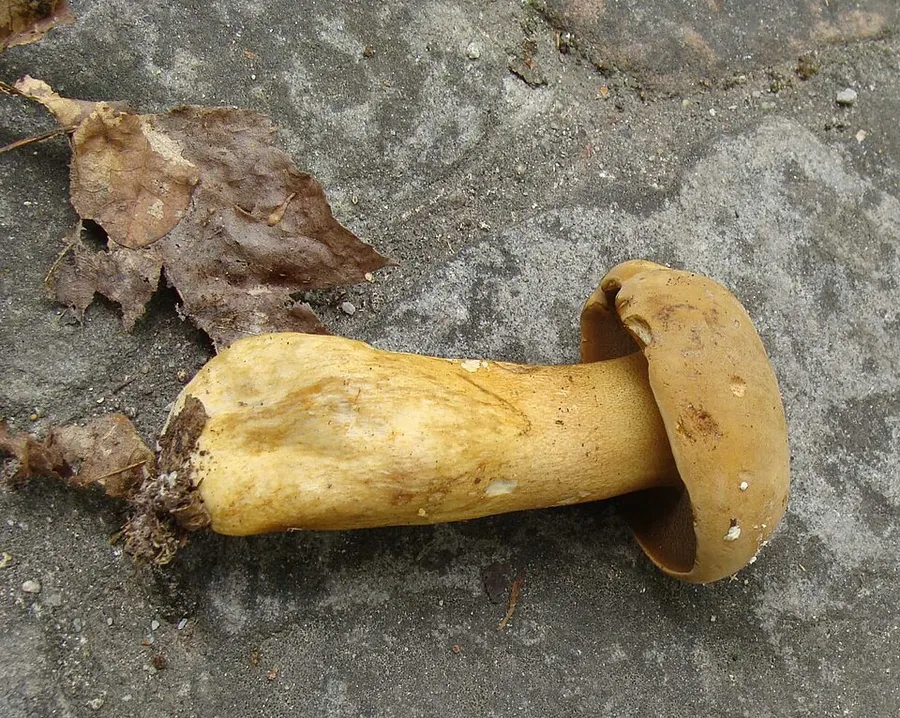
The caps of the fruit body initially have a rounded shape, but later become broadly convex and eventually flattened in age; they reach dimensions of 4.5 – 17.5 cm wide. The color ranges from yellowish brown to orangish brown to tobacco brown. The cap surface is dry with a somewhat velvet-like texture, although in larger specimens the surface is areolate (divided into small areas by cracks). The cap margin is even and wavy. The tubes on the underside of the cap (comprising the hymenium) are dark brown to cinnamon-brown. The angular to circular pores are lighter in color than the tubes and number about 1–2 pores per millimeter, while the tubes are up to 1.4 cm long. The pore surface is depressed around the stem. The cap flesh is white, but typically stains purplish buff or pinkish buff when cut. The stipe typically measures 4 – 16.5 cm by 2.5 – 6 cm thick. When young, it is bulbous, but matures to become more or less equal in width throughout. Its color is roughly the same as the cap, although it tends to be slightly darker in the upper portion, where it is reticulate (covered with a net-like patterns of ridges). The odor of the mushroom has been described variously as "not distinctive, fruity, fishy, or pungent", while the taste is indistinct to slightly bitter. The edibility of the mushroom is unknown. The variety amarus is similar in appearance, but has bitter-tasting flesh, while variety dubius has a lighter colored-cap and less distinctive reticulations on the apex of the stem. Fruit bodies produce a spore print ranging in color from pinkish brown to reddish brown. The spores measure 10–17 by 3.5–4.5 μm, and are fusoid (somewhat spindle-shaped) to elliptical.

Sebagian uraian ditampilkan dalam bahasa sumber; terjemahannya belum tersedia atau belum lolos pemeriksaan.

Rujukan: [1]

Pengukuran mengikuti objek, spesimen atau kultur, dan metode yang disebutkan sumber. Baca uraian asli untuk konteks lengkap.

02 / Kehidupan

Habitat dan peran ekologis

Tylopilus tabacinus bentuk ektomikoriza asosiasi dengan ek, dan tubuh buah biasanya ditemukan secara sepi, tersebar, atau dalam kelompok di tanah berpasir di bawah ek atau di hutan ek-pine campuran dari July to September. Di Amerika Serikat, jamur ini didistribusikan dari Florida north ke Rhode Island, dan barat ke Mississippi. Hal ini juga telah dikumpulkan dari hutan awan pegunungan Mexican Beech (Fagus grandifolia var. mexicana) di negara bagian Hidalgo, Meksiko. Penemuan jamur "sesekali sampai cukup umum". Varietas amarus dan dubius jarang ditemukan, hanya dikenal dari lokasi koleksi asli mereka di Gainesville, Florida.

Rujukan: [1]

Habitat atau konteks temuan
hutan
Substrat
Informasi belum tersedia pada sumber rilis ini.
Peran atau konteks
Mitra tumbuhan
Temukan hubungan serupa
03 / Siklus hidup

Reproduksi

Fruit bodies produce a spore print ranging in color from pinkish brown to reddish brown. The spores measure 10–17 by 3.5–4.5 μm, and are fusoid (somewhat spindle-shaped) to elliptical. Spores have a smooth surface, and a plage (a depressed area where the spore was once attached to the basidium via the sterigma). The spore walls are thin, up to 0.2 μm. They are pale yellow to cream green in a solution of potassium hydroxide, pale yellow-rust in Melzer's reagent, and blue in Methyl blue; without stain, they appear hyaline to pale yellow. The cap cuticle is an interwoven trichodermium—a cellular arrangement whereby the hyphae are of roughly equal length and arranged perpendicularly to the surface.

Sebagian uraian ditampilkan dalam bahasa sumber; terjemahannya belum tersedia atau belum lolos pemeriksaan.

Rujukan: [1]

Sinonim menurut acuan taksonomi rilis: Boletus tabacinus; Ceriomyces tabacinus; Tylopilus tabacinus var. amarus; Tylopilus tabacinus var. dubius
04 / Batas informasi

Catatan identitas dan cakupan

  • Nama diterima mengikuti Catalogue of Life Base2026-09-11; uraian mempertahankan konsep dan nama sumber aslinya.
  • Original geographic, specimen and life-cycle scope retained; source import awaits individual editorial review.
  • Impor dan terjemahan otomatis belum diperiksa editorial per profil. Struktur reproduktif yang disebutkan tidak membuktikan seluruh siklus hidup diketahui.
  • Pengukuran pada uraian mengikuti spesimen, kultur, dan metode sumber; angka tidak diperluas ke semua populasi.

Catatan distribusi dalam narasi mengikuti sumbernya. Dokumentasi spesimen atau foto mengikuti catatan sumber. Bukti wilayah Indonesia dan penilaian konservasi tidak disimpulkan dari gambar.

05 / Dokumentasi

Melihat dengan konteks

Dokumentasi Tylopilus tabacinus dari Wikimedia Commons. A fruit body of the bolete fungus Tylopilus tabacinus (Peck) Singer. Specimen collected in Millstream Gardens Conservation Area, Missouri, USA. Identifikasi mengikuti record berkas sumber.

Jenis
Fotografi
Kredit
Patrick Harvey (pg_harvey)
Sumber media
Buka entri sumber

Gambar menunjukkan objek menurut identifikasi sumber, bukan verifikasi independen spesimen oleh Fungi. Tidak ada skala baru yang ditambahkan.

06 / Rujukan

Sumber profil

  1. [1] Tylopilus tabacinus — Wikipedia (en)Bagian sumber: Frozen revision 1308081947
    Tanggal penghimpunan sumber: 2026-10-12
    Teks sumber: CC BY-SA4.0 · Wikipedia contributors
  2. [2] Catalogue of Life Base2026-09-11 — Tylopilus tabacinusBagian sumber: ColDP NameUsage.tsv ID 59TYS; accepted species; source 2073
    Tanggal penghimpunan sumber: 2026-10-12
  3. [3] Dokumentasi visual — Tylopilus tabacinusBagian sumber: Individual media record; identification follows the source, not independent determination
    Tanggal penghimpunan sumber: 2026-10-12
    Media sumber: CC BY-SA 3.0 · Patrick Harvey (pg_harvey)

Adaptasi teks: CC BY-SA 4.0. Wikipedia contributors — Tylopilus tabacinus — Wikipedia (en)

Uraian asli dan riwayat sumber

Riwayat atau halaman sumber

Ringkasan sumber

Tylopilus tabacinus is a species of bolete fungus in the family Boletaceae. It is characterized by a tawny-brown cap measuring up to 17.5 cm in diameter, and a reticulated stem up to 16.5 cm long by 6 cm thick. A characteristic microscopic feature is the distinctive crystalline substance encrusted on the hyphae on the surface of the cap. The species is known from the eastern United States from Florida north to Rhode Island, and west to Mississippi, and from eastern Mexico. It is a mycorrhizal species, and associates with oak and beech trees.

Revisi sumber

Morfologi sumber

The caps of the fruit body initially have a rounded shape, but later become broadly convex and eventually flattened in age; they reach dimensions of 4.5 – 17.5 cm wide. The color ranges from yellowish brown to orangish brown to tobacco brown. The cap surface is dry with a somewhat velvet-like texture, although in larger specimens the surface is areolate (divided into small areas by cracks). The cap margin is even and wavy. The tubes on the underside of the cap (comprising the hymenium) are dark brown to cinnamon-brown. The angular to circular pores are lighter in color than the tubes and number about 1–2 pores per millimeter, while the tubes are up to 1.4 cm long. The pore surface is depressed around the stem. The cap flesh is white, but typically stains purplish buff or pinkish buff when cut. The stipe typically measures 4 – 16.5 cm by 2.5 – 6 cm thick. When young, it is bulbous, but matures to become more or less equal in width throughout. Its color is roughly the same as the cap, although it tends to be slightly darker in the upper portion, where it is reticulate (covered with a net-like patterns of ridges). The odor of the mushroom has been described variously as "not distinctive, fruity, fishy, or pungent", while the taste is indistinct to slightly bitter. The edibility of the mushroom is unknown. The variety amarus is similar in appearance, but has bitter-tasting flesh, while variety dubius has a lighter colored-cap and less distinctive reticulations on the apex of the stem. Fruit bodies produce a spore print ranging in color from pinkish brown to reddish brown. The spores measure 10–17 by 3.5–4.5 μm, and are fusoid (somewhat spindle-shaped) to elliptical.

Revisi sumber

Ekologi sumber

Tylopilus tabacinus forms ectomycorrhizal associations with oaks, and fruit bodies are usually found solitarily, scattered, or in groups on sandy soil under oaks or in mixed oak-pine woods from July to September. In the United States, the mushroom is distributed from Florida north to Rhode Island, and west to Mississippi. It has also been collected from a montane cloud forest of Mexican Beech (Fagus grandifolia var. mexicana) in the state of Hidalgo, Mexico. The occurrence of the mushroom is "occasional to fairly common". The varieties amarus and dubius are rare, known only from their original collection locations in Gainesville, Florida.

Revisi sumber

Struktur reproduksi sumber

Fruit bodies produce a spore print ranging in color from pinkish brown to reddish brown. The spores measure 10–17 by 3.5–4.5 μm, and are fusoid (somewhat spindle-shaped) to elliptical. Spores have a smooth surface, and a plage (a depressed area where the spore was once attached to the basidium via the sterigma). The spore walls are thin, up to 0.2 μm. They are pale yellow to cream green in a solution of potassium hydroxide, pale yellow-rust in Melzer's reagent, and blue in Methyl blue; without stain, they appear hyaline to pale yellow. The cap cuticle is an interwoven trichodermium—a cellular arrangement whereby the hyphae are of roughly equal length and arranged perpendicularly to the surface.

Revisi sumber

Rujukan halaman ini

Fungi. Tylopilus tabacinus. Rilis data fungi-2026-10-12-expansion-2. https://fungi-atlas.mgadib.chatgpt.site/jamur/tylopilus-tabacinus/.

Status: impor sumber; pemeriksaan editorial per profil belum selesai. Untuk klaim biologis, gunakan rujukan pada bagian terkait dan periksa konteks sumber aslinya.