Ciri dan struktur
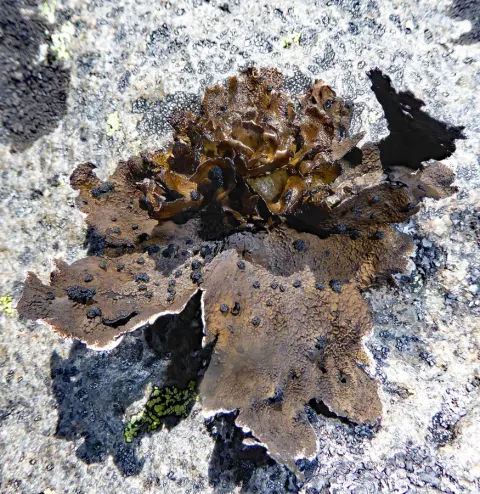
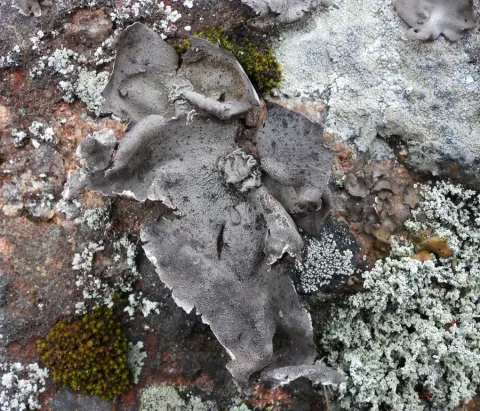
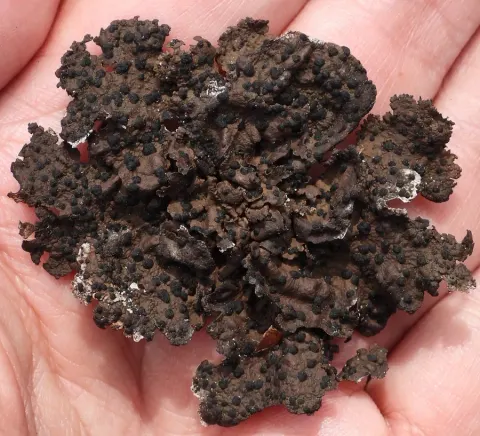
The thallus of Umbilicaria hirsuta typically spans 2 to 5 cm across. Thalli may occur singly or in small clusters. The lobe edges often curve downward and may be smooth and rounded or jagged and torn. The upper surface is grey to brownish grey, finely cracked, and often becomes as it breaks down into diffuse powdery propagules near and on the margins. The sparse, powdery to granular vegetative propagules are usually not grouped into discrete soralia and can therefore be easy to overlook. In the European U. hirsuta group these propagules have been interpreted as "parasoredia" because they arise from fragmentation of the algal-bearing upper thallus layer rather than from undifferentiated medulla. The underside of Umbilicaria hirsuta ranges from pale brown to black, generally becoming darker towards the centre. The underside may be smooth or have small wart-like protrusions, and it typically bears numerous dark brown to black, root-like rhizinomorphs. Fruiting bodies (apothecia) are uncommon. When present, they are small (0.5–2 mm in diameter) and may be slightly depressed or raised on the thallus surface. They are flat but may appear wrinkled or convoluted, and are sometimes encircled by soralia (clusters of ). Identification of the lichen can be harder in very young thalli (before diaspores develop) or in overmature or abraded specimens, because the diagnostic propagules may be absent or damaged. The ascospores of Umbilicaria hirsuta are colourless, lack internal divisions (septa), and measure 10–13 μm long and 3–7 μm wide (occasionally up to 8 μm).
Habitat dan peran ekologis
In North America, Umbilicaria hirsuta is sporadic from the Arctic to Mexico and appears to be rare throughout its range. It grows on non-calcareous rock, especially on sheltered rock faces in forested or semi-open areas, and is rare in the Pacific Northwest. Kofranek and McCune reported the species from Oregon for the first time in 2008, finding it on a non-calcareous igneous rock outcrop in the Siskiyou Mountains, where it grew on vertical rock faces in filtered light under partial forest canopy cover. Later fieldwork in southwestern Oregon found additional populations on very large boulders and rock outcrops at open, high-elevation sites in the Cascade–Siskiyou region, typically on underhangs or along trickle lines; the same study reported collections from northern and central California and summarized several older records from southern California. In Montana, it has been recorded several times beginning with an initial report from Glacier National Park, and more recently from an old fibreglass travel trailer in western Montana, where it colonized the sheltered side alongside other lichen species. In the Iberian Peninsula, Umbilicaria hirsuta is chiefly a lichen of higher elevations, occurring mainly from the upper supramediterranean belt (the cooler upland zone above the lowland Mediterranean belt) upward, or from the montane belt in the Pyrenees and Cantabrian Mountains.
- Habitat atau konteks temuan
- hutan
- Substrat
- Informasi belum tersedia pada sumber rilis ini.
- Peran atau konteks
- Pembentuk liken
Reproduksi
The ascospores of Umbilicaria hirsuta are colourless, lack internal divisions (septa), and measure 10–13 μm long and 3–7 μm wide (occasionally up to 8 μm).
Catatan identitas dan cakupan
- Nama diterima mengikuti Catalogue of Life Base2026-09-11; uraian mempertahankan konsep dan nama sumber aslinya.
- Original geographic, specimen and life-cycle scope retained; source import awaits individual editorial review.
- Impor dan terjemahan otomatis belum diperiksa editorial per profil. Struktur reproduktif yang disebutkan tidak membuktikan seluruh siklus hidup diketahui.
- Pengukuran pada uraian mengikuti spesimen, kultur, dan metode sumber; angka tidak diperluas ke semua populasi.
Catatan distribusi dalam narasi mengikuti sumbernya. Dokumentasi spesimen atau foto mengikuti catatan sumber. Bukti wilayah Indonesia dan penilaian konservasi tidak disimpulkan dari gambar.
Melihat dengan konteks
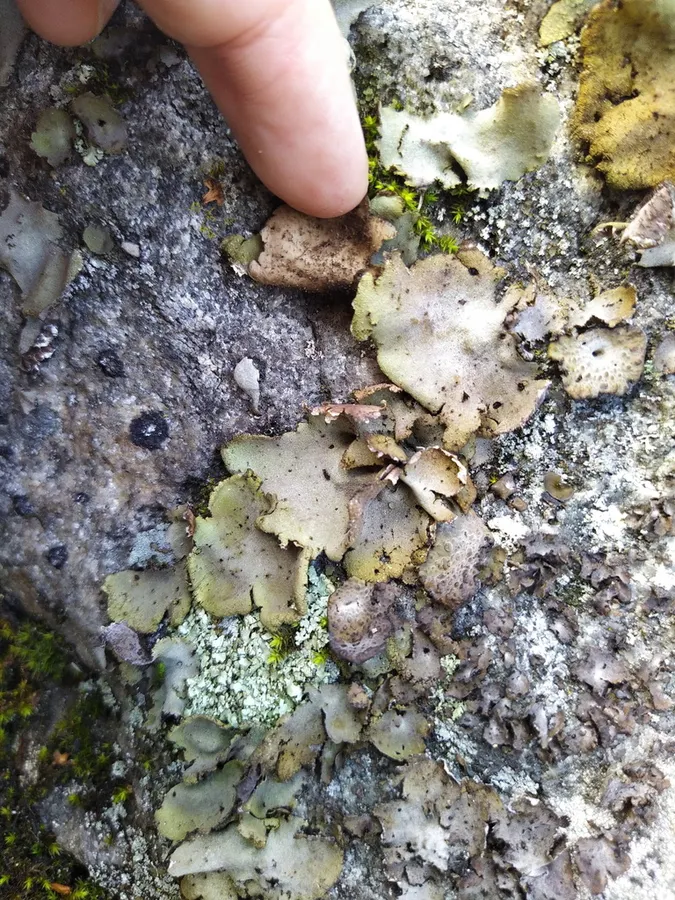
Dokumentasi Umbilicaria hirsuta menurut asosiasi foto pada record takson iNaturalist. Kredit: Vesa Oikonen. Identitas mengikuti sumber; bukan penentuan spesimen independen.
- Jenis
- Fotografi
- Kredit
- no rights reserved, uploaded by Vesa Oikonen
- Lisensi
- CC0 1.0
- Sumber media
- Buka entri sumber
Sumber profil
- [1] Umbilicaria hirsuta — Wikipedia (en)
- [2] Catalogue of Life Base2026-09-11 — Umbilicaria hirsuta
- [3] Dokumentasi visual — Umbilicaria hirsuta
Rujukan halaman ini
Fungi. Umbilicaria hirsuta. Rilis data fungi-2026-10-12-expansion-2. https://fungi-atlas.mgadib.chatgpt.site/jamur/umbilicaria-hirsuta/.
Status: impor sumber; pemeriksaan editorial per profil belum selesai. Untuk klaim biologis, gunakan rujukan pada bagian terkait dan periksa konteks sumber aslinya.