Ciri dan struktur
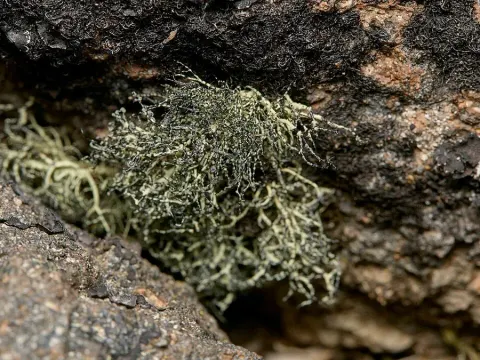
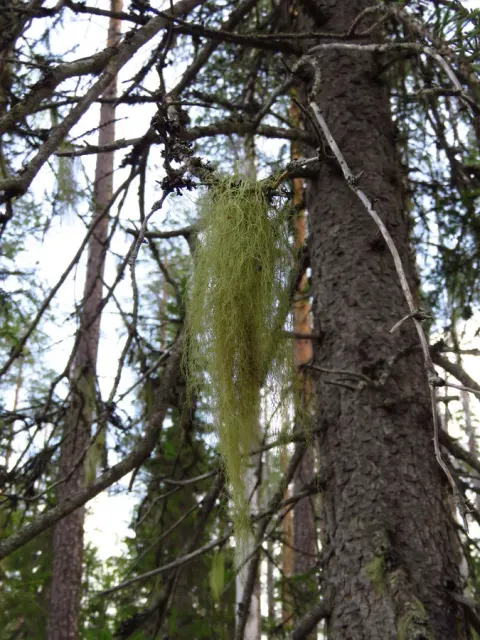
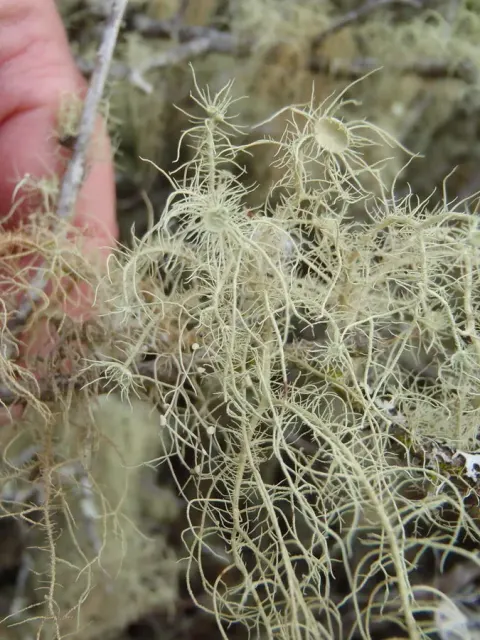
Usnea glabrescens is a shrubby to pendulous lichen measuring 3–10 (sometimes up to 15) cm in height. It grows in a somewhat upright manner at the base but typically becomes more hanging (pendulous) towards the tips. The main branches can reach up to 1.5 mm in diameter and are often abundantly branched and crowded near the base, with long side branches extending outward. The lichen typically has few or no fibrils (small, hair-like branches). The surface colour is grey-green or yellow-grey, with a characteristic blackening at the base. The main branches give rise to thinner branches that are densely covered with small (wart-like protrusions) arranged in an even pattern, while the main branches themselves appear smooth. A distinctive feature of this lichen is its conspicuous and numerous soralia—specialised structures for vegetative reproduction. These soralia are rounded and even to slightly (bumpy) or regularly shaped and distinctively rounded. They never exceed half of the branch diameter, remain discrete, and occasionally form paler eroded patches. The soralia exclusively produce soredia (powdery propagules) rather than other reproductive structures. Three chemical variants (chemotypes) of this species exist, which can be identified by chemical spot tests: Type A: The medulla (inner layer) is C−, K+ (yellow to blood-red), KC−, and Pd+ (orange). This chemotype contains usnic, norstictic, and stictic acids. Type B: Is C−, K+ (yellow to blood-red), Pd+ (yellow to orange). This chemotype contains norstictic and salazinic acids. Type C: Is C−, K−, and KC−, but turns yellow with Pd (Pd+ yellow).
Habitat dan peran ekologis
Usnea glabrescens is primarily epiphytic, growing on a variety of tree species. In East Fennoscandia, it has been documented most frequently on Betula, Picea, and Alnus, with less common occurrences on Pinus, Sorbus, Populus, Salix, Prunus, Larix, and Juniperus. It occasionally grows on dead wood (lignum) and rarely on rocks. The species favours various forest types but typically avoids dry sites. Unlike some related Usnea species such as U. fulvoreagens and U. wasmuthii, U. glabrescens is relatively less common in inhabited areas and is more restricted to old-growth forests. Usnea glabrescens has a wide distribution across East Fennoscandia, occurring in most biogeographical provinces of Finland and adjacent areas of Russia. It becomes increasingly rare, however, in northern regions. On a global scale, U. glabrescens has an incompletely circumpolar distribution from northern boreal to temperate regions. It is widely distributed throughout Europe, though outside of Fennoscandia it is primarily found in alpine and more continental areas.
- Habitat atau konteks temuan
- hutan
- Substrat
- kayu
- Peran atau konteks
- Pembentuk liken
Reproduksi
The main branches give rise to thinner branches that are densely covered with small (wart-like protrusions) arranged in an even pattern, while the main branches themselves appear smooth. A distinctive feature of this lichen is its conspicuous and numerous soralia—specialised structures for vegetative reproduction. These soralia are rounded and even to slightly (bumpy) or regularly shaped and distinctively rounded. They never exceed half of the branch diameter, remain discrete, and occasionally form paler eroded patches. The soralia exclusively produce soredia (powdery propagules) rather than other reproductive structures. This species differs from somewhat pendulous forms of Usnea subfloridana by having small, rounded, somewhat excavate soralia that always lack , in contrast to the abrasions left by shed isidiomorphs in U. subfloridana.
Catatan identitas dan cakupan
- Nama diterima mengikuti Catalogue of Life Base2026-09-11; uraian mempertahankan konsep dan nama sumber aslinya.
- Original geographic, specimen and life-cycle scope retained; source import awaits individual editorial review.
- Impor dan terjemahan otomatis belum diperiksa editorial per profil. Struktur reproduktif yang disebutkan tidak membuktikan seluruh siklus hidup diketahui.
- Pengukuran pada uraian mengikuti spesimen, kultur, dan metode sumber; angka tidak diperluas ke semua populasi.
Catatan distribusi dalam narasi mengikuti sumbernya. Dokumentasi spesimen atau foto mengikuti catatan sumber. Bukti wilayah Indonesia dan penilaian konservasi tidak disimpulkan dari gambar.
Melihat dengan konteks
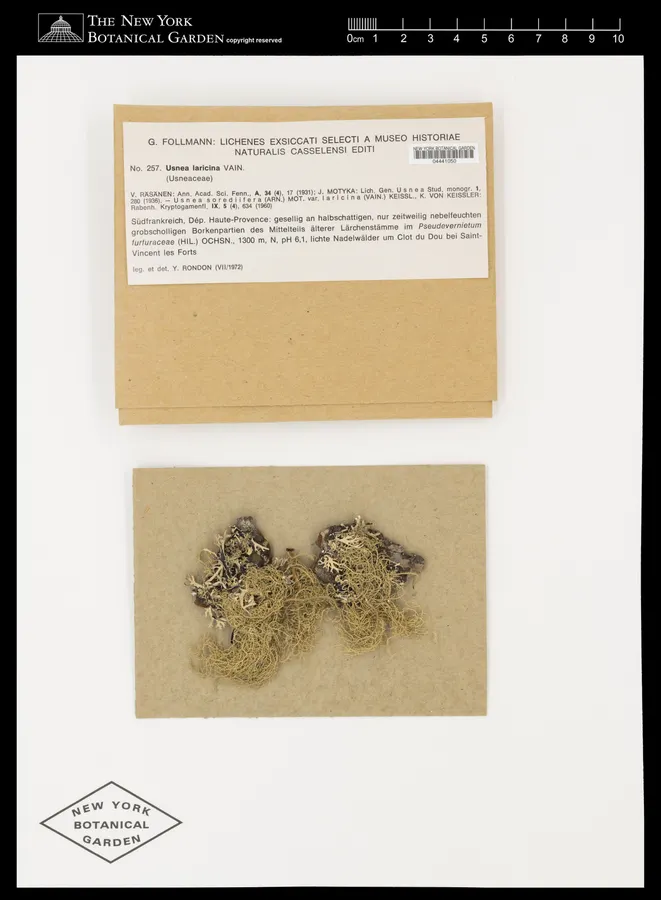
Voucher herbarium Usnea laricina (04441050), The New York Botanical Garden. Identifikasi mengikuti record spesimen sumber. Foto bahan, kemasan, atau label herbarium sebagaimana tersedia pada record institusi; bukan foto lapangan atau penentuan spesimen independen.
- Jenis
- Voucher herbarium
- Kredit
- The New York Botanical Garden
- Lisensi
- CC BY 4.0
- Sumber media
- Buka entri sumber
Sumber profil
- [1] Usnea glabrescens — Wikipedia (en)
- [2] Catalogue of Life Base2026-09-11 — Usnea glabrescens
- [3] Dokumentasi visual — Usnea laricina
Rujukan halaman ini
Fungi. Usnea glabrescens. Rilis data fungi-2026-10-12-expansion-2. https://fungi-atlas.mgadib.chatgpt.site/jamur/usnea-glabrescens/.
Status: impor sumber; pemeriksaan editorial per profil belum selesai. Untuk klaim biologis, gunakan rujukan pada bagian terkait dan periksa konteks sumber aslinya.