01 / Morfologi

Ciri dan struktur

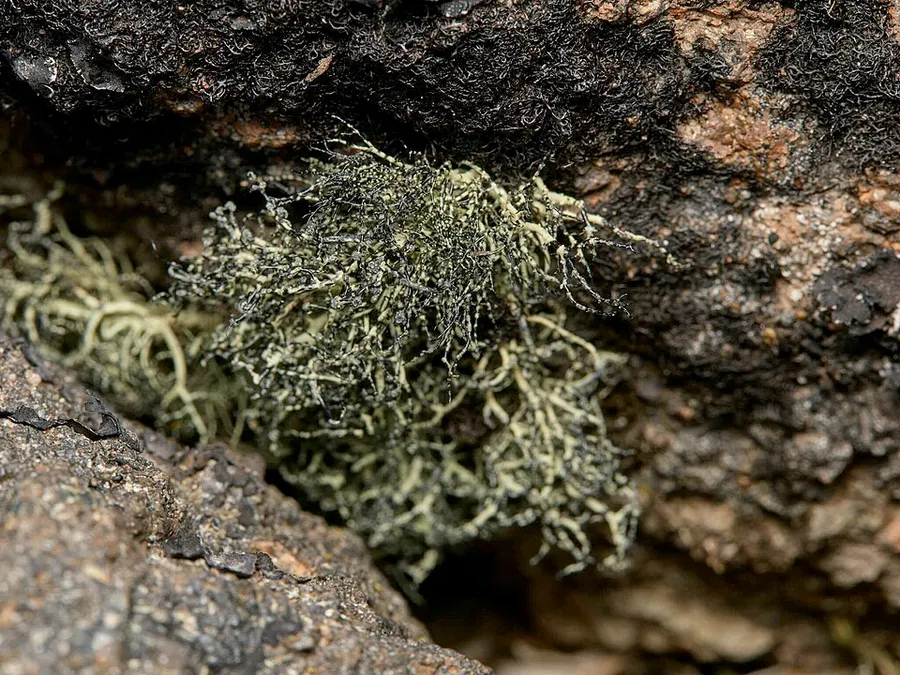
Usnea lambii grows erect and (i.e. small and bushy), reaching up to about 2 cm in height. The thallus is narrowly anchored at the base, branching sparsely. The basal are mostly sulphurous-yellow in color but can darken above, with a smooth and somewhat polished texture. They do not have any significant or annular (ring-like) features. The thinner, ultimate branches may develop a banded appearance due to blackening. These branches have abundant soredia which are yellowish, possibly turning black, with a grainy texture. Neither apothecia (sexual reproductive structures) nor pycnidia (asexual reproductive structures) have been observed in the species. There are two chemotypes of U. lambii: chemotype 1 contains usnic acid, while chemotype 2 contains usnic acid and psoromic acid as major substances, hypostrepsilic acid as a minor component, and trace amounts of isostrepsilic acid. It has similarities with Usnea sulphurea due to the loose nature of the medulla but can be distinguished by its branches which are not scabrid-verruculose. It is also noted to closely resemble Usnea acromelana but has distinct differences in medulla and central strand structure.

Sebagian uraian ditampilkan dalam bahasa sumber; terjemahannya belum tersedia atau belum lolos pemeriksaan.

Rujukan: [1]

Pengukuran mengikuti objek, spesimen atau kultur, dan metode yang disebutkan sumber. Baca uraian asli untuk konteks lengkap.

02 / Kehidupan

Habitat dan peran ekologis

The discovery of Usnea lambii in the Northern Hemisphere, specifically on Mount Rainier, was significant at the time, as traditionally, Neuropogon species had mostly found in the Southern Hemisphere. This particular species, having affinities with arctic species but being found in Mount Rainier rather than high elevations in the Rocky Mountains (similar to some other bipolar lichens), has a unique distribution pattern.

Sebagian uraian ditampilkan dalam bahasa sumber; terjemahannya belum tersedia atau belum lolos pemeriksaan.

Rujukan: [1]

Habitat atau konteks temuan
Informasi belum tersedia pada sumber rilis ini.
Substrat
Informasi belum tersedia pada sumber rilis ini.
Peran atau konteks
Pembentuk liken
Temukan hubungan serupa
03 / Siklus hidup

Reproduksi

Usnea lambii grows erect and (i.e. small and bushy), reaching up to about 2 cm in height. The thallus is narrowly anchored at the base, branching sparsely. The basal are mostly sulphurous-yellow in color but can darken above, with a smooth and somewhat polished texture. They do not have any significant or annular (ring-like) features. The thinner, ultimate branches may develop a banded appearance due to blackening. These branches have abundant soredia which are yellowish, possibly turning black, with a grainy texture. Neither apothecia (sexual reproductive structures) nor pycnidia (asexual reproductive structures) have been observed in the species.

Sebagian uraian ditampilkan dalam bahasa sumber; terjemahannya belum tersedia atau belum lolos pemeriksaan.

Rujukan: [1]

Sinonim menurut acuan taksonomi rilis: Neuropogon lambii
04 / Batas informasi

Catatan identitas dan cakupan

  • Nama diterima mengikuti Catalogue of Life Base2026-09-11; uraian mempertahankan konsep dan nama sumber aslinya.
  • Original geographic, specimen and life-cycle scope retained; source import awaits individual editorial review.
  • Impor dan terjemahan otomatis belum diperiksa editorial per profil. Struktur reproduktif yang disebutkan tidak membuktikan seluruh siklus hidup diketahui.
  • Pengukuran pada uraian mengikuti spesimen, kultur, dan metode sumber; angka tidak diperluas ke semua populasi.

Catatan distribusi dalam narasi mengikuti sumbernya. Dokumentasi spesimen atau foto mengikuti catatan sumber. Bukti wilayah Indonesia dan penilaian konservasi tidak disimpulkan dari gambar.

05 / Dokumentasi

Melihat dengan konteks

Dokumentasi Usnea lambii dari Wikimedia Commons. Photo of Usnea lambii, found on volcanic rocks at Devil's Garden on the east side of Mount Adams Identifikasi mengikuti record berkas sumber.

Jenis
Fotografi
Kredit
Wweellll
Lisensi
CC BY 4.0
Sumber media
Buka entri sumber

Gambar menunjukkan objek menurut identifikasi sumber, bukan verifikasi independen spesimen oleh Fungi. Tidak ada skala baru yang ditambahkan.

06 / Rujukan

Sumber profil

  1. [1] Usnea lambii — Wikipedia (en)Bagian sumber: Frozen revision 1343565165
    Tanggal penghimpunan sumber: 2026-10-12
    Teks sumber: CC BY-SA4.0 · Wikipedia contributors
  2. [2] Catalogue of Life Base2026-09-11 — Usnea lambiiBagian sumber: ColDP NameUsage.tsv ID 7F32M; accepted species; source 2073
    Tanggal penghimpunan sumber: 2026-10-12
  3. [3] Dokumentasi visual — Usnea lambiiBagian sumber: Individual media record; identification follows the source, not independent determination
    Tanggal penghimpunan sumber: 2026-10-12
    Media sumber: CC BY 4.0 · Wweellll

Adaptasi teks: CC BY-SA 4.0. Wikipedia contributors — Usnea lambii — Wikipedia (en)

Uraian asli dan riwayat sumber

Riwayat atau halaman sumber

Ringkasan sumber

Usnea lambii or "witch's hair" is a small species of fruticose lichen in the family Parmeliaceae. It was first formally described as a new species in 1954 by Henry Imshaug. It has a bipolar distribution, that is, it occurs at both of Earth's polar regions. It is also found at high elevations in Mount Rainier National Park in Washington state, where it was first discovered.

Revisi sumber

Morfologi sumber

Usnea lambii grows erect and (i.e. small and bushy), reaching up to about 2 cm in height. The thallus is narrowly anchored at the base, branching sparsely. The basal are mostly sulphurous-yellow in color but can darken above, with a smooth and somewhat polished texture. They do not have any significant or annular (ring-like) features. The thinner, ultimate branches may develop a banded appearance due to blackening. These branches have abundant soredia which are yellowish, possibly turning black, with a grainy texture. Neither apothecia (sexual reproductive structures) nor pycnidia (asexual reproductive structures) have been observed in the species. There are two chemotypes of U. lambii: chemotype 1 contains usnic acid, while chemotype 2 contains usnic acid and psoromic acid as major substances, hypostrepsilic acid as a minor component, and trace amounts of isostrepsilic acid. It has similarities with Usnea sulphurea due to the loose nature of the medulla but can be distinguished by its branches which are not scabrid-verruculose. It is also noted to closely resemble Usnea acromelana but has distinct differences in medulla and central strand structure.

Revisi sumber

Ekologi sumber

The discovery of Usnea lambii in the Northern Hemisphere, specifically on Mount Rainier, was significant at the time, as traditionally, Neuropogon species had mostly found in the Southern Hemisphere. This particular species, having affinities with arctic species but being found in Mount Rainier rather than high elevations in the Rocky Mountains (similar to some other bipolar lichens), has a unique distribution pattern.

Revisi sumber

Struktur reproduksi sumber

Usnea lambii grows erect and (i.e. small and bushy), reaching up to about 2 cm in height. The thallus is narrowly anchored at the base, branching sparsely. The basal are mostly sulphurous-yellow in color but can darken above, with a smooth and somewhat polished texture. They do not have any significant or annular (ring-like) features. The thinner, ultimate branches may develop a banded appearance due to blackening. These branches have abundant soredia which are yellowish, possibly turning black, with a grainy texture. Neither apothecia (sexual reproductive structures) nor pycnidia (asexual reproductive structures) have been observed in the species.

Revisi sumber

Rujukan halaman ini

Fungi. Usnea lambii. Rilis data fungi-2026-10-12-expansion-2. https://fungi-atlas.mgadib.chatgpt.site/jamur/usnea-lambii/.

Status: impor sumber; pemeriksaan editorial per profil belum selesai. Untuk klaim biologis, gunakan rujukan pada bagian terkait dan periksa konteks sumber aslinya.