01 / Morfologi

Ciri dan struktur

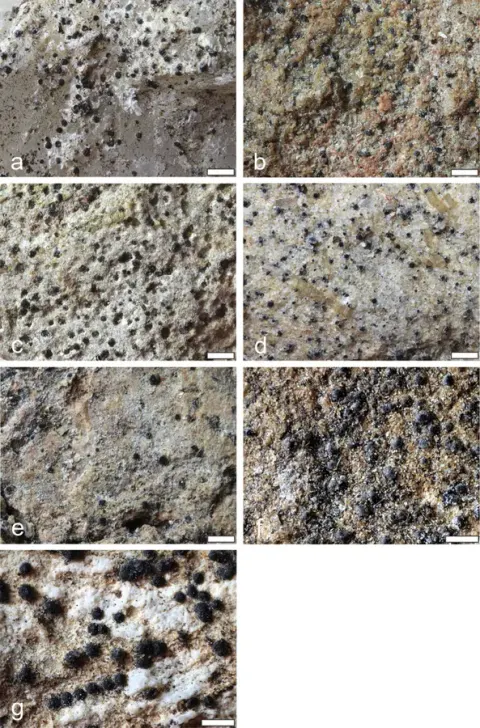
Verrucaria viridula presents a thallus — the main body of the lichen — that is partially to entirely immersed in the cracks of its rocky , sometimes only discernible as brown flecks on the surface. When it is superficial, its color can vary, most often appearing pale brown, but occasionally presenting shades of white, pale grey, or green-grey. Its structure — resembling a pattern of small areas or islands — is divided by cracks, and it lacks any vegetative propagules, or structures involved in reproduction. The , the fruiting bodies of the lichen, are embedded halfway to almost fully in the thallus. These display as convex to conical-hemispherical projections, with widths ranging from 0.15 to 0.5 mm. Their bases are immersed in the substrate. Each perithecium has an — the outer protective layer of the fruiting body — which measures between 0.35 and 0.6 mm wide. The apex of the exciple extends into a short beak-like projection and is pigmented. The , another protective layer, is weakly developed and extends from the apex of the exciple, either loosely adhering to the upper half of the exciple or slightly spreading out. Verrucaria viridula produces that are more or less ellipsoid in shape, typically measuring between 28.5 and 34 μm in length and 14.5 to 20 μm in width. The , or the outer layer of the ascospore, can sometimes be observed and measures up to 0.5 μm thick. , another type of fruiting body, are identifiable as dark dots up to 0.06 mm wide or larger. These produce conidia, or asexual spores, that are straight to slightly curved, measuring approximately 7 to 10 by 1 μm.

Sebagian uraian ditampilkan dalam bahasa sumber; terjemahannya belum tersedia atau belum lolos pemeriksaan.

Rujukan: [1]

Pengukuran mengikuti objek, spesimen atau kultur, dan metode yang disebutkan sumber. Baca uraian asli untuk konteks lengkap.

02 / Kehidupan

Habitat dan peran ekologis

Verrucaria viridula is a widely distributed species, occurring in Africa, Asia, Australia, Europe, Macaronesia, Central America, and North America. It grows on calcareous rock.

Sebagian uraian ditampilkan dalam bahasa sumber; terjemahannya belum tersedia atau belum lolos pemeriksaan.

Rujukan: [1]

Habitat atau konteks temuan
Informasi belum tersedia pada sumber rilis ini.
Substrat
Informasi belum tersedia pada sumber rilis ini.
Peran atau konteks
Pembentuk liken
Temukan hubungan serupa
03 / Siklus hidup

Reproduksi

Verrucaria viridula presents a thallus — the main body of the lichen — that is partially to entirely immersed in the cracks of its rocky , sometimes only discernible as brown flecks on the surface. When it is superficial, its color can vary, most often appearing pale brown, but occasionally presenting shades of white, pale grey, or green-grey. Its structure — resembling a pattern of small areas or islands — is divided by cracks, and it lacks any vegetative propagules, or structures involved in reproduction. Verrucaria viridula produces that are more or less ellipsoid in shape, typically measuring between 28.5 and 34 μm in length and 14.5 to 20 μm in width. The , or the outer layer of the ascospore, can sometimes be observed and measures up to 0.5 μm thick. , another type of fruiting body, are identifiable as dark dots up to 0.06 mm wide or larger.

Sebagian uraian ditampilkan dalam bahasa sumber; terjemahannya belum tersedia atau belum lolos pemeriksaan.

Rujukan: [1]

Sinonim menurut acuan taksonomi rilis: Amphoridium leightonii; Amphoridium viridulum; Arthopyrenia viridula; Endocarpon viridulum; Lichen placothallus; Lichen viridulus; Lithoicea mauroides; Lithoicea nigrescens var. mauroides; Lithoicea viridula; Sagedia viridula; Verrucaria fuscella var. viridula; Verrucaria hydrela var. papillosa; Verrucaria integra var. viridula; Verrucaria leightonii; Verrucaria margacea f. mauroides; Verrucaria margacea subsp. papillosa; Verrucaria margacea var. mauroides; Verrucaria margacea var. papillosa; Verrucaria muralis var. papillosa; Verrucaria nigrescens f. maurioides; Verrucaria nigrescens subsp. viridula; Verrucaria nigrescens var. mauroides; Verrucaria nigrescens var. viridula; Verrucaria papillosa
04 / Batas informasi

Catatan identitas dan cakupan

  • Nama diterima mengikuti Catalogue of Life Base2026-09-11; uraian mempertahankan konsep dan nama sumber aslinya.
  • Original geographic, specimen and life-cycle scope retained; source import awaits individual editorial review.
  • Impor dan terjemahan otomatis belum diperiksa editorial per profil. Struktur reproduktif yang disebutkan tidak membuktikan seluruh siklus hidup diketahui.
  • Pengukuran pada uraian mengikuti spesimen, kultur, dan metode sumber; angka tidak diperluas ke semua populasi.

Catatan distribusi dalam narasi mengikuti sumbernya. Dokumentasi spesimen atau foto mengikuti catatan sumber. Bukti wilayah Indonesia dan penilaian konservasi tidak disimpulkan dari gambar.

05 / Dokumentasi

Melihat dengan konteks

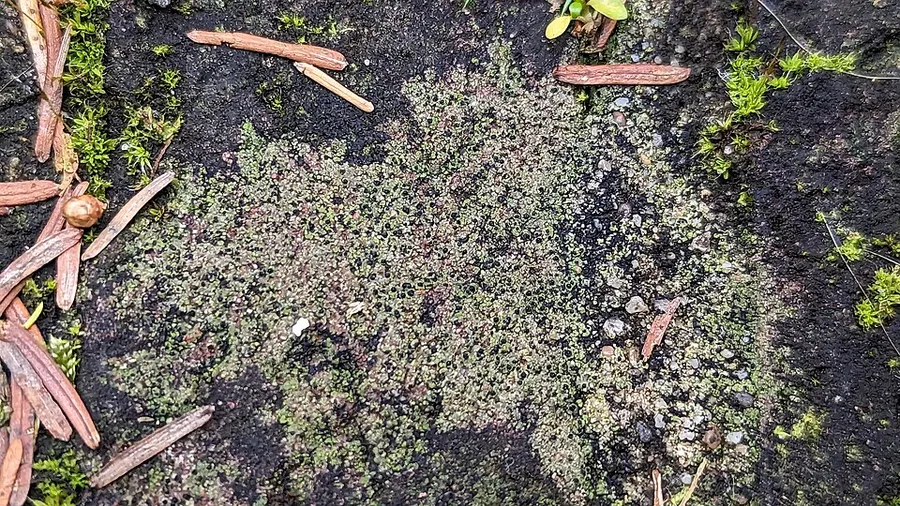
Dokumentasi Verrucaria viridula dari Wikimedia Commons. Verrucaria viridula Identifikasi mengikuti record berkas sumber.

Jenis
Fotografi
Kredit
Michel Langeveld
Sumber media
Buka entri sumber

Gambar menunjukkan objek menurut identifikasi sumber, bukan verifikasi independen spesimen oleh Fungi. Tidak ada skala baru yang ditambahkan.

06 / Rujukan

Sumber profil

  1. [1] Verrucaria viridula — Wikipedia (en)Bagian sumber: Frozen revision 1159920657
    Tanggal penghimpunan sumber: 2026-10-12
    Teks sumber: CC BY-SA4.0 · Wikipedia contributors
  2. [2] Catalogue of Life Base2026-09-11 — Verrucaria viridulaBagian sumber: ColDP NameUsage.tsv ID 5B8J8; accepted species; source 2073
    Tanggal penghimpunan sumber: 2026-10-12
  3. [3] Dokumentasi visual — Verrucaria viridulaBagian sumber: Individual media record; identification follows the source, not independent determination
    Tanggal penghimpunan sumber: 2026-10-12
    Media sumber: CC BY-SA 4.0 · Michel Langeveld

Adaptasi teks: CC BY-SA 4.0. Wikipedia contributors — Verrucaria viridula — Wikipedia (en)

Uraian asli dan riwayat sumber

Riwayat atau halaman sumber

Ringkasan sumber

Verrucaria viridula is a common and widely distributed species of saxicolous (rock-dwelling), crustose lichen in the family Verrucariaceae. Although it is a somewhat morphologically variable species, two persistent distinguishing characteristics are its relatively large , which are often curved into a beak, and its large .

Revisi sumber

Morfologi sumber

Verrucaria viridula presents a thallus — the main body of the lichen — that is partially to entirely immersed in the cracks of its rocky , sometimes only discernible as brown flecks on the surface. When it is superficial, its color can vary, most often appearing pale brown, but occasionally presenting shades of white, pale grey, or green-grey. Its structure — resembling a pattern of small areas or islands — is divided by cracks, and it lacks any vegetative propagules, or structures involved in reproduction. The , the fruiting bodies of the lichen, are embedded halfway to almost fully in the thallus. These display as convex to conical-hemispherical projections, with widths ranging from 0.15 to 0.5 mm. Their bases are immersed in the substrate. Each perithecium has an — the outer protective layer of the fruiting body — which measures between 0.35 and 0.6 mm wide. The apex of the exciple extends into a short beak-like projection and is pigmented. The , another protective layer, is weakly developed and extends from the apex of the exciple, either loosely adhering to the upper half of the exciple or slightly spreading out. Verrucaria viridula produces that are more or less ellipsoid in shape, typically measuring between 28.5 and 34 μm in length and 14.5 to 20 μm in width. The , or the outer layer of the ascospore, can sometimes be observed and measures up to 0.5 μm thick. , another type of fruiting body, are identifiable as dark dots up to 0.06 mm wide or larger. These produce conidia, or asexual spores, that are straight to slightly curved, measuring approximately 7 to 10 by 1 μm.

Revisi sumber

Ekologi sumber

Verrucaria viridula is a widely distributed species, occurring in Africa, Asia, Australia, Europe, Macaronesia, Central America, and North America. It grows on calcareous rock.

Revisi sumber

Struktur reproduksi sumber

Verrucaria viridula presents a thallus — the main body of the lichen — that is partially to entirely immersed in the cracks of its rocky , sometimes only discernible as brown flecks on the surface. When it is superficial, its color can vary, most often appearing pale brown, but occasionally presenting shades of white, pale grey, or green-grey. Its structure — resembling a pattern of small areas or islands — is divided by cracks, and it lacks any vegetative propagules, or structures involved in reproduction. Verrucaria viridula produces that are more or less ellipsoid in shape, typically measuring between 28.5 and 34 μm in length and 14.5 to 20 μm in width. The , or the outer layer of the ascospore, can sometimes be observed and measures up to 0.5 μm thick. , another type of fruiting body, are identifiable as dark dots up to 0.06 mm wide or larger.

Revisi sumber

Rujukan halaman ini

Fungi. Verrucaria viridula. Rilis data fungi-2026-10-12-expansion-2. https://fungi-atlas.mgadib.chatgpt.site/jamur/verrucaria-viridula/.

Status: impor sumber; pemeriksaan editorial per profil belum selesai. Untuk klaim biologis, gunakan rujukan pada bagian terkait dan periksa konteks sumber aslinya.