Ciri dan struktur
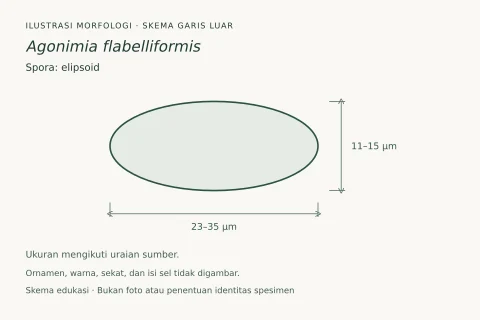
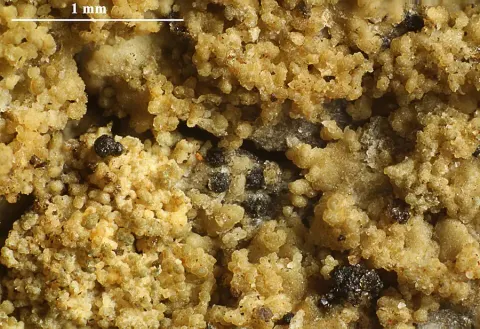
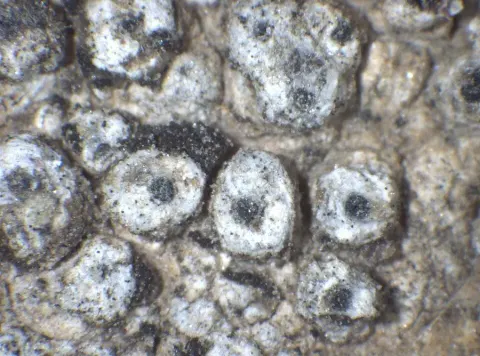
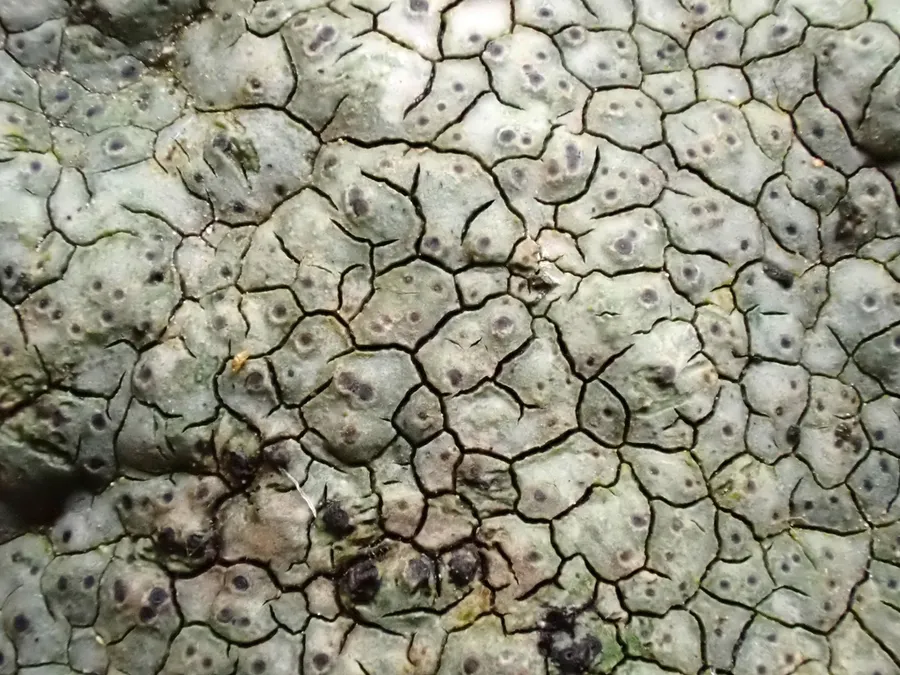
The thallus is crustose and —i.e., it forms a thin crust that breaks into small polygonal blocks—and ranges in color from yellowish to olive or medium brown. Its surface varies from finely cracked () to deeply cracked and blocky (-areolate) and can approach a "diffractellate" pattern; areoles may be contiguous or partly dispersed, and fertile are sometimes slightly larger than sterile ones. Cracks between areoles are often darkly pigmented, and overall thallus thickness is variable. The spore-bearing bodies (perithecia) are immersed within the areoles; the pore at the top (ostiole) may be inconspicuous or clearly raised and is typically 0.1–0.3 mm across. A comparative survey showed that much of this morphological spread occurs even within single thalli depending on light exposure and the inclination of the substrate, indicating ecological plasticity rather than hidden species. Internally, the thallus has a palisade algal layer and the is a stichococcoid green alga of the genus Diplosphaera. Perithecia have a dark (a sheath around the upper wall) that can flare laterally or wrap inwards toward the base of the . The excipulum is pale and sometimes darkened near the ostiole. Asci contain 6 to 8 hyaline, ascospores (colorless spores divided by many cross-walls into a brick-like pattern) measuring about 15–32 × 9–15 μm. Algal cells also occur among the spore-bearing tissues (the hymenium), a feature recorded for this species in modern treatments. In simple iodine solution the hymenial gel turns blue (I+), a reaction reported in regional floras. At the generic level, Willeya species characteristically possess a weakly developed upper layer (a ), and W. diffractella conforms to that pattern.
Habitat dan peran ekologis
Willeya diffractella occurs on both calcareous rocks (limestone, dolomite) and non-calcareous lithologies (rhyolite, sandstone, micaceous schist, shale). Within North America it is an eastern endemic, from New England south to Alabama and west to Minnesota, Iowa, and Missouri. Gueidan and colleagues (2007) documented the Vermont lectotype and additional material from Missouri, confirming this range in modern treatments. Verified records span 23 U.S. states (Appalachians, Ozarks, Great Plains) and Quebec, and mapping of 133 studied specimens indicates the species is widespread and common in eastern North America. On that basis the authors considered it not of conservation concern (effectively Least Concern if assessed). In the 2014 revision, the authors remarked that among the species they placed in Willeya, all except W. diffractella were Asian or Australian, emphasizing its otherwise North American occurrence in that framework. Historical material assigned to the variety flavicans extends to Brazil and Costa Rica, but the authors cautioned that the delimitation of varieties under W. diffractella requires further study.
- Habitat atau konteks temuan
- Informasi belum tersedia pada sumber rilis ini.
- Substrat
- Informasi belum tersedia pada sumber rilis ini.
- Peran atau konteks
- Pembentuk liken
Reproduksi
The spore-bearing bodies (perithecia) are immersed within the areoles; the pore at the top (ostiole) may be inconspicuous or clearly raised and is typically 0.1–0.3 mm across. A comparative survey showed that much of this morphological spread occurs even within single thalli depending on light exposure and the inclination of the substrate, indicating ecological plasticity rather than hidden species. Asci contain 6 to 8 hyaline, ascospores (colorless spores divided by many cross-walls into a brick-like pattern) measuring about 15–32 × 9–15 μm. Algal cells also occur among the spore-bearing tissues (the hymenium), a feature recorded for this species in modern treatments. In simple iodine solution the hymenial gel turns blue (I+), a reaction reported in regional floras.
Catatan identitas dan cakupan
- Nama diterima mengikuti Catalogue of Life Base2026-09-11; uraian mempertahankan konsep dan nama sumber aslinya.
- Original geographic, specimen and life-cycle scope retained; source import awaits individual editorial review.
- Impor dan terjemahan otomatis belum diperiksa editorial per profil. Struktur reproduktif yang disebutkan tidak membuktikan seluruh siklus hidup diketahui.
- Pengukuran pada uraian mengikuti spesimen, kultur, dan metode sumber; angka tidak diperluas ke semua populasi.
Catatan distribusi dalam narasi mengikuti sumbernya. Dokumentasi spesimen atau foto mengikuti catatan sumber. Bukti wilayah Indonesia dan penilaian konservasi tidak disimpulkan dari gambar.
Melihat dengan konteks
Dokumentasi Willeya diffractella menurut asosiasi foto pada record takson iNaturalist. Kredit: David Bird. Identitas mengikuti sumber; bukan penentuan spesimen independen.
- Jenis
- Fotografi
- Kredit
- no rights reserved, uploaded by David Bird
- Lisensi
- CC0 1.0
- Sumber media
- Buka entri sumber
Dokumentasi tambahan
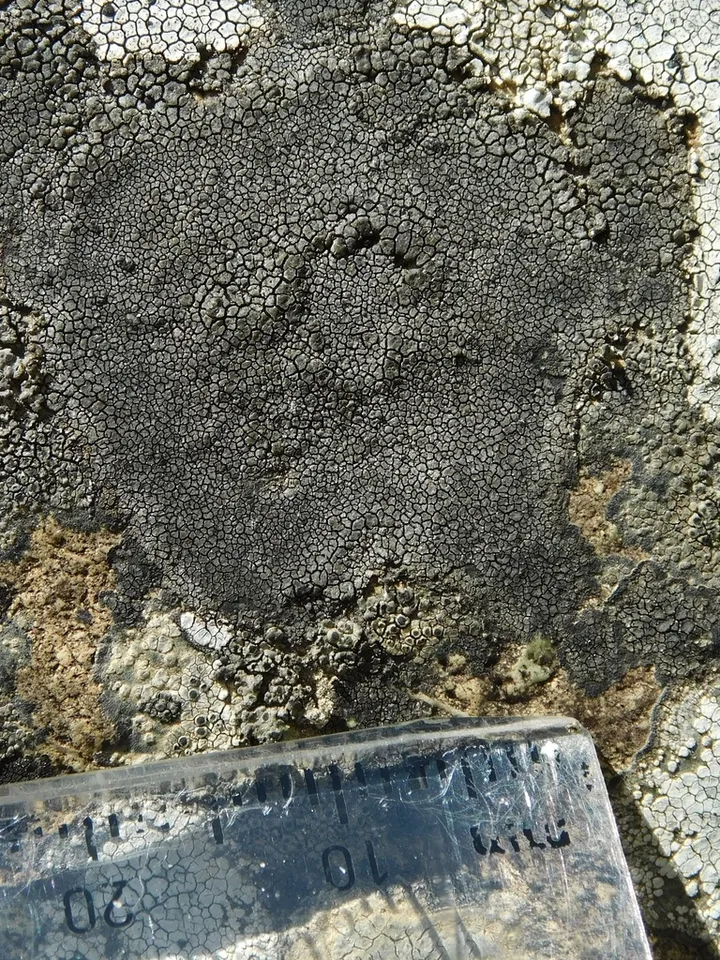
Foto yang diasosiasikan dengan Willeya diffractella pada iNaturalist. Identifikasi mengikuti sumber; bukan penentuan spesimen independen.
Kredit dan penggunaan
(c) Michael J. Papay, some rights reserved (CC BY), uploaded by Michael J. Papay
Ukuran dan format gambar disesuaikan tanpa pemotongan, retus, atau penambahan skala. Lisensi sumber dipertahankan.
Sumber profil
- [1] Willeya diffractella — Wikipedia (en)
- [2] Catalogue of Life Base2026-09-11 — Willeya diffractella
- [3] Dokumentasi visual — Willeya diffractella
- [4] Dokumentasi visual — Willeya diffractella
Rujukan halaman ini
Fungi. Willeya diffractella. Rilis data fungi-2026-10-12-expansion-2. https://fungi-atlas.mgadib.chatgpt.site/jamur/willeya-diffractella/.
Status: impor sumber; pemeriksaan editorial per profil belum selesai. Untuk klaim biologis, gunakan rujukan pada bagian terkait dan periksa konteks sumber aslinya.