01 / Morfologi

Ciri dan struktur

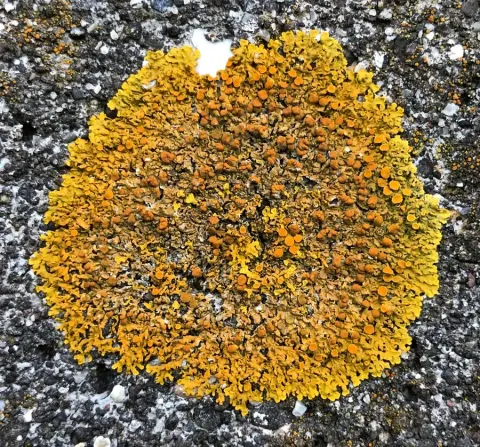
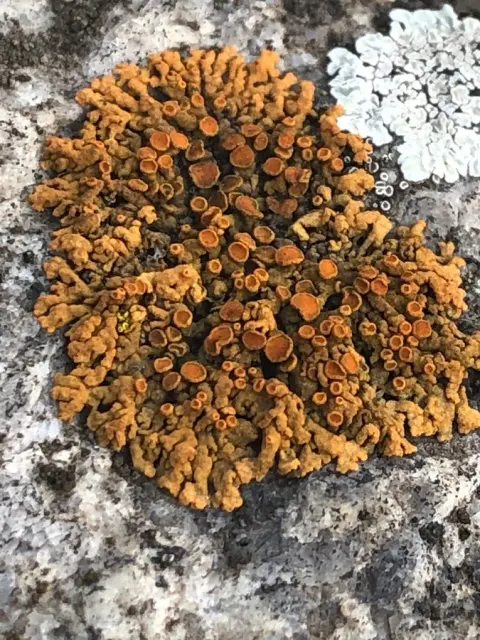
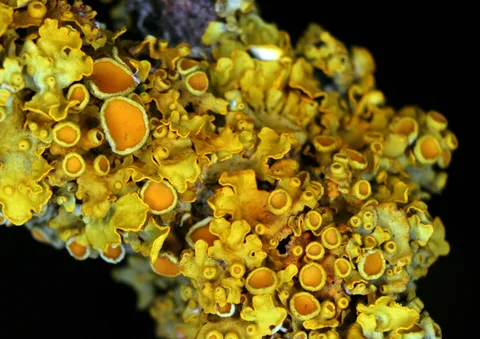
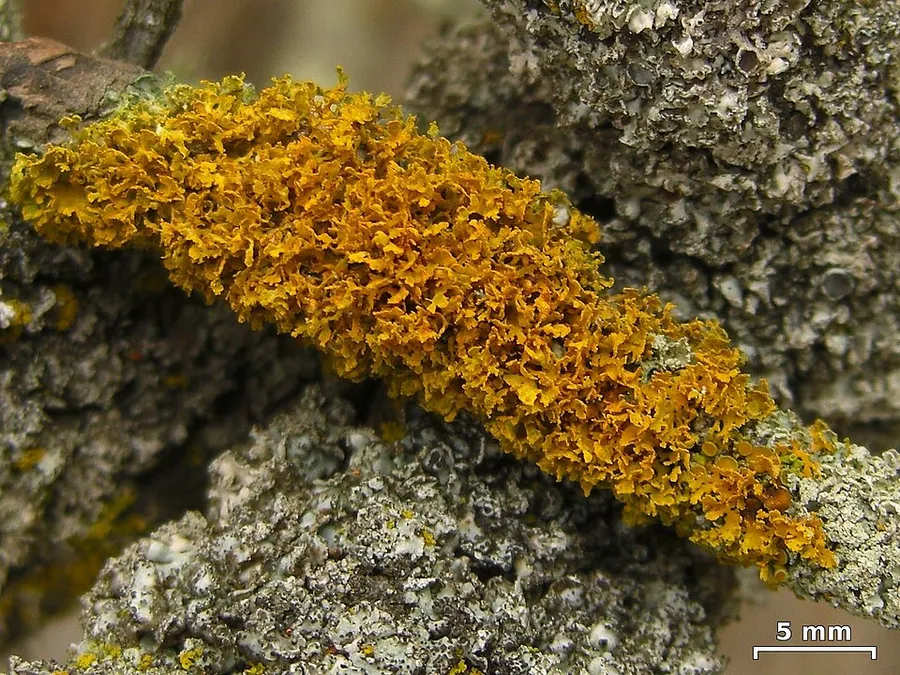
The thallus of Xanthomendosa oregana has a bright yellow to orange upper surface, forming tufts of up to about 3 cm in diameter. The of this lichen, which are the leaf-like or flattened branches that make up its thallus, tend to lie flat against the surface they grow on but can also rise up slightly. These lobes are generally smooth, though they can sometimes have a slightly wrinkled appearance. A key characteristic of Xanthomendosa oregana is the formation of marginal or near the edge structures known as , which are involved in asexual reproduction. Rhizines are scattered on the underside, either free or attached to the . Apothecia (fruiting bodies), which are typically disc-shaped and produce spores, are not commonly found in this species. However, when they do occur, they can be quite numerous on certain individual lichens. Another feature of Xanthomendosa oregana is the frequent presence of pycnidia, which are tiny, flask-shaped structures that produce asexual spores (conidia). The conidia in these pycnidia vary in shape, ranging from ellipsoid to (rod-like). Its distribution of secondary metabolites (lichen products) corresponds to the A previously elaborated by Søchting.

Sebagian uraian ditampilkan dalam bahasa sumber; terjemahannya belum tersedia atau belum lolos pemeriksaan.

Rujukan: [1]

Pengukuran mengikuti objek, spesimen atau kultur, dan metode yang disebutkan sumber. Baca uraian asli untuk konteks lengkap.

02 / Kehidupan

Habitat dan peran ekologis

Xanthomendoza oregana is part of a biogeographical group that is found in both western Europe and western North America, known as the western Europe–western North America disjunct biogeographical element. In the western regions of North America, particularly in the Pacific oceanic and suboceanic areas, Xanthomendoza oregana is quite widespread. In Europe, this species has been identified in several countries, though it was previously reported under a different name (X. poeltii). It has been observed in Hungary, Germany, Denmark, southern Sweden, and southern Norway. The full extent of its geographical distribution remains somewhat unclear. Unlike many other lichens and bryophytes that share this transatlantic distribution, Xanthomendoza oregana primarily inhabits lowland temperate areas. This corticolous lichen typically grows on deciduous trees, often in open spaces. In southern Sweden, for example, it is commonly found on trees in parks and churchyards, indicating its preference for semi-urban environments where there is sufficient light and air circulation.

Sebagian uraian ditampilkan dalam bahasa sumber; terjemahannya belum tersedia atau belum lolos pemeriksaan.

Rujukan: [1]

Habitat atau konteks temuan
Informasi belum tersedia pada sumber rilis ini.
Substrat
Informasi belum tersedia pada sumber rilis ini.
Peran atau konteks
Pembentuk liken
Temukan hubungan serupa
03 / Siklus hidup

Reproduksi

The thallus of Xanthomendosa oregana has a bright yellow to orange upper surface, forming tufts of up to about 3 cm in diameter. The of this lichen, which are the leaf-like or flattened branches that make up its thallus, tend to lie flat against the surface they grow on but can also rise up slightly. These lobes are generally smooth, though they can sometimes have a slightly wrinkled appearance. A key characteristic of Xanthomendosa oregana is the formation of marginal or near the edge structures known as , which are involved in asexual reproduction. Rhizines are scattered on the underside, either free or attached to the . Apothecia (fruiting bodies), which are typically disc-shaped and produce spores, are not commonly found in this species.

Sebagian uraian ditampilkan dalam bahasa sumber; terjemahannya belum tersedia atau belum lolos pemeriksaan.

Rujukan: [1]

Sinonim menurut acuan taksonomi rilis: Oxneria oregana; Xanthoria oregana
04 / Batas informasi

Catatan identitas dan cakupan

  • Nama diterima mengikuti Catalogue of Life Base2026-09-11; uraian mempertahankan konsep dan nama sumber aslinya.
  • Original geographic, specimen and life-cycle scope retained; source import awaits individual editorial review.
  • Impor dan terjemahan otomatis belum diperiksa editorial per profil. Struktur reproduktif yang disebutkan tidak membuktikan seluruh siklus hidup diketahui.
  • Pengukuran pada uraian mengikuti spesimen, kultur, dan metode sumber; angka tidak diperluas ke semua populasi.

Catatan distribusi dalam narasi mengikuti sumbernya. Dokumentasi spesimen atau foto mengikuti catatan sumber. Bukti wilayah Indonesia dan penilaian konservasi tidak disimpulkan dari gambar.

05 / Dokumentasi

Melihat dengan konteks

Dokumentasi Xanthomendoza oregana dari Wikimedia Commons. Conejo Mountain, Santa Monica Mountains, southern California, 20111019 Identifikasi mengikuti record berkas sumber.

Jenis
Fotografi
Kredit
Jason Hollinger
Lisensi
CC BY 2.0
Sumber media
Buka entri sumber

Gambar menunjukkan objek menurut identifikasi sumber, bukan verifikasi independen spesimen oleh Fungi. Tidak ada skala baru yang ditambahkan.

06 / Rujukan

Sumber profil

  1. [1] Xanthomendoza oregana — Wikipedia (en)Bagian sumber: Frozen revision 1328411881
    Tanggal penghimpunan sumber: 2026-10-12
    Teks sumber: CC BY-SA4.0 · Wikipedia contributors
  2. [2] Catalogue of Life Base2026-09-11 — Xanthomendoza oreganaBagian sumber: ColDP NameUsage.tsv ID 7G6VY; accepted species; source 2073
    Tanggal penghimpunan sumber: 2026-10-12
  3. [3] Dokumentasi visual — Xanthomendoza oreganaBagian sumber: Individual media record; identification follows the source, not independent determination
    Tanggal penghimpunan sumber: 2026-10-12
    Media sumber: CC BY 2.0 · Jason Hollinger

Adaptasi teks: CC BY-SA 4.0. Wikipedia contributors — Xanthomendoza oregana — Wikipedia (en)

Uraian asli dan riwayat sumber

Riwayat atau halaman sumber

Ringkasan sumber

Xanthomendoza oregana is a species of corticolous (bark-dwelling), foliose lichen in the family Teloschistaceae. It forms an orange to bright-yellow thallus with ascending that gives it the overall appearance of a tuft. The lichen occurs in western and northern Europe and western North America.

Revisi sumber

Morfologi sumber

The thallus of Xanthomendosa oregana has a bright yellow to orange upper surface, forming tufts of up to about 3 cm in diameter. The of this lichen, which are the leaf-like or flattened branches that make up its thallus, tend to lie flat against the surface they grow on but can also rise up slightly. These lobes are generally smooth, though they can sometimes have a slightly wrinkled appearance. A key characteristic of Xanthomendosa oregana is the formation of marginal or near the edge structures known as , which are involved in asexual reproduction. Rhizines are scattered on the underside, either free or attached to the . Apothecia (fruiting bodies), which are typically disc-shaped and produce spores, are not commonly found in this species. However, when they do occur, they can be quite numerous on certain individual lichens. Another feature of Xanthomendosa oregana is the frequent presence of pycnidia, which are tiny, flask-shaped structures that produce asexual spores (conidia). The conidia in these pycnidia vary in shape, ranging from ellipsoid to (rod-like). Its distribution of secondary metabolites (lichen products) corresponds to the A previously elaborated by Søchting.

Revisi sumber

Ekologi sumber

Xanthomendoza oregana is part of a biogeographical group that is found in both western Europe and western North America, known as the western Europe–western North America disjunct biogeographical element. In the western regions of North America, particularly in the Pacific oceanic and suboceanic areas, Xanthomendoza oregana is quite widespread. In Europe, this species has been identified in several countries, though it was previously reported under a different name (X. poeltii). It has been observed in Hungary, Germany, Denmark, southern Sweden, and southern Norway. The full extent of its geographical distribution remains somewhat unclear. Unlike many other lichens and bryophytes that share this transatlantic distribution, Xanthomendoza oregana primarily inhabits lowland temperate areas. This corticolous lichen typically grows on deciduous trees, often in open spaces. In southern Sweden, for example, it is commonly found on trees in parks and churchyards, indicating its preference for semi-urban environments where there is sufficient light and air circulation.

Revisi sumber

Struktur reproduksi sumber

The thallus of Xanthomendosa oregana has a bright yellow to orange upper surface, forming tufts of up to about 3 cm in diameter. The of this lichen, which are the leaf-like or flattened branches that make up its thallus, tend to lie flat against the surface they grow on but can also rise up slightly. These lobes are generally smooth, though they can sometimes have a slightly wrinkled appearance. A key characteristic of Xanthomendosa oregana is the formation of marginal or near the edge structures known as , which are involved in asexual reproduction. Rhizines are scattered on the underside, either free or attached to the . Apothecia (fruiting bodies), which are typically disc-shaped and produce spores, are not commonly found in this species.

Revisi sumber

Rujukan halaman ini

Fungi. Xanthomendoza oregana. Rilis data fungi-2026-10-12-expansion-2. https://fungi-atlas.mgadib.chatgpt.site/jamur/xanthomendoza-oregana/.

Status: impor sumber; pemeriksaan editorial per profil belum selesai. Untuk klaim biologis, gunakan rujukan pada bagian terkait dan periksa konteks sumber aslinya.