01 / Morfologi

Ciri dan struktur

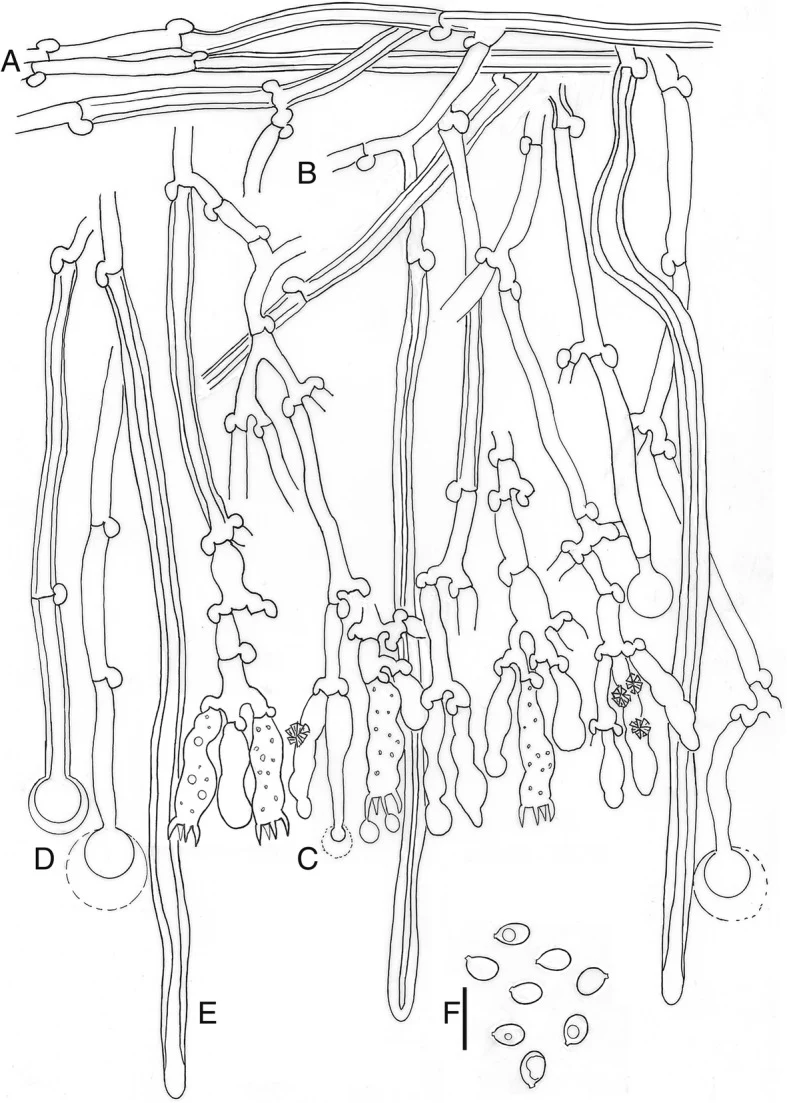
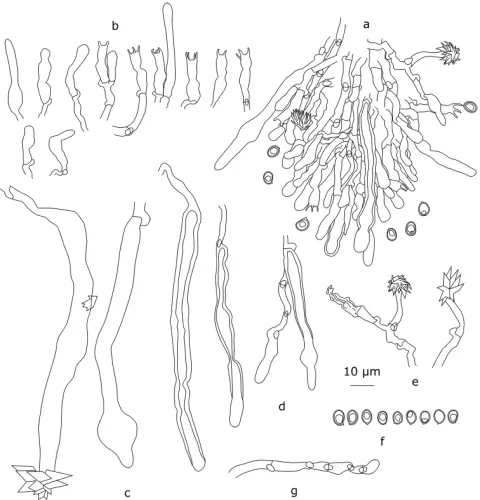
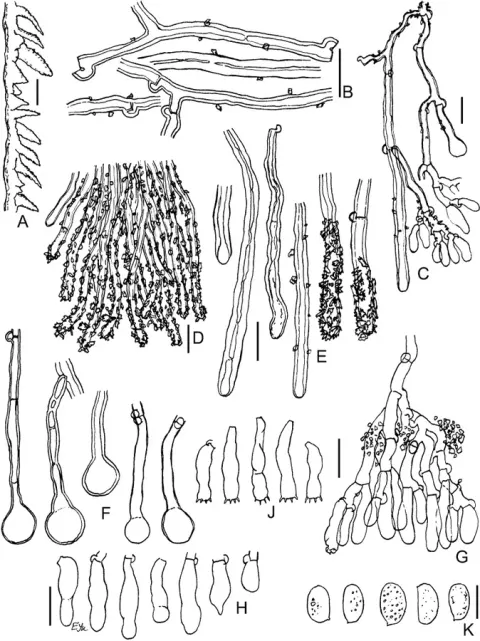
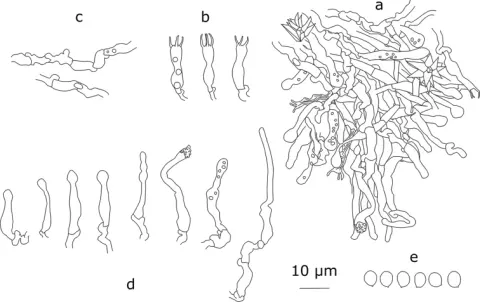
Description: Basidioma resupinate, effuse, adnate; hymenophore poroid, 1–4 pores/mm, regular to angular, dissepiments dentate in old specimens, on vertical substrata irregularly irpicoid with flattened teeth, yellow-white to orange-yellow (92. y White – 71. m. OY); margin clearly differentiated, paler (Fig. 5a). Hyphal system monomitic; generative hyphae hyaline, thin to thick-walled, sparsely branched, with clamps, 3–5 μm wide; subicular hyphae loosely interwoven, parallel to substratum (Fig. 6a); subhymenial hyphae, perpendicular to the substratum (Fig. 6 b). Cystidia or rather cystidial elements present: (1) capitate, subcylindrical, fusiform or moniliform cystidia arise from the hymenium (Fig. 6c), sometimes encrusted or with an apical bladder, thin-walled, with basal clamp, 17–26 × 3–5 μm; (2) capitate hyphae arise from the subiculum (Fig. 6d), sometimes with a thin-walled apical bladder, thin to thick-walled, with basal clamp, 30–40 × 3–4.5 μm, apex to 9 μm diam; and (3) tubular hyphae or “skeletocystidia” arise from the subiculum (Fig. 6e), with very thick walls narrowing to the apex, with basal clamp, 120–150 × 3–5 μm. Basidia cylindrical to suburniform, (15–)18–21 × 4–5 μm, four sterigmata, with basal clamp (Fig. 6c). Basidiospores ellipsoidal, (4.5–)5–5.5(− 7) × (2.5–)3–3.5(− 4.5) μm, hyaline, thin-walled, smooth, guttulate (Fig. 6f). L = 5.34, W = 3.33, Q = 1.60.

Sebagian uraian ditampilkan dalam bahasa sumber; terjemahannya belum tersedia atau belum lolos pemeriksaan.

Rujukan: [1]

Pengukuran mengikuti objek, spesimen atau kultur, dan metode yang disebutkan sumber. Baca uraian asli untuk konteks lengkap.

02 / Kehidupan

Habitat dan peran ekologis

Ecology and habitat: On rotted wood of Alnus, Carpinus, Castanea, Eucalyptus, Fagus, Quercus, and Tilia. Present in areas with seasonal climate, warm and dry summers and cold winters. Known distribution: Widespread in Europe, also known from Africa (Canary Islands and Cameroon).

Sebagian uraian ditampilkan dalam bahasa sumber; terjemahannya belum tersedia atau belum lolos pemeriksaan.

Rujukan: [1]

Habitat atau konteks temuan
Informasi belum tersedia pada sumber rilis ini.
Substrat
Informasi belum tersedia pada sumber rilis ini.
Peran atau konteks
Belum dikategorikan pada rilis ini.
Temukan hubungan serupa
03 / Siklus hidup

Reproduksi

Description: Basidioma resupinate, effuse, adnate; hymenophore poroid, 1–4 pores/mm, regular to angular, dissepiments dentate in old specimens, on vertical substrata irregularly irpicoid with flattened teeth, yellow-white to orange-yellow (92. y White – 71. m. OY); margin clearly differentiated, paler (Fig. 5a). Hyphal system monomitic; generative hyphae hyaline, thin to thick-walled, sparsely branched, with clamps, 3–5 μm wide; subicular hyphae loosely interwoven, parallel to substratum (Fig. 6a); subhymenial hyphae, perpendicular to the substratum (Fig. 6 b). Cystidia or rather cystidial elements present: (1) capitate, subcylindrical, fusiform or moniliform cystidia arise from the hymenium (Fig. 6c), sometimes encrusted or with an apical bladder, thin-walled, with basal clamp, 17–26 × 3–5 μm; (2) capitate hyphae arise from the subiculum (Fig. 6d), sometimes with a thin-walled apical bladder, thin to thick-walled, with basal clamp, 30–40 × 3–4.5 μm, apex to 9 μm diam; and (3) tubular hyphae or “skeletocystidia” arise from the subiculum (Fig. 6e), with very thick walls narrowing to the apex, with basal clamp, 120–150 × 3–5 μm.

Sebagian uraian ditampilkan dalam bahasa sumber; terjemahannya belum tersedia atau belum lolos pemeriksaan.

Rujukan: [1]

Sinonim menurut acuan taksonomi rilis: Boletus cerasi; Boletus radula; Coriolus cerasi; Corticium hydnans; Hydnum cerasi; Hydnum flexuosum; Hyphodontia radula; Irpex cerasi; Kneiffiella radula; Odontia cerasi; Odontia macroverruca; Physisporus radula; Polyporus cerasi; Polyporus radula; Poria eyrei; Poria radula; Poria versipora f. radula; Radulum hydnans; Schizopora radula; Sistotrema cerasi; Sistotrema laevigatum; Sistotrema laevigatum var. amelanchieri; Sistotrema laevigatum var. flexuosum; Sistotrema laevigatum var. funiculare; Sistotrema laevigatum var. heterodon; Sistotrema leucoplaca; Xylodon cerasi
04 / Batas informasi

Catatan identitas dan cakupan

  • Nama diterima mengikuti Catalogue of Life Base2026-09-11; uraian mempertahankan konsep dan nama sumber aslinya.
  • Preserve original treatment localities, hosts and substrate scope. Materials examined describe documented specimens, not the full global range.
  • Impor dan terjemahan otomatis belum diperiksa editorial per profil. Struktur reproduktif yang disebutkan tidak membuktikan seluruh siklus hidup diketahui.
  • Pengukuran pada uraian mengikuti spesimen, kultur, dan metode sumber; angka tidak diperluas ke semua populasi.

Catatan distribusi dalam narasi mengikuti sumbernya. Dokumentasi spesimen atau foto mengikuti catatan sumber. Bukti wilayah Indonesia dan penilaian konservasi tidak disimpulkan dari gambar.

05 / Dokumentasi

Melihat dengan konteks

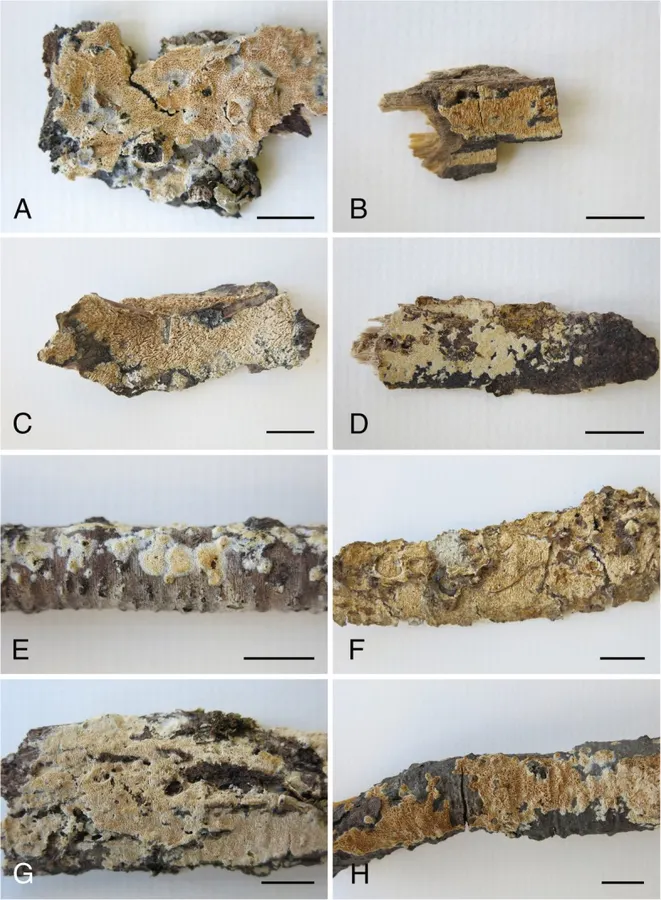
Basidioma of Xylodon species. a. Xylodon raduloides (755MD, MA-Fungi 12,864). b, c. Xylodon laurentianus (B. HHB-719, CFMR, holotype; C. DLL2009–049, CFMR). d–f. Xylodon patagonicus (D. 19684Tell., MA-Fungi 90,707, holotype; E. 14,180 MD, MA-Fungi 90,702, young specimen; F. 19705Tell., MA-Fungi 90,706, old specimen). g, h. Xylodon novozelandicus (G. Paulus 98/20, PDD 70718, holotype; H. Paulus 98/104, PDD 70720). Bars = 1 mm

Jenis
Pelat ilmiah
Kredit
© The Author(s) 2019
Lisensi
CC BY 4.0
Sumber media
Buka entri sumber

Gambar menunjukkan objek menurut identifikasi sumber, bukan verifikasi independen spesimen oleh Fungi. Tidak ada skala baru yang ditambahkan.

Dokumentasi tambahan

06 / Rujukan

Sumber profil

  1. [1] Addressing the diversity of Xylodon raduloides complex through integrative taxonomy — Xylodon raduloidesBagian sumber: Sec13_paragraph_1
    Tanggal penghimpunan sumber: 2026-10-12
    Teks sumber: CC BY 4.0 · Fernández-López J, Telleria MT, Dueñas M, Wilson AW, Padamsee M, Buchanan PK, Mueller GM, Martín MP.
  2. [2] Catalogue of Life Base2026-09-11 — Xylodon raduloidesBagian sumber: ColDP NameUsage.tsv ID 5CL9Y; accepted species; source 2073
    Tanggal penghimpunan sumber: 2026-10-12
  3. [3] Dokumentasi visual — Xylodon raduloidesBagian sumber: Identitas mengikuti sumber dokumentasi; bukan penentuan spesimen independen.
    Tanggal penghimpunan sumber: 2026-10-17
    Media sumber: CC BY 4.0 · © The Author(s) 2019
  4. [4] Dokumentasi visual — Xylodon raduloidesBagian sumber: Identitas mengikuti sumber dokumentasi; bukan penentuan spesimen independen.
    Tanggal penghimpunan sumber: 2026-10-17
    Teks sumber: CC BY 4.0 · © The Author(s) 2019

Adaptasi teks: CC BY 4.0. Fernández-López J, Telleria MT, Dueñas M, Wilson AW, Padamsee M, Buchanan PK, Mueller GM, Martín MP. — Addressing the diversity of Xylodon raduloides complex through integrative taxonomy — Xylodon raduloides

Uraian asli dan riwayat sumber

Riwayat atau halaman sumber

Ringkasan sumber

Description: Basidioma resupinate, effuse, adnate; hymenophore poroid, 1–4 pores/mm, regular to angular, dissepiments dentate in old specimens, on vertical substrata irregularly irpicoid with flattened teeth, yellow-white to orange-yellow (92. y White – 71. m. OY); margin clearly differentiated, paler (Fig. 5a). Hyphal system monomitic; generative hyphae hyaline, thin to thick-walled, sparsely branched, with clamps, 3–5 μm wide; subicular hyphae loosely interwoven, parallel to substratum (Fig. 6a); subhymenial hyphae, perpendicular to the substratum (Fig. 6 b).

Revisi sumber

Morfologi sumber

Description: Basidioma resupinate, effuse, adnate; hymenophore poroid, 1–4 pores/mm, regular to angular, dissepiments dentate in old specimens, on vertical substrata irregularly irpicoid with flattened teeth, yellow-white to orange-yellow (92. y White – 71. m. OY); margin clearly differentiated, paler (Fig. 5a). Hyphal system monomitic; generative hyphae hyaline, thin to thick-walled, sparsely branched, with clamps, 3–5 μm wide; subicular hyphae loosely interwoven, parallel to substratum (Fig. 6a); subhymenial hyphae, perpendicular to the substratum (Fig. 6 b). Cystidia or rather cystidial elements present: (1) capitate, subcylindrical, fusiform or moniliform cystidia arise from the hymenium (Fig. 6c), sometimes encrusted or with an apical bladder, thin-walled, with basal clamp, 17–26 × 3–5 μm; (2) capitate hyphae arise from the subiculum (Fig. 6d), sometimes with a thin-walled apical bladder, thin to thick-walled, with basal clamp, 30–40 × 3–4.5 μm, apex to 9 μm diam; and (3) tubular hyphae or “skeletocystidia” arise from the subiculum (Fig. 6e), with very thick walls narrowing to the apex, with basal clamp, 120–150 × 3–5 μm. Basidia cylindrical to suburniform, (15–)18–21 × 4–5 μm, four sterigmata, with basal clamp (Fig. 6c). Basidiospores ellipsoidal, (4.5–)5–5.5(− 7) × (2.5–)3–3.5(− 4.5) μm, hyaline, thin-walled, smooth, guttulate (Fig. 6f). L = 5.34, W = 3.33, Q = 1.60.

Revisi sumber

Ekologi sumber

Ecology and habitat: On rotted wood of Alnus, Carpinus, Castanea, Eucalyptus, Fagus, Quercus, and Tilia. Present in areas with seasonal climate, warm and dry summers and cold winters. Known distribution: Widespread in Europe, also known from Africa (Canary Islands and Cameroon).

Revisi sumber

Struktur reproduksi sumber

Description: Basidioma resupinate, effuse, adnate; hymenophore poroid, 1–4 pores/mm, regular to angular, dissepiments dentate in old specimens, on vertical substrata irregularly irpicoid with flattened teeth, yellow-white to orange-yellow (92. y White – 71. m. OY); margin clearly differentiated, paler (Fig. 5a). Hyphal system monomitic; generative hyphae hyaline, thin to thick-walled, sparsely branched, with clamps, 3–5 μm wide; subicular hyphae loosely interwoven, parallel to substratum (Fig. 6a); subhymenial hyphae, perpendicular to the substratum (Fig. 6 b). Cystidia or rather cystidial elements present: (1) capitate, subcylindrical, fusiform or moniliform cystidia arise from the hymenium (Fig. 6c), sometimes encrusted or with an apical bladder, thin-walled, with basal clamp, 17–26 × 3–5 μm; (2) capitate hyphae arise from the subiculum (Fig. 6d), sometimes with a thin-walled apical bladder, thin to thick-walled, with basal clamp, 30–40 × 3–4.5 μm, apex to 9 μm diam; and (3) tubular hyphae or “skeletocystidia” arise from the subiculum (Fig. 6e), with very thick walls narrowing to the apex, with basal clamp, 120–150 × 3–5 μm.

Revisi sumber

Rujukan halaman ini

Fungi. Xylodon raduloides. Rilis data fungi-2026-10-12-expansion-2. https://fungi-atlas.mgadib.chatgpt.site/jamur/xylodon-raduloides/.

Status: impor sumber; pemeriksaan editorial per profil belum selesai. Untuk klaim biologis, gunakan rujukan pada bagian terkait dan periksa konteks sumber aslinya.