01 / Morfologi

Ciri dan struktur

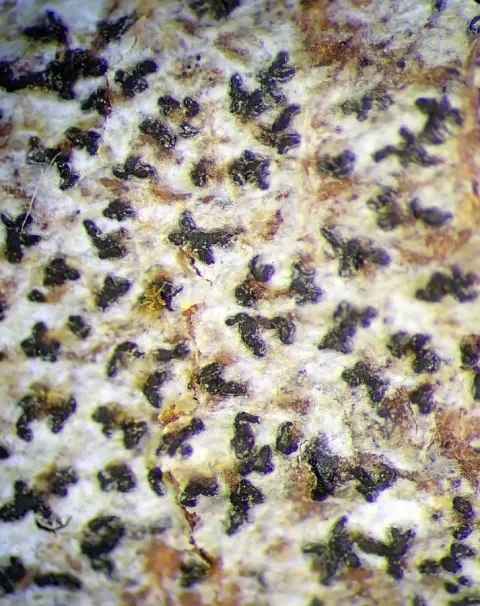
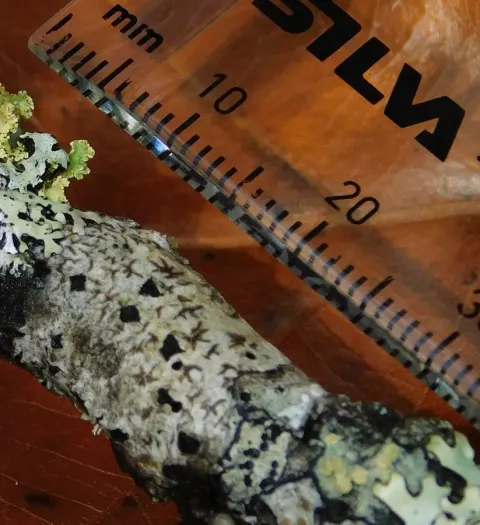
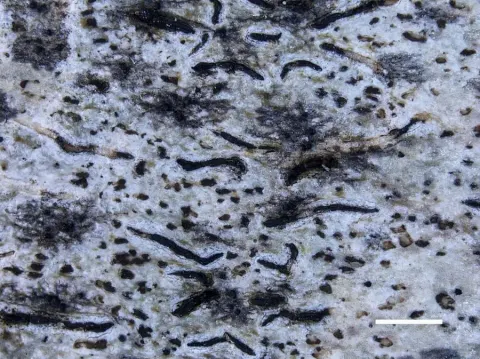
Arthonia ilicinella is a crustose lichen with a thallus (the main body of the lichen) is immersed within its substrate rather than sitting prominently on the surface. The thallus appears either as a diffuse growth or with defined boundaries marked by a brown line, and is coloured white-grey to cream-white. The reproductive structures (apothecia) measure between 0.1–0.6 mm in diameter, though some may be elongated, reaching about 0.8 mm long by 0.15–0.3 mm wide. These structures are irregularly rounded, relatively flat, and black in colour without any powdery coating (). The apothecia are 80–95 micrometres (μm) tall. Internally, the lichen has a layered structure: the (upper layer) is red-brown and turns pale green when exposed to potassium hydroxide solution (K); the hymenium (fertile layer where spores are produced) measures 40–60 μm in height, is pale red-brown, and also turns pale green with K; the hypothecium (layer beneath the hymenium) is 10–25 μm tall and matches the colour of the hymenium. The (sterile filaments between spore-producing cells) are about 1 μm in diameter, with brown-walled and slightly thicker (1.5–2 μm) structures in the , occasionally showing caps at their tips. The (reproductive spores) typically measure 18–23 by 7–9 μm and have a cylindrical to egg-shaped form with 3 or 4 (occasionally 5) cross-walls or septa, with enlarged cells at the tips. Older spores turn brown and have a surface that is smooth or very slightly textured when viewed at high magnification (1000×). Small asexual reproductive structures (pycnidia are often present but usually few in number, measuring 60–80 μm in diameter.

Sebagian uraian ditampilkan dalam bahasa sumber; terjemahannya belum tersedia atau belum lolos pemeriksaan.

Rujukan: [1]

Pengukuran mengikuti objek, spesimen atau kultur, dan metode yang disebutkan sumber. Baca uraian asli untuk konteks lengkap.

02 / Kehidupan

Habitat dan peran ekologis

Arthonia ilicinella has a wide global distribution, occurring across multiple continents. In Europe, it is found in Germany, Ireland, Portugal (including the Azores in the Atlantic Ocean), Spain, Switzerland, and the United Kingdom. The species also appears in South America, specifically in Argentina and Chile, and extends to Asia where it has been documented in South Korea. In the British Isles, Arthonia ilicinella serves as an ecological indicator species, commonly used by researchers and conservationists when conducting environmental assessments. In Scotland, it has been noted as one of the benchmark "old-growth" indicator species that had undergone the most significant decline over a five-decade period. In 2016, it was reported from South Korea.

Sebagian uraian ditampilkan dalam bahasa sumber; terjemahannya belum tersedia atau belum lolos pemeriksaan.

Rujukan: [1]

Habitat atau konteks temuan
Informasi belum tersedia pada sumber rilis ini.
Substrat
Informasi belum tersedia pada sumber rilis ini.
Peran atau konteks
Pembentuk liken
Temukan hubungan serupa
03 / Siklus hidup

Reproduksi

Arthonia ilicinella is a crustose lichen with a thallus (the main body of the lichen) is immersed within its substrate rather than sitting prominently on the surface. The thallus appears either as a diffuse growth or with defined boundaries marked by a brown line, and is coloured white-grey to cream-white. The reproductive structures (apothecia) measure between 0.1–0.6 mm in diameter, though some may be elongated, reaching about 0.8 mm long by 0.15–0.3 mm wide. These structures are irregularly rounded, relatively flat, and black in colour without any powdery coating (). The apothecia are 80–95 micrometres (μm) tall. Internally, the lichen has a layered structure: the (upper layer) is red-brown and turns pale green when exposed to potassium hydroxide solution (K); the hymenium (fertile layer where spores are produced) measures 40–60 μm in height, is pale red-brown, and also turns pale green with K; the hypothecium (layer beneath the hymenium) is 10–25 μm tall and matches the colour of the hymenium.

Sebagian uraian ditampilkan dalam bahasa sumber; terjemahannya belum tersedia atau belum lolos pemeriksaan.

Rujukan: [1]

04 / Batas informasi

Catatan identitas dan cakupan

  • Nama diterima mengikuti Catalogue of Life Base2026-09-11; uraian mempertahankan konsep dan nama sumber aslinya.
  • Original geographic, specimen and life-cycle scope retained; source import awaits individual editorial review.
  • Impor dan terjemahan otomatis belum diperiksa editorial per profil. Struktur reproduktif yang disebutkan tidak membuktikan seluruh siklus hidup diketahui.
  • Pengukuran pada uraian mengikuti spesimen, kultur, dan metode sumber; angka tidak diperluas ke semua populasi.

Catatan distribusi dalam narasi mengikuti sumbernya. Dokumentasi spesimen atau foto mengikuti catatan sumber. Bukti wilayah Indonesia dan penilaian konservasi tidak disimpulkan dari gambar.

05 / Dokumentasi

Melihat dengan konteks

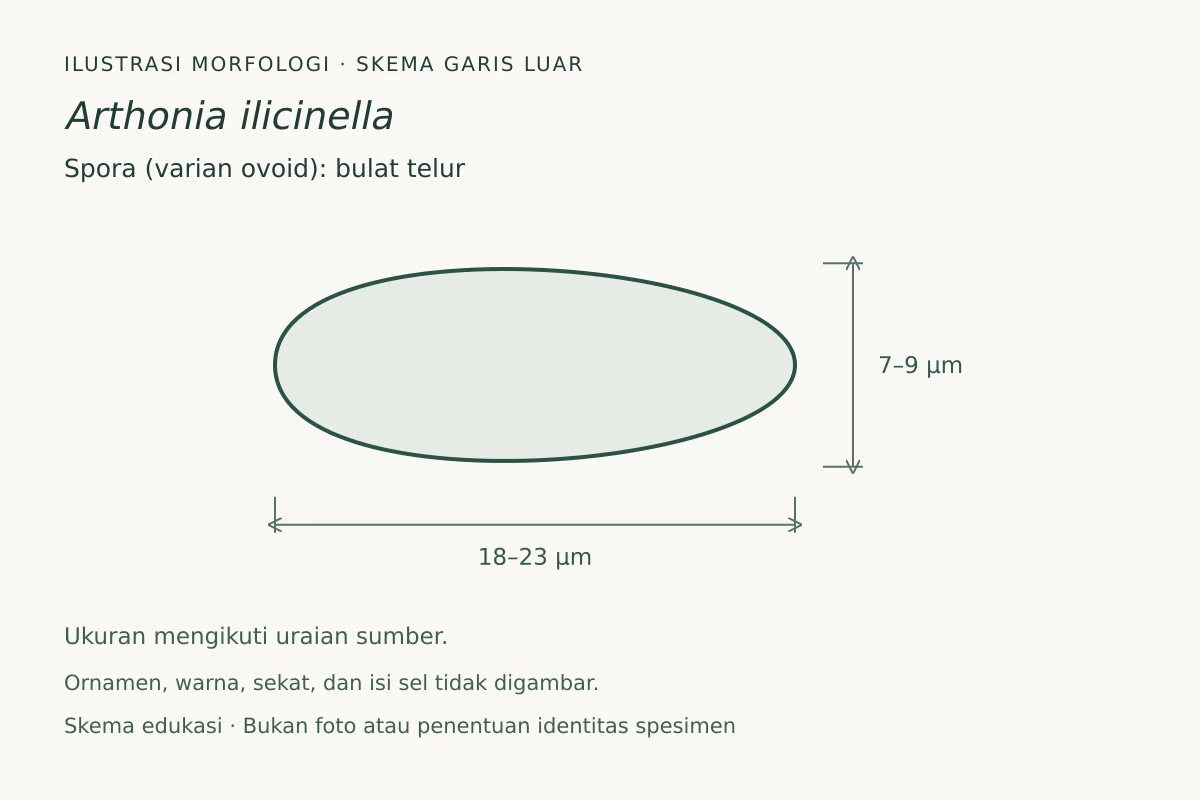
Ilustrasi skematis garis luar spora (varian ovoid) Arthonia ilicinella, berdasarkan uraian sumber; ukuran yang dilaporkan 18–23 × 7–9 µm. Proporsi disederhanakan, bukan salinan satu spesimen. Ornamen permukaan, warna, sekat, dan isi sel tidak direkonstruksi. Varian spora berbentuk telur, 18–23 × 7–9 µm. Pembesaran sel ujung serta 3–4 atau kadang 5 sekat tidak direkonstruksi. Ornamen, warna, sekat, dan isi sel tidak digambar. Skema edukasi, bukan alat identifikasi.

Jenis
Ilustrasi skematis
Kredit
Fungi, ilustrasi orisinal (2026); fakta morfologi berdasarkan Wikipedia contributors
Sumber media
Buka entri sumber

Gambar menunjukkan objek menurut identifikasi sumber, bukan verifikasi independen spesimen oleh Fungi. Tidak ada skala baru yang ditambahkan.

06 / Rujukan

Sumber profil

  1. [1] Arthonia ilicinella — Wikipedia (en)Bagian sumber: Frozen revision 1293515402
    Tanggal penghimpunan sumber: 2026-10-12
    Media sumber: CC BY-SA4.0 · Wikipedia contributors
  2. [2] Catalogue of Life Base2026-09-11 — Arthonia ilicinellaBagian sumber: ColDP NameUsage.tsv ID GXHB; accepted species; source 2073
    Tanggal penghimpunan sumber: 2026-10-12

Adaptasi teks: CC BY-SA 4.0. Wikipedia contributors — Arthonia ilicinella — Wikipedia (en)

Uraian asli dan riwayat sumber

Riwayat atau halaman sumber

Ringkasan sumber

Arthonia ilicinella is a species of crustose lichen belonging to the family Arthoniaceae. First described in 1867, it is characterised by its immersed thallus that appears white-grey to cream-white, and its small black reproductive structures. The species has a widespread global distribution, occurring across Europe (including the United Kingdom, Ireland, Germany, Portugal, Spain, and Switzerland), South America (Argentina and Chile), and parts of Asia (South Korea). In the British Isles, it serves as an ecological indicator species used in environmental assessments, and has been noted in Scotland as an old-growth forest indicator that has significantly declined over recent decades.

Revisi sumber

Morfologi sumber

Arthonia ilicinella is a crustose lichen with a thallus (the main body of the lichen) is immersed within its substrate rather than sitting prominently on the surface. The thallus appears either as a diffuse growth or with defined boundaries marked by a brown line, and is coloured white-grey to cream-white. The reproductive structures (apothecia) measure between 0.1–0.6 mm in diameter, though some may be elongated, reaching about 0.8 mm long by 0.15–0.3 mm wide. These structures are irregularly rounded, relatively flat, and black in colour without any powdery coating (). The apothecia are 80–95 micrometres (μm) tall. Internally, the lichen has a layered structure: the (upper layer) is red-brown and turns pale green when exposed to potassium hydroxide solution (K); the hymenium (fertile layer where spores are produced) measures 40–60 μm in height, is pale red-brown, and also turns pale green with K; the hypothecium (layer beneath the hymenium) is 10–25 μm tall and matches the colour of the hymenium. The (sterile filaments between spore-producing cells) are about 1 μm in diameter, with brown-walled and slightly thicker (1.5–2 μm) structures in the , occasionally showing caps at their tips. The (reproductive spores) typically measure 18–23 by 7–9 μm and have a cylindrical to egg-shaped form with 3 or 4 (occasionally 5) cross-walls or septa, with enlarged cells at the tips. Older spores turn brown and have a surface that is smooth or very slightly textured when viewed at high magnification (1000×). Small asexual reproductive structures (pycnidia are often present but usually few in number, measuring 60–80 μm in diameter.

Revisi sumber

Ekologi sumber

Arthonia ilicinella has a wide global distribution, occurring across multiple continents. In Europe, it is found in Germany, Ireland, Portugal (including the Azores in the Atlantic Ocean), Spain, Switzerland, and the United Kingdom. The species also appears in South America, specifically in Argentina and Chile, and extends to Asia where it has been documented in South Korea. In the British Isles, Arthonia ilicinella serves as an ecological indicator species, commonly used by researchers and conservationists when conducting environmental assessments. In Scotland, it has been noted as one of the benchmark "old-growth" indicator species that had undergone the most significant decline over a five-decade period. In 2016, it was reported from South Korea.

Revisi sumber

Struktur reproduksi sumber

Arthonia ilicinella is a crustose lichen with a thallus (the main body of the lichen) is immersed within its substrate rather than sitting prominently on the surface. The thallus appears either as a diffuse growth or with defined boundaries marked by a brown line, and is coloured white-grey to cream-white. The reproductive structures (apothecia) measure between 0.1–0.6 mm in diameter, though some may be elongated, reaching about 0.8 mm long by 0.15–0.3 mm wide. These structures are irregularly rounded, relatively flat, and black in colour without any powdery coating (). The apothecia are 80–95 micrometres (μm) tall. Internally, the lichen has a layered structure: the (upper layer) is red-brown and turns pale green when exposed to potassium hydroxide solution (K); the hymenium (fertile layer where spores are produced) measures 40–60 μm in height, is pale red-brown, and also turns pale green with K; the hypothecium (layer beneath the hymenium) is 10–25 μm tall and matches the colour of the hymenium.

Revisi sumber

Rujukan halaman ini

Fungi. Arthonia ilicinella. Rilis data fungi-2026-10-12-expansion-2. https://fungi-atlas.mgadib.chatgpt.site/jamur/arthonia-ilicinella/.

Status: impor sumber; pemeriksaan editorial per profil belum selesai. Untuk klaim biologis, gunakan rujukan pada bagian terkait dan periksa konteks sumber aslinya.