01 / Morfologi

Ciri dan struktur

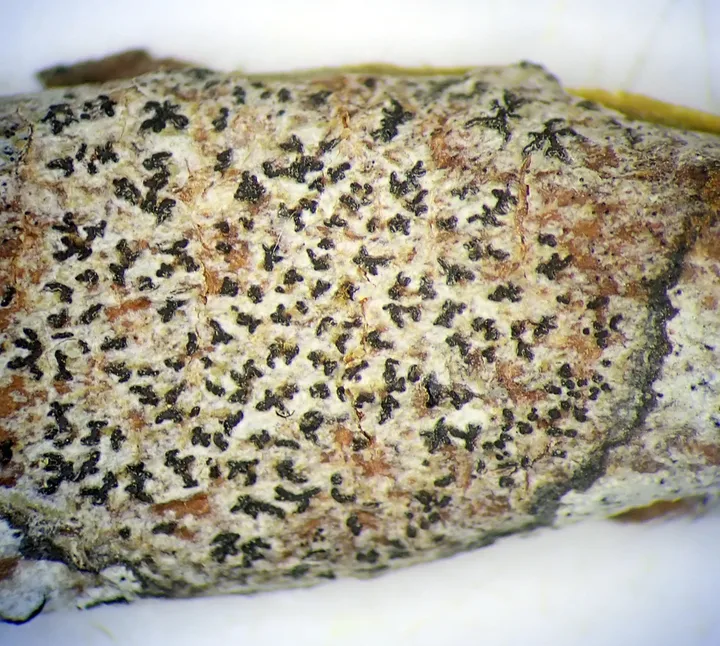
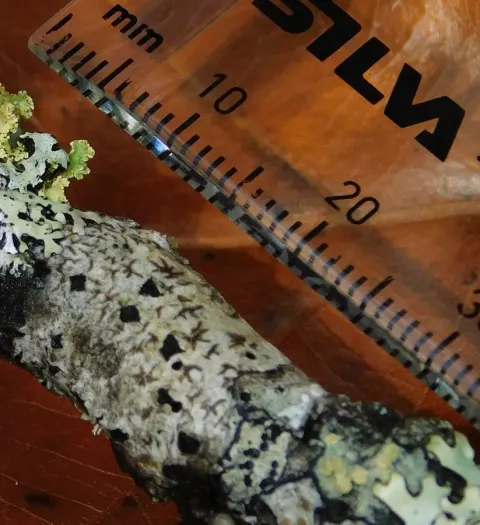
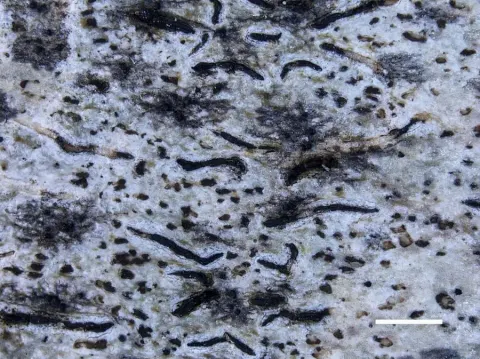
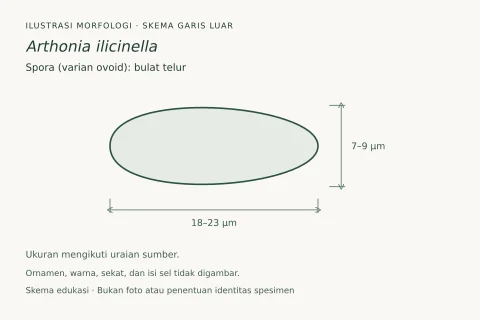
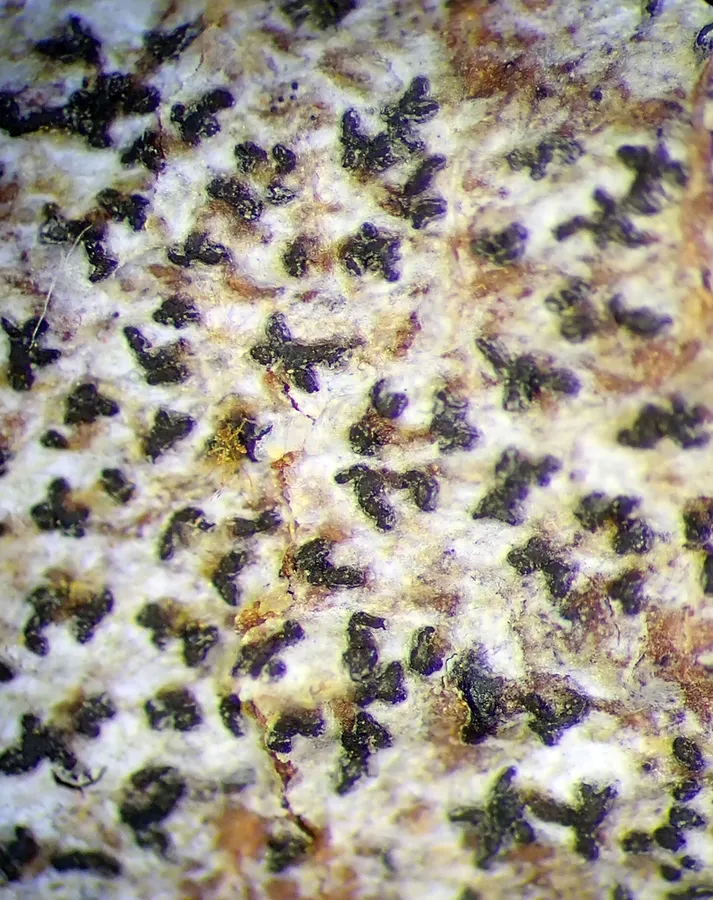
Arthonia radiata is a crustose lichen with an immersed thallus, often separated from its surroundings by a thin brown line. The thallus is typically pale, ranging from white to pale grey, sometimes with a brown or olive tinge, and often forms a mosaic-like pattern on its . Its reproductive structures, called apothecia, are black and can appear in various shapes—rounded, star-like (stellate), or elongated. These apothecia can measure between 0.15 and 2.2 mm across, and are usually flat or slightly convex. They lack a frosted appearance, often referred to as being non-. Under a microscope, the apothecia have a thin (the upper layer) that is brown or olive-brown, reacting to certain chemical tests by turning pale green. The internal structure includes a clear hymenium (spore-producing layer) and a hypothecium (the layer beneath) that is also colourless to pale olive-brown. The (sterile filaments within the hymenium) are narrow, 1–2 μm wide, but can expand to 3 μm, and they are often capped with darker brown tips. Arthonia radiata produces spores that are cylindric-obovoid to cylindrical, with 3 internal walls (septa) dividing the spore into 4 cells. These ascospores measure between 15 and 20 μm long and 4.5 to 6 μm wide, and the uppermost cell is not enlarged. While its asexual reproductive structures, pycnidia, are rare, they are immersed in the thallus and black, with a pale green reaction in chemical tests. These structures release small, rod-like conidia (asexual spores), about 4–5 μm long. No secondary metabolites, often used to identify lichen species, have been detected in Arthonia radiata using thin-layer chromatography.

Sebagian uraian ditampilkan dalam bahasa sumber; terjemahannya belum tersedia atau belum lolos pemeriksaan.

Rujukan: [1]

Pengukuran mengikuti objek, spesimen atau kultur, dan metode yang disebutkan sumber. Baca uraian asli untuk konteks lengkap.

02 / Kehidupan

Habitat dan peran ekologis

Arthonia radiata is a widespread and common species. It grows on the smooth bark of many trees and shrubs.

Sebagian uraian ditampilkan dalam bahasa sumber; terjemahannya belum tersedia atau belum lolos pemeriksaan.

Rujukan: [1]

Habitat atau konteks temuan
Informasi belum tersedia pada sumber rilis ini.
Substrat
Informasi belum tersedia pada sumber rilis ini.
Peran atau konteks
Pembentuk liken
Temukan hubungan serupa
03 / Siklus hidup

Reproduksi

Arthonia radiata is a crustose lichen with an immersed thallus, often separated from its surroundings by a thin brown line. The thallus is typically pale, ranging from white to pale grey, sometimes with a brown or olive tinge, and often forms a mosaic-like pattern on its . Its reproductive structures, called apothecia, are black and can appear in various shapes—rounded, star-like (stellate), or elongated. These apothecia can measure between 0.15 and 2.2 mm across, and are usually flat or slightly convex. They lack a frosted appearance, often referred to as being non-. Under a microscope, the apothecia have a thin (the upper layer) that is brown or olive-brown, reacting to certain chemical tests by turning pale green.

Sebagian uraian ditampilkan dalam bahasa sumber; terjemahannya belum tersedia atau belum lolos pemeriksaan.

Rujukan: [1]

Sinonim menurut acuan taksonomi rilis: Arthonia astroidea; Arthonia astroidea f. opegraphina; Arthonia astroidea f. parallela; Arthonia astroidea f. radiata; Arthonia astroidea radiata; Arthonia astroidea subsp. swartziana; Arthonia astroidea tynnocarpa; Arthonia astroidea var. epipastoides; Arthonia astroidea var. opegraphina; Arthonia astroidea var. parallela; Arthonia astroidea var. radiata; Arthonia astroidea var. simulans; Arthonia astroidea var. swartziana; Arthonia cinnabarina var. epipastoides; Arthonia cinnabarina var. opegraphina; Arthonia epipastoides; Arthonia gregaria var. opegraphina; Arthonia opegraphina; Arthonia radiata f. astroidea; Arthonia radiata f. parallela; Arthonia radiata subsp. swartziana; Arthonia radiata var. astroidea; Arthonia radiata var. epipastoides; Arthonia radiata var. opegraphina; Arthonia radiata var. parallela; Arthonia radiata var. swartziana; Arthonia swartziana; Arthonia vulgaris f. astroidea; Arthonia vulgaris f. radiata; Arthonia vulgaris f. swartziana; Arthonia vulgaris var. astroidea; Arthonia vulgaris var. radiata; Arthonia vulgaris var. swartziana; Graphis atra var. astroidea; Lichen astroites; Lichen swartzianus; Opegrapha astroidea; Opegrapha astroidea var. radiata; Opegrapha atra var. astroidea; Opegrapha atra var. radiata; Opegrapha atra var. swartziana; Opegrapha gregaria var. radiata; Opegrapha radiata; Opegrapha radiata var. astroidea; Opegrapha radiata var. swartziana; Opegrapha swartziana; Opegrapha vulgata var. swartziana
04 / Batas informasi

Catatan identitas dan cakupan

  • Nama diterima mengikuti Catalogue of Life Base2026-09-11; uraian mempertahankan konsep dan nama sumber aslinya.
  • Original geographic, specimen and life-cycle scope retained; source import awaits individual editorial review.
  • Impor dan terjemahan otomatis belum diperiksa editorial per profil. Struktur reproduktif yang disebutkan tidak membuktikan seluruh siklus hidup diketahui.
  • Pengukuran pada uraian mengikuti spesimen, kultur, dan metode sumber; angka tidak diperluas ke semua populasi.

Catatan distribusi dalam narasi mengikuti sumbernya. Dokumentasi spesimen atau foto mengikuti catatan sumber. Bukti wilayah Indonesia dan penilaian konservasi tidak disimpulkan dari gambar.

05 / Dokumentasi

Melihat dengan konteks

Dokumentasi Arthonia radiata menurut asosiasi foto pada record takson iNaturalist. Kredit: Peter de Lange. Identitas mengikuti sumber; bukan penentuan spesimen independen.

Jenis
Fotografi
Kredit
no rights reserved, uploaded by Peter de Lange
Lisensi
CC0 1.0
Sumber media
Buka entri sumber

Gambar menunjukkan objek menurut identifikasi sumber, bukan verifikasi independen spesimen oleh Fungi. Tidak ada skala baru yang ditambahkan.

Dokumentasi tambahan

06 / Rujukan

Sumber profil

  1. [1] Arthonia radiata — Wikipedia (en)Bagian sumber: Frozen revision 1325100332
    Tanggal penghimpunan sumber: 2026-10-12
    Teks sumber: CC BY-SA4.0 · Wikipedia contributors
  2. [2] Catalogue of Life Base2026-09-11 — Arthonia radiataBagian sumber: ColDP NameUsage.tsv ID GXLM; accepted species; source 2073
    Tanggal penghimpunan sumber: 2026-10-12
  3. [3] Dokumentasi visual — Arthonia radiataBagian sumber: Identitas mengikuti sumber dokumentasi; bukan penentuan spesimen independen.
    Tanggal penghimpunan sumber: 2026-10-17
    Media sumber: CC0 1.0 · no rights reserved, uploaded by Peter de Lange
  4. [4] Dokumentasi visual — Arthonia radiataBagian sumber: Identitas mengikuti sumber dokumentasi; bukan penentuan spesimen independen.
    Tanggal penghimpunan sumber: 2026-10-17
    Teks sumber: CC0 1.0 · no rights reserved, uploaded by Peter de Lange

Adaptasi teks: CC BY-SA 4.0. Wikipedia contributors — Arthonia radiata — Wikipedia (en)

Uraian asli dan riwayat sumber

Riwayat atau halaman sumber

Ringkasan sumber

Arthonia radiata, the asterisk lichen, is a common and widepspread species of corticolous (bark-dwelling), crustose lichen in the family Arthoniaceae.

Revisi sumber

Morfologi sumber

Arthonia radiata is a crustose lichen with an immersed thallus, often separated from its surroundings by a thin brown line. The thallus is typically pale, ranging from white to pale grey, sometimes with a brown or olive tinge, and often forms a mosaic-like pattern on its . Its reproductive structures, called apothecia, are black and can appear in various shapes—rounded, star-like (stellate), or elongated. These apothecia can measure between 0.15 and 2.2 mm across, and are usually flat or slightly convex. They lack a frosted appearance, often referred to as being non-. Under a microscope, the apothecia have a thin (the upper layer) that is brown or olive-brown, reacting to certain chemical tests by turning pale green. The internal structure includes a clear hymenium (spore-producing layer) and a hypothecium (the layer beneath) that is also colourless to pale olive-brown. The (sterile filaments within the hymenium) are narrow, 1–2 μm wide, but can expand to 3 μm, and they are often capped with darker brown tips. Arthonia radiata produces spores that are cylindric-obovoid to cylindrical, with 3 internal walls (septa) dividing the spore into 4 cells. These ascospores measure between 15 and 20 μm long and 4.5 to 6 μm wide, and the uppermost cell is not enlarged. While its asexual reproductive structures, pycnidia, are rare, they are immersed in the thallus and black, with a pale green reaction in chemical tests. These structures release small, rod-like conidia (asexual spores), about 4–5 μm long. No secondary metabolites, often used to identify lichen species, have been detected in Arthonia radiata using thin-layer chromatography.

Revisi sumber

Ekologi sumber

Arthonia radiata is a widespread and common species. It grows on the smooth bark of many trees and shrubs.

Revisi sumber

Struktur reproduksi sumber

Arthonia radiata is a crustose lichen with an immersed thallus, often separated from its surroundings by a thin brown line. The thallus is typically pale, ranging from white to pale grey, sometimes with a brown or olive tinge, and often forms a mosaic-like pattern on its . Its reproductive structures, called apothecia, are black and can appear in various shapes—rounded, star-like (stellate), or elongated. These apothecia can measure between 0.15 and 2.2 mm across, and are usually flat or slightly convex. They lack a frosted appearance, often referred to as being non-. Under a microscope, the apothecia have a thin (the upper layer) that is brown or olive-brown, reacting to certain chemical tests by turning pale green.

Revisi sumber

Rujukan halaman ini

Fungi. Arthonia radiata. Rilis data fungi-2026-10-12-expansion-2. https://fungi-atlas.mgadib.chatgpt.site/jamur/arthonia-radiata/.

Status: impor sumber; pemeriksaan editorial per profil belum selesai. Untuk klaim biologis, gunakan rujukan pada bagian terkait dan periksa konteks sumber aslinya.