01 / Morfologi

Ciri dan struktur

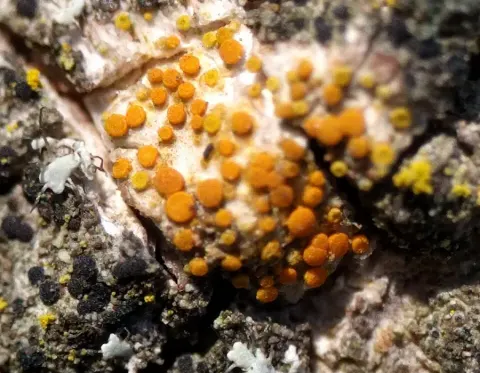
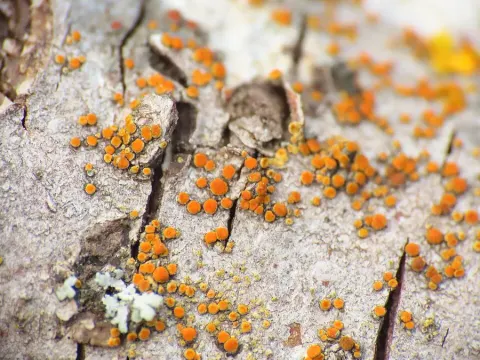
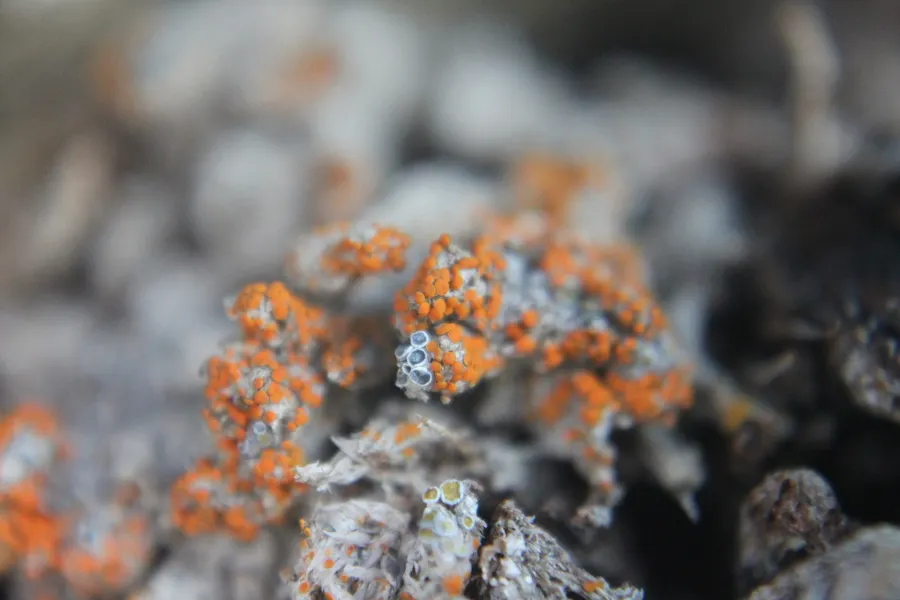
Athallia saxifragarum is a lichen species characterized by its thin, irregularly shaped thallus (the main body of the lichen) that grows either within the substrate () or on its surface (), appearing white. Its apothecia (fruiting bodies) are moderately abundant and somewhat clustered. These small, disc-shaped structures measure 0.2–0.7 mm in diameter and sit directly on the surface (), slightly constricted at the base and pressed closely against the substrate. The apothecia are in form, meaning they have a rim containing algal cells. The central is flat and yellowish-orange in colour, occasionally developing a brownish tinge as it matures, with a surface that ranges from smooth to finely . The margin around the disc is not prominent or wavy (not ) and appears darker than the rest of the thallus, usually yellowish-orange like the disc or slightly paler, with a smooth texture. The internal structure includes an (the outer layer of the apothecium) measuring 20–50 μm wide, with a poorly defined containing few algal cells. The is broad, composed of parallel hyphae (), strongly glutinized (gel-like), and colorless (hyaline). The , which is the layer below the spore-producing layer, is 100 μm high, made up of unoriented to vertically aligned hyphae with mostly wide openings, and is colourless. The (the layer just below the hymenium) is also colourless. The hymenium, where spores are produced, is 70–80 μm high and colorless. The paraphyses (sterile filaments among the spore-producing cells) have simple terminal cells that are swollen up to 6 μm wide and colorless, with subterminal cells up to 3 μm wide.

Sebagian uraian ditampilkan dalam bahasa sumber; terjemahannya belum tersedia atau belum lolos pemeriksaan.

Rujukan: [1]

Pengukuran mengikuti objek, spesimen atau kultur, dan metode yang disebutkan sumber. Baca uraian asli untuk konteks lengkap.

02 / Kehidupan

Habitat dan peran ekologis

Athallia saxifragarum grows over bryophytes (mosses and liverworts) and accumulated plant detritus, often among Saxifraga species. In alpine Europe it has been reported from dead tufts of Saxifraga and from twigs of shrubs and other woody plants. In Arctic regions it is frequently recorded on Saxifraga oppositifolia (purple saxifrage) and Dryas integrifolia (mountain avens), and appears confined to calciferous or otherwise alkaline sites, in dry habitats that are open to partly shaded. The species resembles Athallia pyracea but differs in ecology and spores: A. saxifragarum is mainly associated with plant detritus (often from Saxifraga), whereas A. pyracea is more typical of woody substrates, and A. saxifragarum has a slightly larger spore septum. Athallia saxifragarum is known from Arctic and alpine regions, including Greenland, Svalbard and the European Alps. It was reported as new to Finland and Norway in 2014 and to Sweden in 2023, and it also occurs in North America. Sequenced material has been reported from alpine localities in the Pirin Mountains (Bulgaria), the Prokletije Mountains (Montenegro) and the Retezat Mountains (Romania). In Nepal, A. saxifragarum has been reported from 4,950 to 5,000 m elevation in a compilation of published records; this reported range lies above the tree line used in the study.

Sebagian uraian ditampilkan dalam bahasa sumber; terjemahannya belum tersedia atau belum lolos pemeriksaan.

Rujukan: [1]

Habitat atau konteks temuan
Informasi belum tersedia pada sumber rilis ini.
Substrat
Informasi belum tersedia pada sumber rilis ini.
Peran atau konteks
Pembentuk liken
Temukan hubungan serupa
03 / Siklus hidup

Reproduksi

The internal structure includes an (the outer layer of the apothecium) measuring 20–50 μm wide, with a poorly defined containing few algal cells. The is broad, composed of parallel hyphae (), strongly glutinized (gel-like), and colorless (hyaline). The , which is the layer below the spore-producing layer, is 100 μm high, made up of unoriented to vertically aligned hyphae with mostly wide openings, and is colourless. The (the layer just below the hymenium) is also colourless. The hymenium, where spores are produced, is 70–80 μm high and colorless. The paraphyses (sterile filaments among the spore-producing cells) have simple terminal cells that are swollen up to 6 μm wide and colorless, with subterminal cells up to 3 μm wide.

Sebagian uraian ditampilkan dalam bahasa sumber; terjemahannya belum tersedia atau belum lolos pemeriksaan.

Rujukan: [1]

Sinonim menurut acuan taksonomi rilis: Caloplaca saxifragarum
04 / Batas informasi

Catatan identitas dan cakupan

  • Nama diterima mengikuti Catalogue of Life Base2026-09-11; uraian mempertahankan konsep dan nama sumber aslinya.
  • Original geographic, specimen and life-cycle scope retained; source import awaits individual editorial review.
  • Impor dan terjemahan otomatis belum diperiksa editorial per profil. Struktur reproduktif yang disebutkan tidak membuktikan seluruh siklus hidup diketahui.
  • Pengukuran pada uraian mengikuti spesimen, kultur, dan metode sumber; angka tidak diperluas ke semua populasi.

Catatan distribusi dalam narasi mengikuti sumbernya. Dokumentasi spesimen atau foto mengikuti catatan sumber. Bukti wilayah Indonesia dan penilaian konservasi tidak disimpulkan dari gambar.

05 / Dokumentasi

Melihat dengan konteks

Dokumentasi Athallia saxifragarum menurut asosiasi foto pada record takson iNaturalist. Kredit: Étienne Lacroix-Carignan. Identitas mengikuti sumber; bukan penentuan spesimen independen.

Jenis
Fotografi
Kredit
no rights reserved, uploaded by Étienne Lacroix-Carignan
Lisensi
CC0 1.0
Sumber media
Buka entri sumber

Gambar menunjukkan objek menurut identifikasi sumber, bukan verifikasi independen spesimen oleh Fungi. Tidak ada skala baru yang ditambahkan.

06 / Rujukan

Sumber profil

  1. [1] Athallia saxifragarum — Wikipedia (en)Bagian sumber: Frozen revision 1342769232
    Tanggal penghimpunan sumber: 2026-10-12
    Teks sumber: CC BY-SA4.0 · Wikipedia contributors
  2. [2] Catalogue of Life Base2026-09-11 — Athallia saxifragarumBagian sumber: ColDP NameUsage.tsv ID J9M2; accepted species; source 2073
    Tanggal penghimpunan sumber: 2026-10-12
  3. [3] Dokumentasi visual — Athallia saxifragarumBagian sumber: Individual media record; identification follows the source, not independent determination
    Tanggal penghimpunan sumber: 2026-10-12
    Media sumber: CC0 1.0 · no rights reserved, uploaded by Étienne Lacroix-Carignan

Adaptasi teks: CC BY-SA 4.0. Wikipedia contributors — Athallia saxifragarum — Wikipedia (en)

Uraian asli dan riwayat sumber

Riwayat atau halaman sumber

Ringkasan sumber

Athallia saxifragarum is a species of terricolous (ground-dwelling) crustose lichen in the family Teloschistaceae. First described by Josef Poelt in 1955 as a member of Caloplaca, it was reclassified into the genus Athallia in 2013 following molecular phylogenetics studies. This lichen is characterized by its thin white thallus and small yellowish-orange apothecia. It primarily grows on bryophytes and plant detritus, showing a particular affinity for Saxifraga species, and is typically found in calciferous or alkaline environments in Arctic and alpine regions, including Greenland, Svalbard, and the European Alps, with recent documentation in Fennoscandia.

Revisi sumber

Morfologi sumber

Athallia saxifragarum is a lichen species characterized by its thin, irregularly shaped thallus (the main body of the lichen) that grows either within the substrate () or on its surface (), appearing white. Its apothecia (fruiting bodies) are moderately abundant and somewhat clustered. These small, disc-shaped structures measure 0.2–0.7 mm in diameter and sit directly on the surface (), slightly constricted at the base and pressed closely against the substrate. The apothecia are in form, meaning they have a rim containing algal cells. The central is flat and yellowish-orange in colour, occasionally developing a brownish tinge as it matures, with a surface that ranges from smooth to finely . The margin around the disc is not prominent or wavy (not ) and appears darker than the rest of the thallus, usually yellowish-orange like the disc or slightly paler, with a smooth texture. The internal structure includes an (the outer layer of the apothecium) measuring 20–50 μm wide, with a poorly defined containing few algal cells. The is broad, composed of parallel hyphae (), strongly glutinized (gel-like), and colorless (hyaline). The , which is the layer below the spore-producing layer, is 100 μm high, made up of unoriented to vertically aligned hyphae with mostly wide openings, and is colourless. The (the layer just below the hymenium) is also colourless. The hymenium, where spores are produced, is 70–80 μm high and colorless. The paraphyses (sterile filaments among the spore-producing cells) have simple terminal cells that are swollen up to 6 μm wide and colorless, with subterminal cells up to 3 μm wide.

Revisi sumber

Ekologi sumber

Athallia saxifragarum grows over bryophytes (mosses and liverworts) and accumulated plant detritus, often among Saxifraga species. In alpine Europe it has been reported from dead tufts of Saxifraga and from twigs of shrubs and other woody plants. In Arctic regions it is frequently recorded on Saxifraga oppositifolia (purple saxifrage) and Dryas integrifolia (mountain avens), and appears confined to calciferous or otherwise alkaline sites, in dry habitats that are open to partly shaded. The species resembles Athallia pyracea but differs in ecology and spores: A. saxifragarum is mainly associated with plant detritus (often from Saxifraga), whereas A. pyracea is more typical of woody substrates, and A. saxifragarum has a slightly larger spore septum. Athallia saxifragarum is known from Arctic and alpine regions, including Greenland, Svalbard and the European Alps. It was reported as new to Finland and Norway in 2014 and to Sweden in 2023, and it also occurs in North America. Sequenced material has been reported from alpine localities in the Pirin Mountains (Bulgaria), the Prokletije Mountains (Montenegro) and the Retezat Mountains (Romania). In Nepal, A. saxifragarum has been reported from 4,950 to 5,000 m elevation in a compilation of published records; this reported range lies above the tree line used in the study.

Revisi sumber

Struktur reproduksi sumber

The internal structure includes an (the outer layer of the apothecium) measuring 20–50 μm wide, with a poorly defined containing few algal cells. The is broad, composed of parallel hyphae (), strongly glutinized (gel-like), and colorless (hyaline). The , which is the layer below the spore-producing layer, is 100 μm high, made up of unoriented to vertically aligned hyphae with mostly wide openings, and is colourless. The (the layer just below the hymenium) is also colourless. The hymenium, where spores are produced, is 70–80 μm high and colorless. The paraphyses (sterile filaments among the spore-producing cells) have simple terminal cells that are swollen up to 6 μm wide and colorless, with subterminal cells up to 3 μm wide.

Revisi sumber

Rujukan halaman ini

Fungi. Athallia saxifragarum. Rilis data fungi-2026-10-12-expansion-2. https://fungi-atlas.mgadib.chatgpt.site/jamur/athallia-saxifragarum/.

Status: impor sumber; pemeriksaan editorial per profil belum selesai. Untuk klaim biologis, gunakan rujukan pada bagian terkait dan periksa konteks sumber aslinya.