01 / Morfologi

Ciri dan struktur

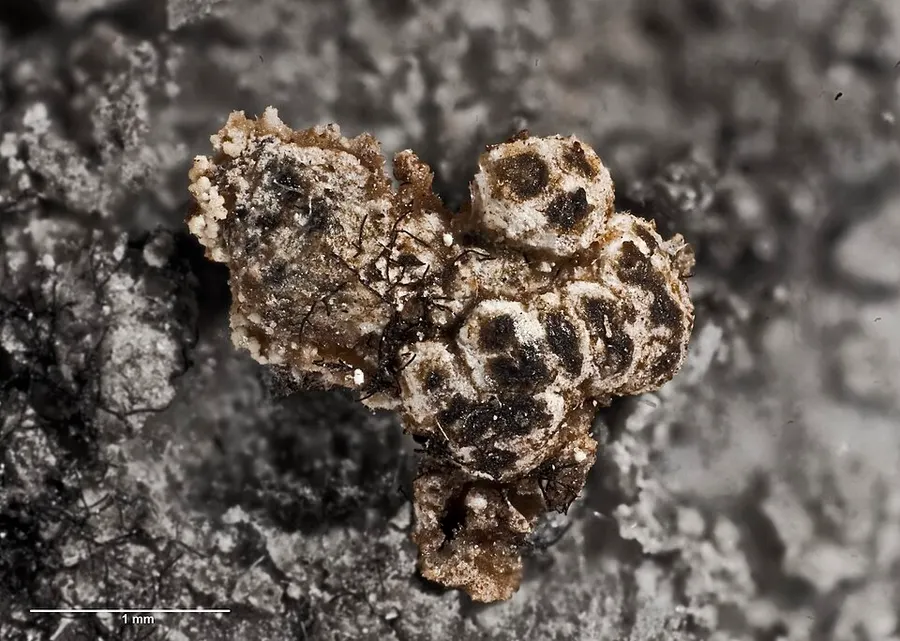
Chiodecton montanum has a thallus (lichen body) that can be either smooth and very thin or slightly roughened (), with a thickness of 0.5–1 mm. Its colour varies from dull reddish-brown to grey-brown or yellowish-grey. When tested with potassium hydroxide solution (K+), parts of the thallus react by turning yellow or reddish-yellow, indicating the presence of secalonic acid pigments. The thallus is typically bordered by a black , a thin layer of fungal growth that helps define the lichen's boundary, and can form large, continuous patches that cover areas of up to 50–100 cm across. The fertile structures, known as , are scattered or sometimes fused into brain-like clusters. These stromata range from 0.5 to 2 mm wide individually, but when clustered, they can reach up to 3.5 mm across. Each stroma is constricted at the base and roughly (rounded), often covered with a whitish powdery coating (). The apothecia, which are (flask-shaped), are very numerous on each stroma, with more than 10 per structure. The visible part of the apothecia, or , is typically small and speck-like, although it can occasionally widen up to 0.5 mm. The , the outer wall of the apothecium, is 10–20 μm thick on the sides, while the hymenium, the spore-producing layer, is 100–140 μm thick and densely filled with oil droplets. The asci (spore sacs) measure 75–90 μm long and 10–15 μm wide, and the (filamentous structures that support the asci) are 1–1.5 μm thick. The themselves are 40–56 μm long and 3–5 μm wide. In addition, the conidia (asexual spores) are 11–16 μm long and 1 μm wide.

Sebagian uraian ditampilkan dalam bahasa sumber; terjemahannya belum tersedia atau belum lolos pemeriksaan.

Rujukan: [1]

Pengukuran mengikuti objek, spesimen atau kultur, dan metode yang disebutkan sumber. Baca uraian asli untuk konteks lengkap.

02 / Kehidupan

Habitat dan peran ekologis

The lichen is found in New Zealand and Tasmania, where it grows in sheltered and moist rock crevices.

Sebagian uraian ditampilkan dalam bahasa sumber; terjemahannya belum tersedia atau belum lolos pemeriksaan.

Rujukan: [1]

Habitat atau konteks temuan
Informasi belum tersedia pada sumber rilis ini.
Substrat
Informasi belum tersedia pada sumber rilis ini.
Peran atau konteks
Pembentuk liken
Temukan hubungan serupa
03 / Siklus hidup

Reproduksi

The , the outer wall of the apothecium, is 10–20 μm thick on the sides, while the hymenium, the spore-producing layer, is 100–140 μm thick and densely filled with oil droplets. The asci (spore sacs) measure 75–90 μm long and 10–15 μm wide, and the (filamentous structures that support the asci) are 1–1.5 μm thick. The themselves are 40–56 μm long and 3–5 μm wide. In addition, the conidia (asexual spores) are 11–16 μm long and 1 μm wide.

Sebagian uraian ditampilkan dalam bahasa sumber; terjemahannya belum tersedia atau belum lolos pemeriksaan.

Rujukan: [1]

04 / Batas informasi

Catatan identitas dan cakupan

  • Nama diterima mengikuti Catalogue of Life Base2026-09-11; uraian mempertahankan konsep dan nama sumber aslinya.
  • Original geographic, specimen and life-cycle scope retained; source import awaits individual editorial review.
  • Impor dan terjemahan otomatis belum diperiksa editorial per profil. Struktur reproduktif yang disebutkan tidak membuktikan seluruh siklus hidup diketahui.
  • Pengukuran pada uraian mengikuti spesimen, kultur, dan metode sumber; angka tidak diperluas ke semua populasi.

Catatan distribusi dalam narasi mengikuti sumbernya. Dokumentasi spesimen atau foto mengikuti catatan sumber. Bukti wilayah Indonesia dan penilaian konservasi tidak disimpulkan dari gambar.

05 / Dokumentasi

Melihat dengan konteks

Dokumentasi Chiodecton montanum dari Wikimedia Commons. Identifikasi mengikuti record berkas sumber.

Jenis
Fotografi
Kredit
Thor, G — Auckland Museum
Lisensi
CC BY 4.0
Sumber media
Buka entri sumber

Gambar menunjukkan objek menurut identifikasi sumber, bukan verifikasi independen spesimen oleh Fungi. Tidak ada skala baru yang ditambahkan.

06 / Rujukan

Sumber profil

  1. [1] Chiodecton montanum — Wikipedia (en)Bagian sumber: Frozen revision 1249373866
    Tanggal penghimpunan sumber: 2026-10-12
    Teks sumber: CC BY-SA4.0 · Wikipedia contributors
  2. [2] Catalogue of Life Base2026-09-11 — Chiodecton montanumBagian sumber: ColDP NameUsage.tsv ID 5XS5S; accepted species; source 2073
    Tanggal penghimpunan sumber: 2026-10-12
  3. [3] Dokumentasi visual — Chiodecton montanumBagian sumber: Individual media record; identification follows the source, not independent determination
    Tanggal penghimpunan sumber: 2026-10-12
    Media sumber: CC BY 4.0 · Thor, G — Auckland Museum

Adaptasi teks: CC BY-SA 4.0. Wikipedia contributors — Chiodecton montanum — Wikipedia (en)

Uraian asli dan riwayat sumber

Riwayat atau halaman sumber

Ringkasan sumber

Chiodecton montanum is a species of saxicolous (rock-dwelling), lichen in the family Roccellaceae. It was formally described as a new species in 1990 by the Swedish lichenologist Göran Thor. Chiodecton montanum is distinguished by its yellow pigments (secalonic acid derivatives and skyrin) in the medulla, a thallus that is tightly attached to the , and a hymenium infused with oil droplets and s.

Revisi sumber

Morfologi sumber

Chiodecton montanum has a thallus (lichen body) that can be either smooth and very thin or slightly roughened (), with a thickness of 0.5–1 mm. Its colour varies from dull reddish-brown to grey-brown or yellowish-grey. When tested with potassium hydroxide solution (K+), parts of the thallus react by turning yellow or reddish-yellow, indicating the presence of secalonic acid pigments. The thallus is typically bordered by a black , a thin layer of fungal growth that helps define the lichen's boundary, and can form large, continuous patches that cover areas of up to 50–100 cm across. The fertile structures, known as , are scattered or sometimes fused into brain-like clusters. These stromata range from 0.5 to 2 mm wide individually, but when clustered, they can reach up to 3.5 mm across. Each stroma is constricted at the base and roughly (rounded), often covered with a whitish powdery coating (). The apothecia, which are (flask-shaped), are very numerous on each stroma, with more than 10 per structure. The visible part of the apothecia, or , is typically small and speck-like, although it can occasionally widen up to 0.5 mm. The , the outer wall of the apothecium, is 10–20 μm thick on the sides, while the hymenium, the spore-producing layer, is 100–140 μm thick and densely filled with oil droplets. The asci (spore sacs) measure 75–90 μm long and 10–15 μm wide, and the (filamentous structures that support the asci) are 1–1.5 μm thick. The themselves are 40–56 μm long and 3–5 μm wide. In addition, the conidia (asexual spores) are 11–16 μm long and 1 μm wide.

Revisi sumber

Ekologi sumber

The lichen is found in New Zealand and Tasmania, where it grows in sheltered and moist rock crevices.

Revisi sumber

Struktur reproduksi sumber

The , the outer wall of the apothecium, is 10–20 μm thick on the sides, while the hymenium, the spore-producing layer, is 100–140 μm thick and densely filled with oil droplets. The asci (spore sacs) measure 75–90 μm long and 10–15 μm wide, and the (filamentous structures that support the asci) are 1–1.5 μm thick. The themselves are 40–56 μm long and 3–5 μm wide. In addition, the conidia (asexual spores) are 11–16 μm long and 1 μm wide.

Revisi sumber

Rujukan halaman ini

Fungi. Chiodecton montanum. Rilis data fungi-2026-10-12-expansion-2. https://fungi-atlas.mgadib.chatgpt.site/jamur/chiodecton-montanum/.

Status: impor sumber; pemeriksaan editorial per profil belum selesai. Untuk klaim biologis, gunakan rujukan pada bagian terkait dan periksa konteks sumber aslinya.