Ciri dan struktur
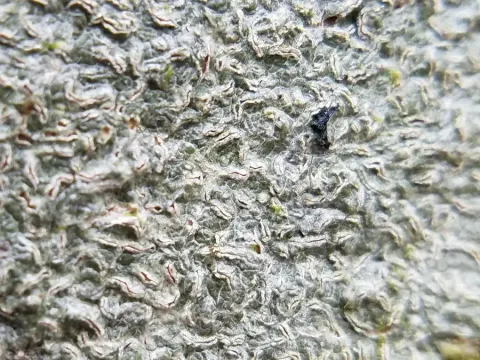
The thallus forms a crust on bark and is typically 0.5–1 cm across and about 30–60 μm thick. It forms a continuous crust with a smooth to slightly uneven, pale greenish-white surface. The (the photosynthetic partner) is a alga (Trentepohlia-type). In cross-section, the thallus has an upper made of tissue, and an irregular with clusters of crystals. The lirellae are straight to curved and may be unbranched or irregularly branched. They are (breaking through the thallus surface) and fissurine, with a thick, complete . Individual lirellae are very small (about 0.3–0.5 mm long and about 0.1 mm wide and high). The is concealed, and the are inconspicuous to slightly swollen, appearing brown along the slit. Microscopically, the asci usually contain eight ellipsoid ascospores. The spores are 3-septate (divided by three internal walls), about 13–18 × 7–9 μm, and non-amyloid (I–). They were described as having "" to thin septa and . Chemical screening (thin-layer chromatography) did not detect any lichen substances. Fissurina analphabetica belongs to a group of Fissurina species with 3-septate, non-amyloid ascospores and no detectable lichen substances, but it is set apart by its exceptionally small, delicate lirellae. It was contrasted with F. tachygrapha, which has similarly delicate lirellae but a thallus that is endoperidermal and (lacking a cortex) and may have more rounded spore lumina and sometimes weak amyloidity. It was also contrasted with F. illiterata, which is often more and may have more rounded spore ; weak amyloidity has also been reported. Thickened (sterile filaments among the asci) were reported in F. illiterata but not in F. analphabetica.
Habitat dan peran ekologis
Fissurina analphabetica is known from multiple collections in Florida, including Fakahatchee Strand Preserve State Park (Collier County), and additional records elsewhere in the state. It grows on the bark of hardwoods. Florida records include Osceola National Forest (Baker County), Hillsborough River State Park (Hillsborough County), and sites in Polk County (including along county roads), in addition to the type locality at Fakahatchee.
- Habitat atau konteks temuan
- hutan
- Substrat
- Informasi belum tersedia pada sumber rilis ini.
- Peran atau konteks
- Pembentuk liken
Reproduksi
The lirellae are straight to curved and may be unbranched or irregularly branched. They are (breaking through the thallus surface) and fissurine, with a thick, complete . Individual lirellae are very small (about 0.3–0.5 mm long and about 0.1 mm wide and high). The is concealed, and the are inconspicuous to slightly swollen, appearing brown along the slit. Microscopically, the asci usually contain eight ellipsoid ascospores. The spores are 3-septate (divided by three internal walls), about 13–18 × 7–9 μm, and non-amyloid (I–). They were described as having "" to thin septa and . Chemical screening (thin-layer chromatography) did not detect any lichen substances. Fissurina analphabetica belongs to a group of Fissurina species with 3-septate, non-amyloid ascospores and no detectable lichen substances, but it is set apart by its exceptionally small, delicate lirellae.
Catatan identitas dan cakupan
- Nama diterima mengikuti Catalogue of Life Base2026-09-11; uraian mempertahankan konsep dan nama sumber aslinya.
- Original geographic, specimen and life-cycle scope retained; source import awaits individual editorial review.
- Impor dan terjemahan otomatis belum diperiksa editorial per profil. Struktur reproduktif yang disebutkan tidak membuktikan seluruh siklus hidup diketahui.
- Pengukuran pada uraian mengikuti spesimen, kultur, dan metode sumber; angka tidak diperluas ke semua populasi.
Catatan distribusi dalam narasi mengikuti sumbernya. Dokumentasi spesimen atau foto mengikuti catatan sumber. Bukti wilayah Indonesia dan penilaian konservasi tidak disimpulkan dari gambar.
Melihat dengan konteks
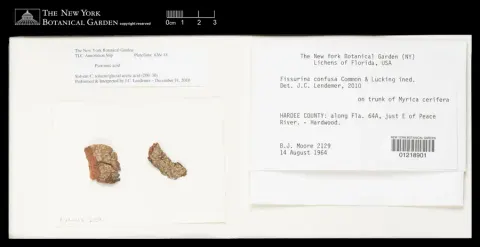
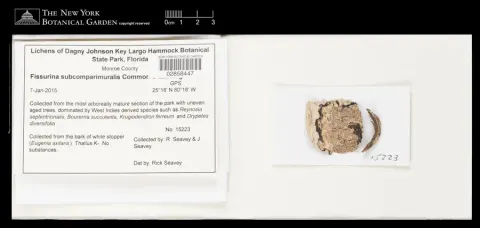
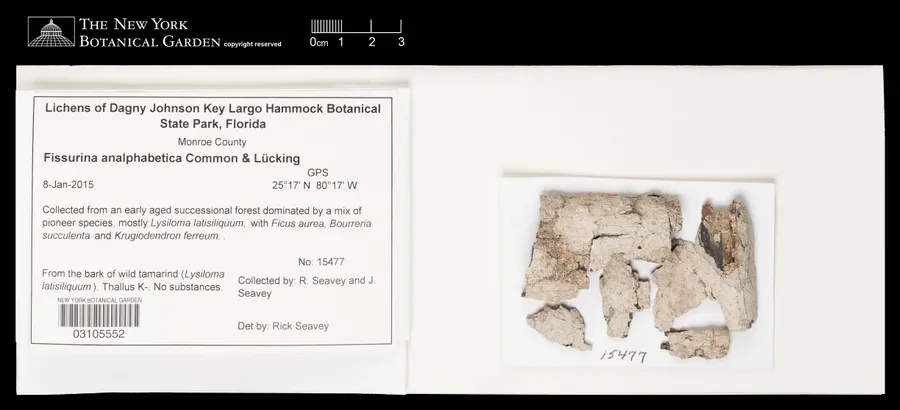
Voucher herbarium Fissurina analphabetica (03105552), The New York Botanical Garden. Identifikasi mengikuti record spesimen sumber. Foto bahan, kemasan, atau label herbarium sebagaimana tersedia pada record institusi; bukan foto lapangan atau penentuan spesimen independen.
- Jenis
- Voucher herbarium
- Kredit
- The New York Botanical Garden
- Lisensi
- CC BY 4.0
- Sumber media
- Buka entri sumber
Sumber profil
- [1] Fissurina analphabetica — Wikipedia (en)
- [2] Catalogue of Life Base2026-09-11 — Fissurina analphabetica
- [3] Dokumentasi visual — Fissurina analphabetica
Rujukan halaman ini
Fungi. Fissurina analphabetica. Rilis data fungi-2026-10-12-expansion-2. https://fungi-atlas.mgadib.chatgpt.site/jamur/fissurina-analphabetica/.
Status: impor sumber; pemeriksaan editorial per profil belum selesai. Untuk klaim biologis, gunakan rujukan pada bagian terkait dan periksa konteks sumber aslinya.