01 / Morfologi

Ciri dan struktur

The lichen forms a thin, bark-dwelling (corticolous) crust 1–2 cm across and 30–50 μm thick. Its surface is smooth and ranges from yellowish-brown to olive-brown. In cross-section the upper is built from tightly interwoven hyphae (a ), beneath which lies an irregular peppered with clusters of crystals. The reproductive structures are —elongate fissures 1–3 mm long and about 0.2 mm wide—that break through the thallus surface. They are straight to gently curved, unbranched or only sparsely forked, and retain a complete of thallus tissue. The concealed sits between grey-black to brown-black lips (), under an olive-brown rim. The —dark brown-black in color and 20–40 μm wide—is overlaid by the , crystal-bearing thallus. A narrow, colorless to pale yellow (5–10 μm high) supports a clear hymenium (the fertile, spore-bearing tissue) 70–90 μm tall, topped by a finely granular grey-brown . Slender, unbranched paraphyses thread the hymenium, while the ostiole is lined with short, spine-tipped . Each ascus (70–80 × 15–20 μm) holds eight colorless ascospores that are —divided by 5–7 transverse and 1–3 longitudinal walls into a grid of chambers—measure 15–25 × 6–8 μm, and lack the blue iodine staining reaction typical of some close relatives. No lichen substances were detected in F. subcomparimuralis by thin-layer chromatography.

Sebagian uraian ditampilkan dalam bahasa sumber; terjemahannya belum tersedia atau belum lolos pemeriksaan.

Rujukan: [1]

Pengukuran mengikuti objek, spesimen atau kultur, dan metode yang disebutkan sumber. Baca uraian asli untuk konteks lengkap.

02 / Kehidupan

Habitat dan peran ekologis

Fissurina subcomparimuralis was originally known to occur only in Fakahatchee Strand Preserve State Park in Collier County, Florida, where it was collected multiple times on the bark of hardwood trees. All preliminary records came from the seasonally humid, low-land forest of this Everglades fringe. In 2023, it was documented from Guangdong Province, China, near the grounds of the South China Botanical Garden. The Chinese collections were quite similar in morphology and chemistry to the Floridian population, except for having a sometimes gaping disc and shorter lirellae.

Sebagian uraian ditampilkan dalam bahasa sumber; terjemahannya belum tersedia atau belum lolos pemeriksaan.

Rujukan: [1]

Habitat atau konteks temuan
hutan
Substrat
Informasi belum tersedia pada sumber rilis ini.
Peran atau konteks
Pembentuk liken
Temukan hubungan serupa
03 / Siklus hidup

Reproduksi

The lichen forms a thin, bark-dwelling (corticolous) crust 1–2 cm across and 30–50 μm thick. Its surface is smooth and ranges from yellowish-brown to olive-brown. In cross-section the upper is built from tightly interwoven hyphae (a ), beneath which lies an irregular peppered with clusters of crystals. The reproductive structures are —elongate fissures 1–3 mm long and about 0.2 mm wide—that break through the thallus surface. They are straight to gently curved, unbranched or only sparsely forked, and retain a complete of thallus tissue. The concealed sits between grey-black to brown-black lips (), under an olive-brown rim. The —dark brown-black in color and 20–40 μm wide—is overlaid by the , crystal-bearing thallus.

Sebagian uraian ditampilkan dalam bahasa sumber; terjemahannya belum tersedia atau belum lolos pemeriksaan.

Rujukan: [1]

04 / Batas informasi

Catatan identitas dan cakupan

  • Nama diterima mengikuti Catalogue of Life Base2026-09-11; uraian mempertahankan konsep dan nama sumber aslinya.
  • Original geographic, specimen and life-cycle scope retained; source import awaits individual editorial review.
  • Impor dan terjemahan otomatis belum diperiksa editorial per profil. Struktur reproduktif yang disebutkan tidak membuktikan seluruh siklus hidup diketahui.
  • Pengukuran pada uraian mengikuti spesimen, kultur, dan metode sumber; angka tidak diperluas ke semua populasi.

Catatan distribusi dalam narasi mengikuti sumbernya. Dokumentasi spesimen atau foto mengikuti catatan sumber. Bukti wilayah Indonesia dan penilaian konservasi tidak disimpulkan dari gambar.

05 / Dokumentasi

Melihat dengan konteks

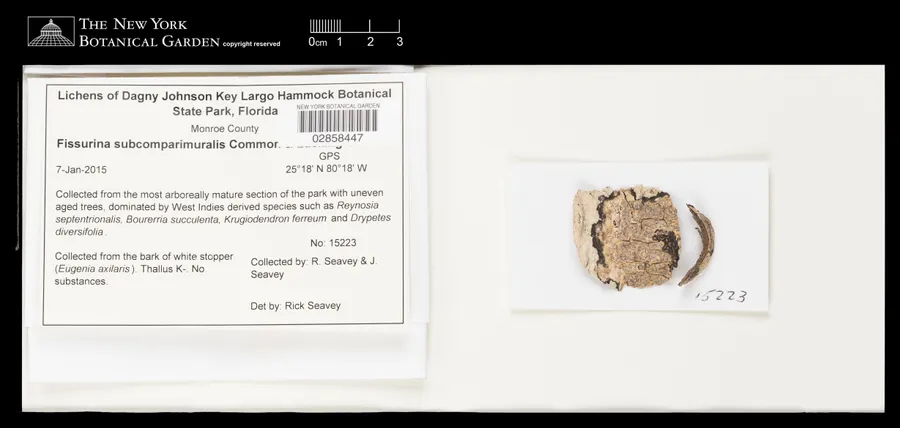
Voucher herbarium Fissurina subcomparimuralis (02858447), The New York Botanical Garden. Identifikasi mengikuti record spesimen sumber. Foto bahan, kemasan, atau label herbarium sebagaimana tersedia pada record institusi; bukan foto lapangan atau penentuan spesimen independen.

Jenis
Voucher herbarium
Kredit
The New York Botanical Garden
Lisensi
CC BY 4.0
Sumber media
Buka entri sumber

Gambar menunjukkan objek menurut identifikasi sumber, bukan verifikasi independen spesimen oleh Fungi. Tidak ada skala baru yang ditambahkan.

06 / Rujukan

Sumber profil

  1. [1] Fissurina subcomparimuralis — Wikipedia (en)Bagian sumber: Frozen revision 1330829981
    Tanggal penghimpunan sumber: 2026-10-12
    Teks sumber: CC BY-SA4.0 · Wikipedia contributors
  2. [2] Catalogue of Life Base2026-09-11 — Fissurina subcomparimuralisBagian sumber: ColDP NameUsage.tsv ID 6J7BP; accepted species; source 2073
    Tanggal penghimpunan sumber: 2026-10-12
  3. [3] Dokumentasi visual — Fissurina subcomparimuralisBagian sumber: Individual media record; identification follows the source, not independent determination
    Tanggal penghimpunan sumber: 2026-10-12
    Media sumber: CC BY 4.0 · The New York Botanical Garden

Adaptasi teks: CC BY-SA 4.0. Wikipedia contributors — Fissurina subcomparimuralis — Wikipedia (en)

Uraian asli dan riwayat sumber

Riwayat atau halaman sumber

Ringkasan sumber

Fissurina subcomparimuralis is a species of lichen-forming fungus in the family Graphidaceae. The species was formally described in 2014 after being distinguished from the closely related F. comparimuralis by differences in spore characteristics and microscopic structures. It forms thin, yellowish-brown to olive-brown crusts on tree bark with elongated fissures that break through the surface. Originally known only from Florida's Everglades region, it has since been found in China as well.

Revisi sumber

Morfologi sumber

The lichen forms a thin, bark-dwelling (corticolous) crust 1–2 cm across and 30–50 μm thick. Its surface is smooth and ranges from yellowish-brown to olive-brown. In cross-section the upper is built from tightly interwoven hyphae (a ), beneath which lies an irregular peppered with clusters of crystals. The reproductive structures are —elongate fissures 1–3 mm long and about 0.2 mm wide—that break through the thallus surface. They are straight to gently curved, unbranched or only sparsely forked, and retain a complete of thallus tissue. The concealed sits between grey-black to brown-black lips (), under an olive-brown rim. The —dark brown-black in color and 20–40 μm wide—is overlaid by the , crystal-bearing thallus. A narrow, colorless to pale yellow (5–10 μm high) supports a clear hymenium (the fertile, spore-bearing tissue) 70–90 μm tall, topped by a finely granular grey-brown . Slender, unbranched paraphyses thread the hymenium, while the ostiole is lined with short, spine-tipped . Each ascus (70–80 × 15–20 μm) holds eight colorless ascospores that are —divided by 5–7 transverse and 1–3 longitudinal walls into a grid of chambers—measure 15–25 × 6–8 μm, and lack the blue iodine staining reaction typical of some close relatives. No lichen substances were detected in F. subcomparimuralis by thin-layer chromatography.

Revisi sumber

Ekologi sumber

Fissurina subcomparimuralis was originally known to occur only in Fakahatchee Strand Preserve State Park in Collier County, Florida, where it was collected multiple times on the bark of hardwood trees. All preliminary records came from the seasonally humid, low-land forest of this Everglades fringe. In 2023, it was documented from Guangdong Province, China, near the grounds of the South China Botanical Garden. The Chinese collections were quite similar in morphology and chemistry to the Floridian population, except for having a sometimes gaping disc and shorter lirellae.

Revisi sumber

Struktur reproduksi sumber

The lichen forms a thin, bark-dwelling (corticolous) crust 1–2 cm across and 30–50 μm thick. Its surface is smooth and ranges from yellowish-brown to olive-brown. In cross-section the upper is built from tightly interwoven hyphae (a ), beneath which lies an irregular peppered with clusters of crystals. The reproductive structures are —elongate fissures 1–3 mm long and about 0.2 mm wide—that break through the thallus surface. They are straight to gently curved, unbranched or only sparsely forked, and retain a complete of thallus tissue. The concealed sits between grey-black to brown-black lips (), under an olive-brown rim. The —dark brown-black in color and 20–40 μm wide—is overlaid by the , crystal-bearing thallus.

Revisi sumber

Rujukan halaman ini

Fungi. Fissurina subcomparimuralis. Rilis data fungi-2026-10-12-expansion-2. https://fungi-atlas.mgadib.chatgpt.site/jamur/fissurina-subcomparimuralis/.

Status: impor sumber; pemeriksaan editorial per profil belum selesai. Untuk klaim biologis, gunakan rujukan pada bagian terkait dan periksa konteks sumber aslinya.