Ciri dan struktur
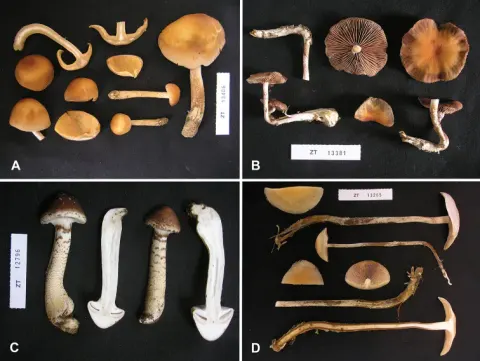
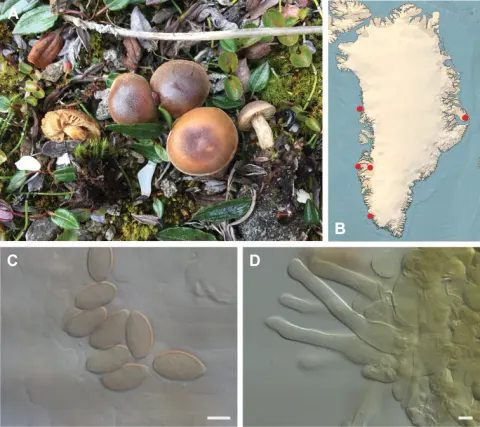
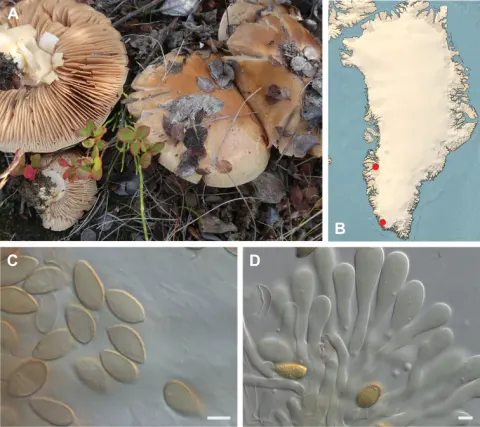
Cap 1.0–4.0 cm in diameter, shallowly convex, campanulate, then almost applanate, broadly umbonate or not, viscid or greasy, with hygrophanous spots, cinnamon to orange-brown or dark brick in center and pale brown on most of the cap, almost unicolored, with or without velar remnants at margin, or with whitish rim, margin originally described as extending beyond the lamellae, thin-fleshed, universal veil sometimes visible on margin edge, partial veil present. Lamellae sinuate, subdecurrent, narrow, becoming broader and eroded, 3.5–5.5 mm broad, without droplets, very pale, cream with pinkish buff tint, number of lamellae {L} 36–48. Stem 1.5–5.0 × 0.2–0.4 cm, equal, slightly curved, pale cream, silky, pruinose above ring zone, dingier to dark brown below, but still pale with golden brown fibrils in zones, blackening towards base, tough, rubbery. Context whitish in cap and stem apex and yellowish brown in lower stem down to blackish at base. Smell raphanoid, rarely odorless. Spore deposit brownish olive. Spores ellipsoid, a few slightly ovoid, not papillate, 8.5–10.5 × 5–6 µm, ave. Q 1.5–2.0, very weakly ornamented (O1 O2), perispore not noticeably loosening (P0), indistinctly dextrinoid (D0 D1), pale yellow, rarely yellow brown, ± guttulate. Basidia 20–33 × 6–8 µm, ave. Q = 3.2–4, clavate, mostly four-spored. Cheilocystidia usually lageniform or ventricose, sometimes cylindrical, occasionally geniculate or septate, subcapitate, on ave. 30–55 × 4–6 (apex) × 4–5 (middle) × 7–9 (base) µm, ratios A/M = 0.96–1.23, A/B = 0.60–0.71, B/M = 1.60–1.82. Epicutis an ixocutis, up to 90 µm thick (measured from exsiccata), ixocutis maximum hyphae width up to 6 µm, hyphae rarely encrusted, shape of trama elements beneath subcutis ellipsoid.
Habitat dan peran ekologis
Known from three localities in southwestern Greenland. Originally described from New York State under Pinus and widespread across North America (Cripps et al. 2019). Similar to H. mesophaeum and therefore likely to be confused and overlooked. Cripps et al. also describe recent records from alpine Rocky Mountains in Colorado and Montana. Three collections, two of them with Salix glauca. In the Rocky Mountains, S. planifolia was the dominant host (Cripps et al. 2019). Two of the localities are on acid soil.
- Habitat atau konteks temuan
- Informasi belum tersedia pada sumber rilis ini.
- Substrat
- Informasi belum tersedia pada sumber rilis ini.
- Peran atau konteks
- Belum dikategorikan pada rilis ini.
Reproduksi
Cap 1.0–4.0 cm in diameter, shallowly convex, campanulate, then almost applanate, broadly umbonate or not, viscid or greasy, with hygrophanous spots, cinnamon to orange-brown or dark brick in center and pale brown on most of the cap, almost unicolored, with or without velar remnants at margin, or with whitish rim, margin originally described as extending beyond the lamellae, thin-fleshed, universal veil sometimes visible on margin edge, partial veil present. Lamellae sinuate, subdecurrent, narrow, becoming broader and eroded, 3.5–5.5 mm broad, without droplets, very pale, cream with pinkish buff tint, number of lamellae {L} 36–48. Stem 1.5–5.0 × 0.2–0.4 cm, equal, slightly curved, pale cream, silky, pruinose above ring zone, dingier to dark brown below, but still pale with golden brown fibrils in zones, blackening towards base, tough, rubbery.
Catatan identitas dan cakupan
- Nama diterima mengikuti Catalogue of Life Base2026-09-11; uraian mempertahankan konsep dan nama sumber aslinya.
- Preserve original treatment localities, hosts and substrate scope. Materials examined describe documented specimens, not the full global range.
- Impor dan terjemahan otomatis belum diperiksa editorial per profil. Struktur reproduktif yang disebutkan tidak membuktikan seluruh siklus hidup diketahui.
- Pengukuran pada uraian mengikuti spesimen, kultur, dan metode sumber; angka tidak diperluas ke semua populasi.
Catatan distribusi dalam narasi mengikuti sumbernya. Dokumentasi spesimen atau foto mengikuti catatan sumber. Bukti wilayah Indonesia dan penilaian konservasi tidak disimpulkan dari gambar.
Melihat dengan konteks
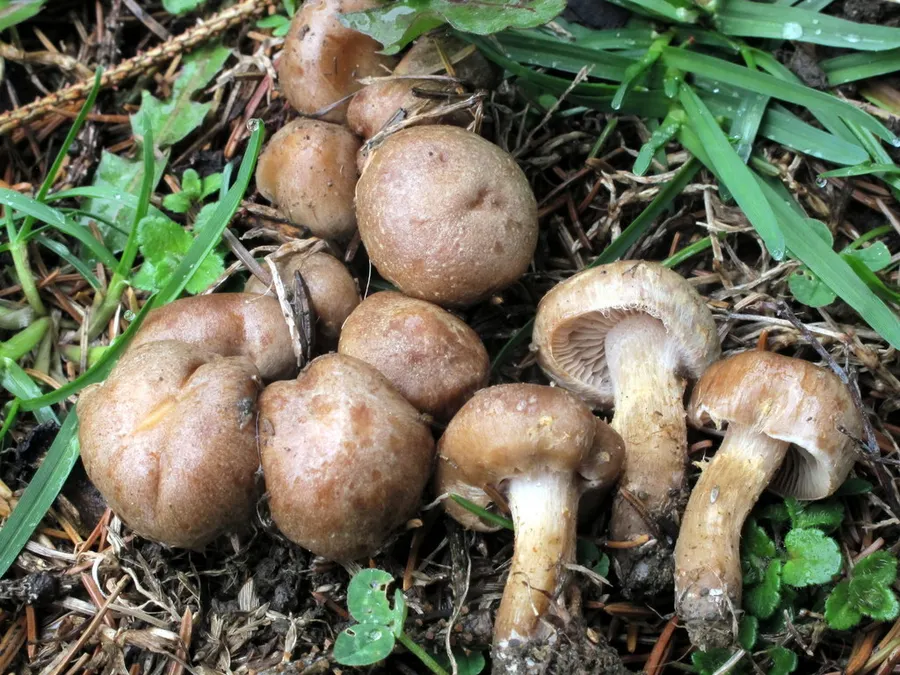
Dokumentasi Hebeloma excedens menurut asosiasi foto pada record takson iNaturalist. Kredit: mycowalt. Identitas mengikuti sumber; bukan penentuan spesimen independen.
- Jenis
- Fotografi
- Kredit
- (c) mycowalt, some rights reserved (CC BY-SA), uploaded by mycowalt
- Lisensi
- CC BY-SA 4.0
- Sumber media
- Buka entri sumber
Dokumentasi tambahan
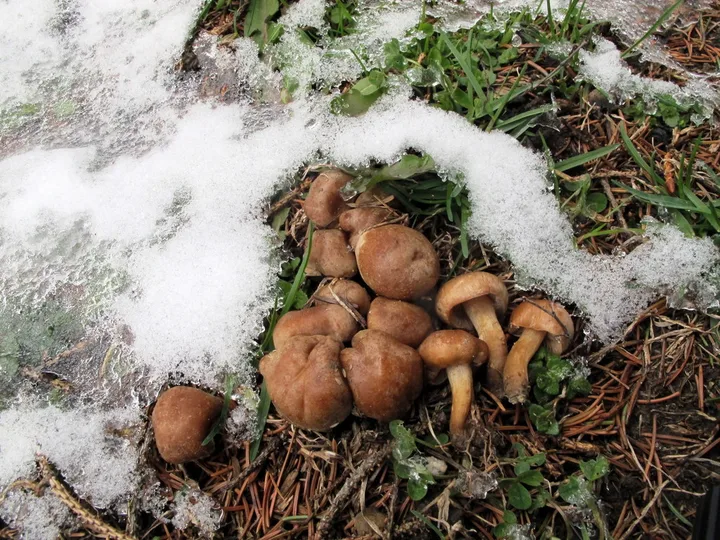
Foto yang diasosiasikan dengan Hebeloma excedens pada iNaturalist. Identifikasi mengikuti sumber; bukan penentuan spesimen independen.
Kredit dan penggunaan
(c) mycowalt, some rights reserved (CC BY-SA), uploaded by mycowalt
Ukuran dan format gambar disesuaikan tanpa pemotongan, retus, atau penambahan skala. Lisensi sumber dipertahankan.
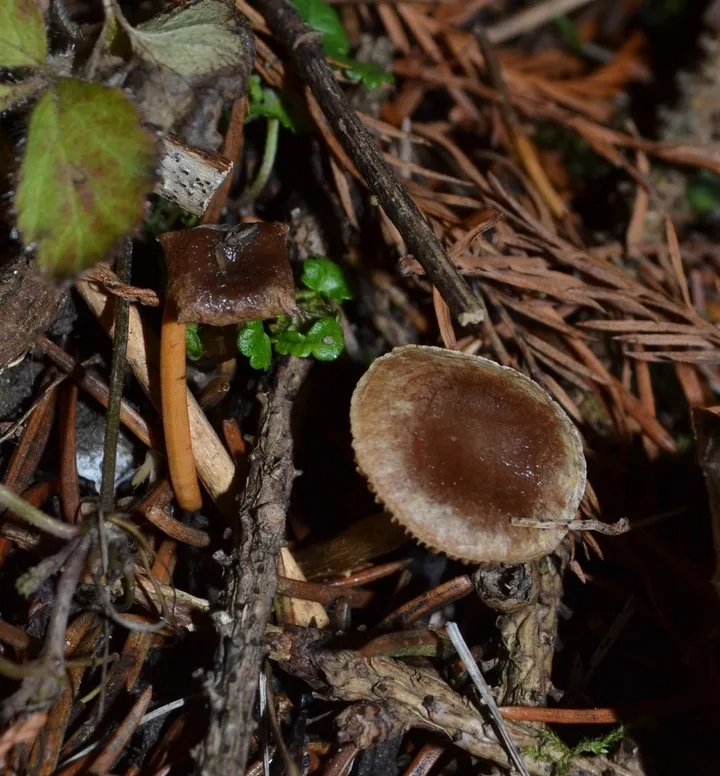
Foto yang diasosiasikan dengan Hebeloma excedens pada iNaturalist. Identifikasi mengikuti sumber; bukan penentuan spesimen independen.
Kredit dan penggunaan
(c) Django Grootmyers, some rights reserved (CC BY-SA), uploaded by Django Grootmyers
Ukuran dan format gambar disesuaikan tanpa pemotongan, retus, atau penambahan skala. Lisensi sumber dipertahankan.
Sumber profil
- [1] A survey of Hebeloma (Hymenogastraceae) in Greenland — Hebeloma excedens
- [2] Catalogue of Life Base2026-09-11 — Hebeloma excedens
- [3] Dokumentasi visual — Hebeloma excedens
- [4] Dokumentasi visual — Hebeloma excedens
- [5] Dokumentasi visual — Hebeloma excedens
Rujukan halaman ini
Fungi. Hebeloma excedens. Rilis data fungi-2026-10-12-expansion-2. https://fungi-atlas.mgadib.chatgpt.site/jamur/hebeloma-excedens/.
Status: impor sumber; pemeriksaan editorial per profil belum selesai. Untuk klaim biologis, gunakan rujukan pada bagian terkait dan periksa konteks sumber aslinya.