01 / Morfologi

Ciri dan struktur

Cap 0.7–2.2 cm in diameter, convex to broadly umbonate, margin smooth to crenulate, tacky when moist, not hygrophanous, uniformly colored or indistinctly bicolored, at center clay-buff to dark olive buff, margin very thin, grayish pink or central color extending to margin, with no traces of veil. Lamellae initially pale, later sordid clay-brown, emarginate, maximum depth 2 mm, number of lamellae {L} 28–40, droplets often absent but occasionally visible even with the naked eye, white fimbriate edge present. Stem 0.8–2.5 × 0.2–0.3 {median} × 0.1–0.3 {base} cm, initially pale, later sordid brownish, cylindrical to clavate, occasionally tapering, stem Q (4–)4.6–7.6(–9.2), pruinose to slightly fibrillose. Context firm, interior stuffed, flesh discoloring weakly from base. Smell absent or raphanoid. Taste not recorded. Spore deposit grayish brown. Spores amygdaloid, limoniform, weakly to strongly papillate, on ave. 12.0–13.0 × 7.0–7.5 µm, ave. Q = 1.6–1.8, yellow brown to brown, guttulate, almost smooth to weakly ornamented (O1 O2), perispore not loosening (P0), indextrinoid to indistinctly dextrinoid (D0 D1 (D2)). Basidia 24–56 × 6–12 µm, ave. Q = 3.2–4.6, mostly four-spored. Cheilocystidia clavate-stipitate, occasionally spathulate-stipitate or capitate-stipitate or clavate-lageniform, occasionally with characteristic apical wall thickening, occasionally bifurcate, septate or sinuate, on ave. 42–59 × 6–11 (apex) × 4.0–5.5 (middle) × 3.5–6.0 (base) µm, ratios A/M = 1.48–2.51, A/B = 1.99–2.92, B/M = 0.81–1.24. Epicutis an ixocutis, up to 100 µm thick (measured from exsiccata), maximum hyphae width 6 µm, sometimes encrusted, trama elements beneath subcutis cylindrical, sausage-shaped.

Sebagian uraian ditampilkan dalam bahasa sumber; terjemahannya belum tersedia atau belum lolos pemeriksaan.

Rujukan: [1]

Pengukuran mengikuti objek, spesimen atau kultur, dan metode yang disebutkan sumber. Baca uraian asli untuk konteks lengkap.

02 / Kehidupan

Habitat dan peran ekologis

Recently described from Svalbard (Beker et al. 2016). The five Greenland collections all occurred north of 67°N and thus provide evidence that H. louiseae is a species of the High Arctic zone. It has not yet been recorded in alpine regions. The Greenland collections are the first from North America and the first outside Europe. Five collections, with Salix glauca and S. arctica in calcareous soil and seemingly moist localities. From Svalbard it was recorded with S. polaris (Beker et al. 2016).

Sebagian uraian ditampilkan dalam bahasa sumber; terjemahannya belum tersedia atau belum lolos pemeriksaan.

Rujukan: [1]

Habitat atau konteks temuan
Informasi belum tersedia pada sumber rilis ini.
Substrat
Informasi belum tersedia pada sumber rilis ini.
Peran atau konteks
Belum dikategorikan pada rilis ini.
Temukan hubungan serupa
03 / Siklus hidup

Reproduksi

Cap 0.7–2.2 cm in diameter, convex to broadly umbonate, margin smooth to crenulate, tacky when moist, not hygrophanous, uniformly colored or indistinctly bicolored, at center clay-buff to dark olive buff, margin very thin, grayish pink or central color extending to margin, with no traces of veil. Lamellae initially pale, later sordid clay-brown, emarginate, maximum depth 2 mm, number of lamellae {L} 28–40, droplets often absent but occasionally visible even with the naked eye, white fimbriate edge present. Stem 0.8–2.5 × 0.2–0.3 {median} × 0.1–0.3 {base} cm, initially pale, later sordid brownish, cylindrical to clavate, occasionally tapering, stem Q (4–)4.6–7.6(–9.2), pruinose to slightly fibrillose.

Sebagian uraian ditampilkan dalam bahasa sumber; terjemahannya belum tersedia atau belum lolos pemeriksaan.

Rujukan: [1]

04 / Batas informasi

Catatan identitas dan cakupan

  • Nama diterima mengikuti Catalogue of Life Base2026-09-11; uraian mempertahankan konsep dan nama sumber aslinya.
  • Preserve original treatment localities, hosts and substrate scope. Materials examined describe documented specimens, not the full global range.
  • Impor dan terjemahan otomatis belum diperiksa editorial per profil. Struktur reproduktif yang disebutkan tidak membuktikan seluruh siklus hidup diketahui.
  • Pengukuran pada uraian mengikuti spesimen, kultur, dan metode sumber; angka tidak diperluas ke semua populasi.

Catatan distribusi dalam narasi mengikuti sumbernya. Dokumentasi spesimen atau foto mengikuti catatan sumber. Bukti wilayah Indonesia dan penilaian konservasi tidak disimpulkan dari gambar.

05 / Dokumentasi

Melihat dengan konteks

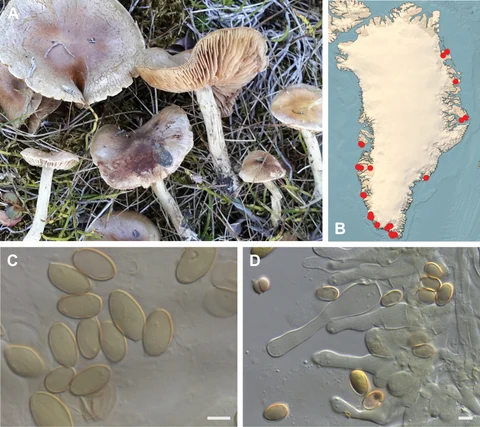
Hebeloma louiseae A SAE-2017.125, photograph S.A. Elborne B distribution of cited collections C spores ×1600 and D cheilocystidia ×1000 of HK17.128A.146 in Melzer’s reagent. Scale bars: 5 µm; microphotographs H.K.J. Beker.

Jenis
Pelat ilmiah
Kredit
Ursula Eberhardt, Henry J. Beker, Torbjørn Borgen, Henning Knudsen, Nicole Schütz, Steen A. Elborne
Lisensi
CC BY 4.0
Sumber media
Buka entri sumber

Gambar menunjukkan objek menurut identifikasi sumber, bukan verifikasi independen spesimen oleh Fungi. Tidak ada skala baru yang ditambahkan.

06 / Rujukan

Sumber profil

  1. [1] A survey of Hebeloma (Hymenogastraceae) in Greenland — Hebeloma louiseaeBagian sumber: PMC8076164_section_148
    Tanggal penghimpunan sumber: 2026-10-12
    Teks sumber: CC BY 4.0 · Eberhardt U, Beker HJ, Borgen T, Knudsen H, Schütz N, Elborne SA.
  2. [2] Catalogue of Life Base2026-09-11 — Hebeloma louiseaeBagian sumber: ColDP NameUsage.tsv ID 3JXRB; accepted species; source 2073
    Tanggal penghimpunan sumber: 2026-10-12
  3. [3] Dokumentasi visual — Hebeloma louiseaeBagian sumber: Individual media record; identification follows the source, not independent determination
    Tanggal penghimpunan sumber: 2026-10-12
    Media sumber: CC BY 4.0 · Ursula Eberhardt, Henry J. Beker, Torbjørn Borgen, Henning Knudsen, Nicole Schütz, Steen A. Elborne

Adaptasi teks: CC BY 4.0. Eberhardt U, Beker HJ, Borgen T, Knudsen H, Schütz N, Elborne SA. — A survey of Hebeloma (Hymenogastraceae) in Greenland — Hebeloma louiseae

Uraian asli dan riwayat sumber

Riwayat atau halaman sumber

Ringkasan sumber

Cap 0.7–2.2 cm in diameter, convex to broadly umbonate, margin smooth to crenulate, tacky when moist, not hygrophanous, uniformly colored or indistinctly bicolored, at center clay-buff to dark olive buff, margin very thin, grayish pink or central color extending to margin, with no traces of veil. Lamellae initially pale, later sordid clay-brown, emarginate, maximum depth 2 mm, number of lamellae {L} 28–40, droplets often absent but occasionally visible even with the naked eye, white fimbriate edge present.

Revisi sumber

Morfologi sumber

Cap 0.7–2.2 cm in diameter, convex to broadly umbonate, margin smooth to crenulate, tacky when moist, not hygrophanous, uniformly colored or indistinctly bicolored, at center clay-buff to dark olive buff, margin very thin, grayish pink or central color extending to margin, with no traces of veil. Lamellae initially pale, later sordid clay-brown, emarginate, maximum depth 2 mm, number of lamellae {L} 28–40, droplets often absent but occasionally visible even with the naked eye, white fimbriate edge present. Stem 0.8–2.5 × 0.2–0.3 {median} × 0.1–0.3 {base} cm, initially pale, later sordid brownish, cylindrical to clavate, occasionally tapering, stem Q (4–)4.6–7.6(–9.2), pruinose to slightly fibrillose. Context firm, interior stuffed, flesh discoloring weakly from base. Smell absent or raphanoid. Taste not recorded. Spore deposit grayish brown. Spores amygdaloid, limoniform, weakly to strongly papillate, on ave. 12.0–13.0 × 7.0–7.5 µm, ave. Q = 1.6–1.8, yellow brown to brown, guttulate, almost smooth to weakly ornamented (O1 O2), perispore not loosening (P0), indextrinoid to indistinctly dextrinoid (D0 D1 (D2)). Basidia 24–56 × 6–12 µm, ave. Q = 3.2–4.6, mostly four-spored. Cheilocystidia clavate-stipitate, occasionally spathulate-stipitate or capitate-stipitate or clavate-lageniform, occasionally with characteristic apical wall thickening, occasionally bifurcate, septate or sinuate, on ave. 42–59 × 6–11 (apex) × 4.0–5.5 (middle) × 3.5–6.0 (base) µm, ratios A/M = 1.48–2.51, A/B = 1.99–2.92, B/M = 0.81–1.24. Epicutis an ixocutis, up to 100 µm thick (measured from exsiccata), maximum hyphae width 6 µm, sometimes encrusted, trama elements beneath subcutis cylindrical, sausage-shaped.

Revisi sumber

Ekologi sumber

Recently described from Svalbard (Beker et al. 2016). The five Greenland collections all occurred north of 67°N and thus provide evidence that H. louiseae is a species of the High Arctic zone. It has not yet been recorded in alpine regions. The Greenland collections are the first from North America and the first outside Europe. Five collections, with Salix glauca and S. arctica in calcareous soil and seemingly moist localities. From Svalbard it was recorded with S. polaris (Beker et al. 2016).

Revisi sumber

Struktur reproduksi sumber

Cap 0.7–2.2 cm in diameter, convex to broadly umbonate, margin smooth to crenulate, tacky when moist, not hygrophanous, uniformly colored or indistinctly bicolored, at center clay-buff to dark olive buff, margin very thin, grayish pink or central color extending to margin, with no traces of veil. Lamellae initially pale, later sordid clay-brown, emarginate, maximum depth 2 mm, number of lamellae {L} 28–40, droplets often absent but occasionally visible even with the naked eye, white fimbriate edge present. Stem 0.8–2.5 × 0.2–0.3 {median} × 0.1–0.3 {base} cm, initially pale, later sordid brownish, cylindrical to clavate, occasionally tapering, stem Q (4–)4.6–7.6(–9.2), pruinose to slightly fibrillose.

Revisi sumber

Rujukan halaman ini

Fungi. Hebeloma louiseae. Rilis data fungi-2026-10-12-expansion-2. https://fungi-atlas.mgadib.chatgpt.site/jamur/hebeloma-louiseae/.

Status: impor sumber; pemeriksaan editorial per profil belum selesai. Untuk klaim biologis, gunakan rujukan pada bagian terkait dan periksa konteks sumber aslinya.