Ciri dan struktur
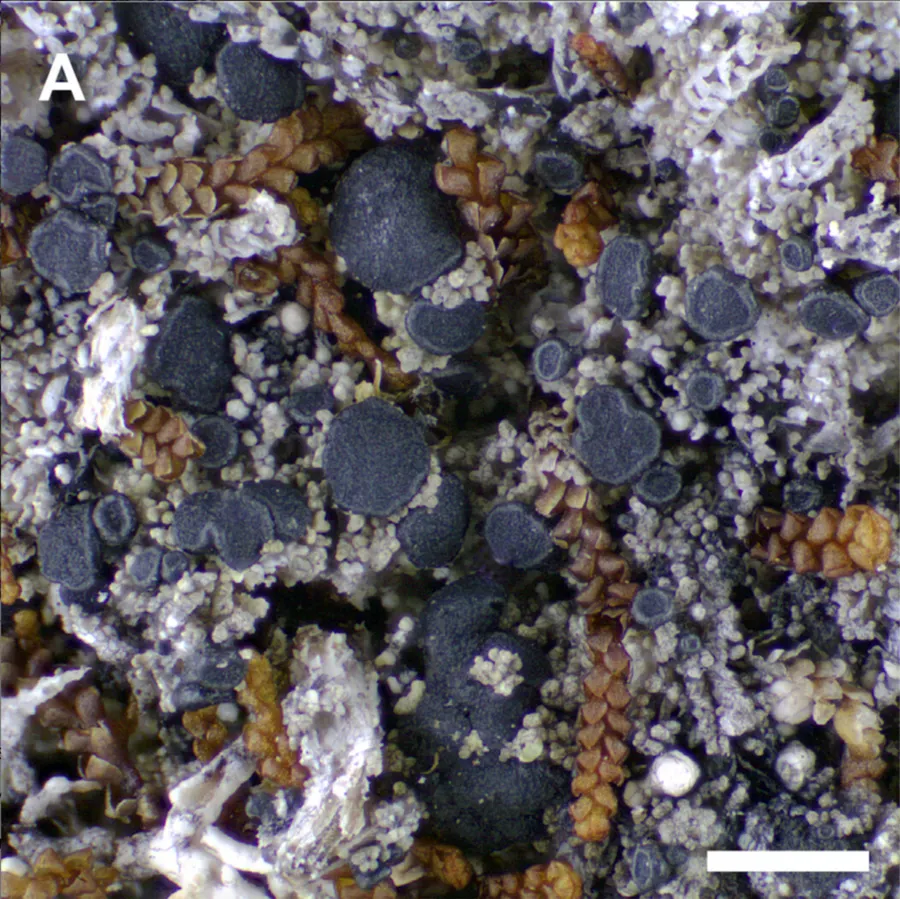
The thallus is crustose and spreading (), thin, and whitish, with scattered minute, wart-like granules. A distinct is present, whitish but sometimes with a pinkish tinge, and described as having a varnished (sometimes slightly gelatinous) look. The apothecia (fruiting bodies) are black and solid, typically raised on a more-or-less thick stalk that may be straight or curved. Some apothecia can appear stalkless when the stalk is curved, immersed in the moss, and hidden. The is initially urn-shaped and then flattening, finally becoming convex to almost hemispherical, very black, opaque, and bare. The margin is (blackened), at first thicker and raised, later thinning and eventually rolling back. Older apothecia may become misshapen and tuberculate. The asci are club-shaped ( and typically contain eight simple, hyaline ascospores, usually about 13–18 μm long and about 4 μm wide; smaller spores (about 8–10 μm by about 3 μm) were also reported. A modern summary characterises the apothecia as black, typically 0.2–0.6 mm across, and distinctly marginate and often shortly stalked when young, with a well-developed exciple. Pycnidia are reported to be rare and (about 0.065–0.15 mm across), producing microconidia about 6–9 × 1–1.5 μm; no secondary lichen products have been detected.
Habitat dan peran ekologis
Helocarpon crassipes is an arctic-alpine lichen that typically grows over bryophytes (including mosses). It is reported from Europe and North America. In Switzerland, H. crassipes is rare and is documented from the canton of Graubünden. It grows over mosses in cold, exposed habitats, including on wind-swept summit rocks, and it can also occur on the ground where mosses or plant debris provide a stable surface. Swiss records include a collection on humus in a subalpine spruce (Picea) forest at the Albulapass, and a later record from the Val Poschiavo area of the southern Swiss Alps at about 2,000 m, in larch and Swiss stone pine woodland. In the Swiss Lichen Red List work, the species was evaluated using IUCN criteria and placed in the category Least Concern (LC); the authors considered that its rarity in collections does not, by itself, indicate an immediate conservation risk. In the same review, it was treated as threatened in Great Britain and Slovakia, and reported as absent from Germany, Italy, the Netherlands, Finland and Sweden.
- Habitat atau konteks temuan
- hutan
- Substrat
- tanah
- Peran atau konteks
- Pembentuk liken
Reproduksi
The thallus is crustose and spreading (), thin, and whitish, with scattered minute, wart-like granules. A distinct is present, whitish but sometimes with a pinkish tinge, and described as having a varnished (sometimes slightly gelatinous) look. The apothecia (fruiting bodies) are black and solid, typically raised on a more-or-less thick stalk that may be straight or curved. Some apothecia can appear stalkless when the stalk is curved, immersed in the moss, and hidden. The is initially urn-shaped and then flattening, finally becoming convex to almost hemispherical, very black, opaque, and bare. The margin is (blackened), at first thicker and raised, later thinning and eventually rolling back.
Catatan identitas dan cakupan
- Nama diterima mengikuti Catalogue of Life Base2026-09-11; uraian mempertahankan konsep dan nama sumber aslinya.
- Original geographic, specimen and life-cycle scope retained; source import awaits individual editorial review.
- Impor dan terjemahan otomatis belum diperiksa editorial per profil. Struktur reproduktif yang disebutkan tidak membuktikan seluruh siklus hidup diketahui.
- Pengukuran pada uraian mengikuti spesimen, kultur, dan metode sumber; angka tidak diperluas ke semua populasi.
Catatan distribusi dalam narasi mengikuti sumbernya. Dokumentasi spesimen atau foto mengikuti catatan sumber. Bukti wilayah Indonesia dan penilaian konservasi tidak disimpulkan dari gambar.
Melihat dengan konteks
Dokumentasi Helocarpon crassipes dari Wikimedia Commons. Closeup of the crustose lichen Helocarpon crassipes showing its black, marginate apothecia (fruiting bodies); scale: 1 mm Identifikasi mengikuti record berkas sumber.
- Jenis
- Fotografi
- Kredit
- Martin Westberg
- Lisensi
- CC BY 4.0
- Sumber media
- Buka entri sumber
Sumber profil
- [1] Helocarpon crassipes — Wikipedia (en)
- [2] Catalogue of Life Base2026-09-11 — Helocarpon crassipes
- [3] Dokumentasi visual — Helocarpon crassipes
Rujukan halaman ini
Fungi. Helocarpon crassipes. Rilis data fungi-2026-10-12-expansion-2. https://fungi-atlas.mgadib.chatgpt.site/jamur/helocarpon-crassipes/.
Status: impor sumber; pemeriksaan editorial per profil belum selesai. Untuk klaim biologis, gunakan rujukan pada bagian terkait dan periksa konteks sumber aslinya.