Ciri dan struktur
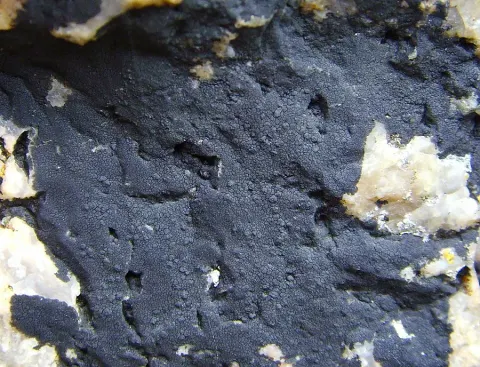
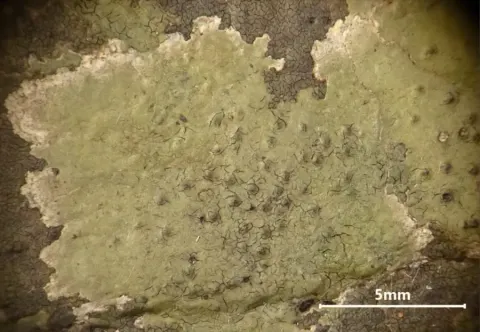
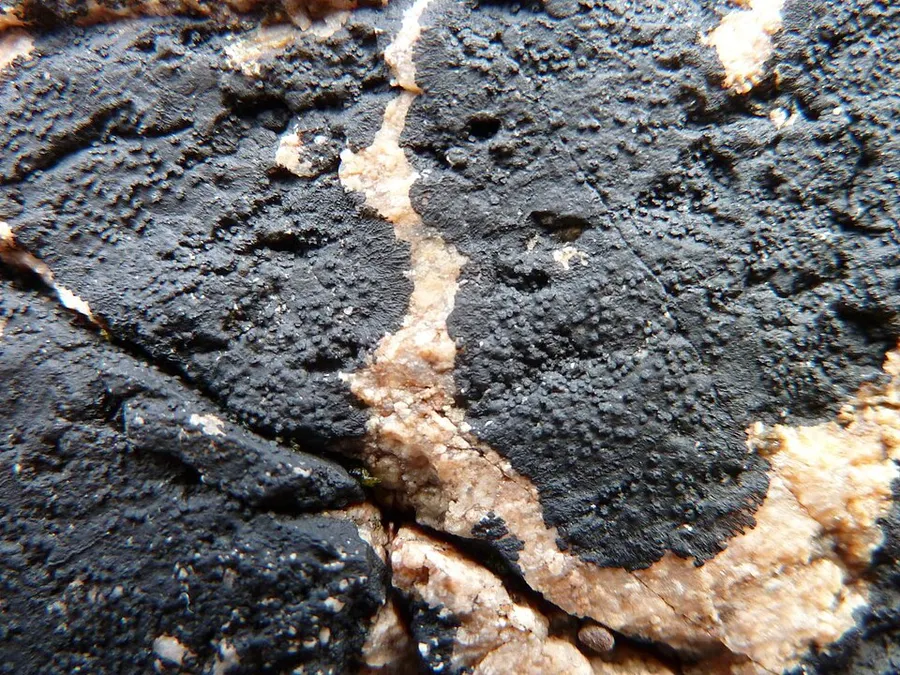
The crustose lichen Hydropunctaria amphibia is characterised by a prothallus that is typically inconspicuous, but in some specific, small areas, it can become visible as a whitish layer. The thallus, which is on the surface of the rock, presents a translucent green to amber colouration when wet, and black when dry. It has an abundantly cracked surface that often separates into discrete (small, distinct patches), making the surface appear uneven with numerous blackish ridges. The actively growing edge of the thallus is clearly defined, with ridges measuring between 40 and 400 micrometres (μm) in length and 40 to 50 μm in width, generally aligned perpendicular to the margin. Within the interior of the thallus, these ridges are shorter, often branched, and do not follow a uniform direction. The , a layer beneath the surface of the thallus, contains brown pigment, contributing to the lichen's dark appearance. , the reproductive structures of the lichen, project from the thallus surface. They typically measure 220 to 360 μm in diameter, and often have a distinct flat top. The sides may be uneven or have protrusions (bosses). The ostiole, or opening, of the perithecia may be visible as a small pit. The , another structural component of the perithecia, is well-developed, providing additional protection to the spore-producing parts. The , which are the reproductive cells produced within the perithecia, are narrowly cylindrical to ellipsoidal in shape, measuring between 13 and 19.5 μm in length and 5 to 7.5 μm in width, with a length to width ratio ranging from 2.1 to 3.5, indicating their elongated form.
Habitat dan peran ekologis
Hydropunctaria amphibia is one of several marine lichens in the genus Hydropunctaria. It grows on seashore rocks, both siliceous and limestone. Rarely, it has been recorded growing on concrete. It usually grows in the supralittoral zone, the area above the spring high tide line that is regularly but infrequently splashed. It typically gets exposure to direct sunlight in these locations. It is one of few species able to survive under these conditions, due to its extreme resistance to desiccation. Other organisms commonly found in this habitat include the barnacle species Microeuraphia depressa, and the sea snail species Melarhaphe neritoides and Echinolittorina punctata. Hydropunctaria amphibia grows in the belt underneath its close relative H. maura. The lichen is widely distributed in Europe, from Norway south to the Mediterranean and also on the Iberian coasts. Detailed cartography of the littoral habitats found along the Catalan coast of Spain show its almost ubiquitous presence there. In North America, Hydropunctaria amphibia has been documented from the Atlantic Coast, including the littoral zone of Nova Scotia's Bay of Fundy coast, the coast of Newfoundland and Labrador, and the Boston Harbor Islands National Recreation Area.
- Habitat atau konteks temuan
- Informasi belum tersedia pada sumber rilis ini.
- Substrat
- Informasi belum tersedia pada sumber rilis ini.
- Peran atau konteks
- Pembentuk liken
Reproduksi
The , a layer beneath the surface of the thallus, contains brown pigment, contributing to the lichen's dark appearance. , the reproductive structures of the lichen, project from the thallus surface. They typically measure 220 to 360 μm in diameter, and often have a distinct flat top. The sides may be uneven or have protrusions (bosses). The ostiole, or opening, of the perithecia may be visible as a small pit. The , another structural component of the perithecia, is well-developed, providing additional protection to the spore-producing parts. The , which are the reproductive cells produced within the perithecia, are narrowly cylindrical to ellipsoidal in shape, measuring between 13 and 19.5 μm in length and 5 to 7.5 μm in width, with a length to width ratio ranging from 2.1 to 3.5, indicating their elongated form.
Catatan identitas dan cakupan
- Nama diterima mengikuti Catalogue of Life Base2026-09-11; uraian mempertahankan konsep dan nama sumber aslinya.
- Original geographic, specimen and life-cycle scope retained; source import awaits individual editorial review.
- Impor dan terjemahan otomatis belum diperiksa editorial per profil. Struktur reproduktif yang disebutkan tidak membuktikan seluruh siklus hidup diketahui.
- Pengukuran pada uraian mengikuti spesimen, kultur, dan metode sumber; angka tidak diperluas ke semua populasi.
Catatan distribusi dalam narasi mengikuti sumbernya. Dokumentasi spesimen atau foto mengikuti catatan sumber. Bukti wilayah Indonesia dan penilaian konservasi tidak disimpulkan dari gambar.
Melihat dengan konteks
Dokumentasi Hydropunctaria amphibia dari Wikimedia Commons. Hydropunctaria amphibia (Beuzec-Cap-Sizun, Finistère, Bretagne, France) Identifikasi mengikuti record berkas sumber.
- Jenis
- Fotografi
- Kredit
- Jymm
- Lisensi
- CC BY-SA 4.0
- Sumber media
- Buka entri sumber
Sumber profil
- [1] Hydropunctaria amphibia — Wikipedia (en)
- [2] Catalogue of Life Base2026-09-11 — Hydropunctaria amphibia
- [3] Dokumentasi visual — Hydropunctaria amphibia
Rujukan halaman ini
Fungi. Hydropunctaria amphibia. Rilis data fungi-2026-10-12-expansion-2. https://fungi-atlas.mgadib.chatgpt.site/jamur/hydropunctaria-amphibia/.
Status: impor sumber; pemeriksaan editorial per profil belum selesai. Untuk klaim biologis, gunakan rujukan pada bagian terkait dan periksa konteks sumber aslinya.