01 / Morfologi

Ciri dan struktur

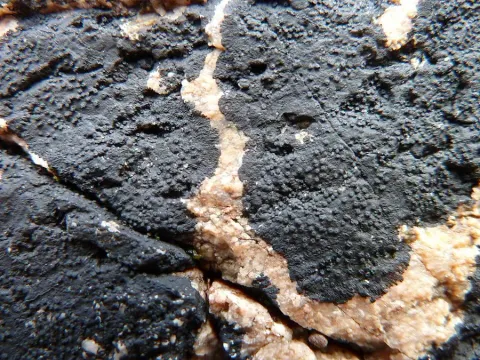
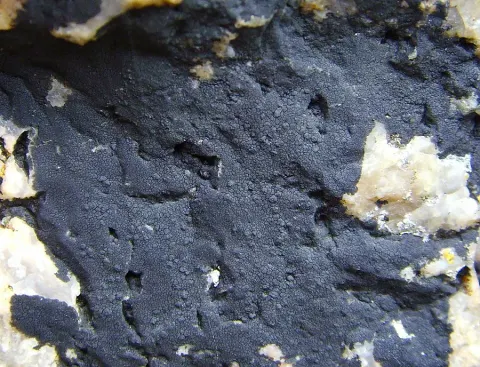
Hydropunctaria rheitrophila has a whitish (initial fungal growth area) that is non-fimbriate (lacking hair-like projections). When multiple thalli grow adjacent to one another, they are often separated by thin black lines. The thallus (main body of the lichen) is thin to thick, measuring 60–140 micrometre (μm) in thickness, and grows superficially on its substrate. It has a somewhat gelatinous texture and is well-developed, typically measuring 60–95 μm thick. The surface appears even, either smooth or roughened, and is usually uncracked, though sparse cracks may sometimes be present. The thallus colour ranges from pale brownish green to olive green or dark green, and is dotted with sparse to numerous black spots. The upper (outer protective layer) is (composed of closely packed fungal cells) but poorly defined, measuring about 20 μm in thickness. The cell walls contain dark pigmentation, ranging from yellowish brown to blackish brown in colour. The algal cells ( partner) measure 8–15 μm in diameter and are arranged in more or less vertical columns throughout the thallus. The medulla (inner layer) is also paraplectenchymatous and contains intensely pigmented patches that appear as discrete black (dots) or columns. A black basal layer is generally absent or present only in small areas of the thallus. The reproductive structures of H. rheitrophila are perithecia, which may be completely immersed and visible only as black points, or they may project from the surface, depending on the thickness of the thallus. The (protective covering of the perithecium) is highly variable, ranging from apical and little-developed to well-developed in the upper half of the , often spreading outwards and downwards.

Sebagian uraian ditampilkan dalam bahasa sumber; terjemahannya belum tersedia atau belum lolos pemeriksaan.

Rujukan: [1]

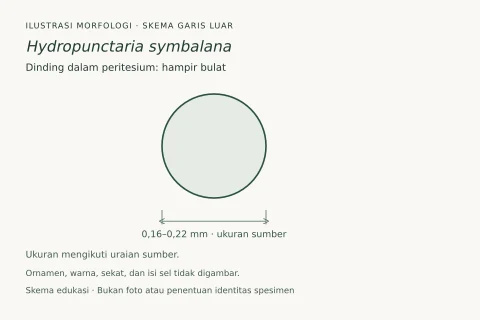
Pengukuran mengikuti objek, spesimen atau kultur, dan metode yang disebutkan sumber. Baca uraian asli untuk konteks lengkap.

02 / Kehidupan

Habitat dan peran ekologis

Hydropunctaria rheitrophila is predominantly found throughout the holarctic region, with its range extending across central and northern Eurasia, North America, Asia, and Australia. Despite its primarily Northern Hemisphere distribution, the species has also been documented in the Southern Hemisphere, specifically in New Zealand. The species has been documented throughout various regions of the Iberian Peninsula, including Catalonia in northeastern Spain. In the Pyrenees mountains, it has been found in submerged or periodically inundated environments, particularly in mountain streams at elevations ranging from 1400 to 2900 metres. This lichen species inhabits a specialized ecological niche, growing on submerged or frequently wetted siliceous rocks and pebbles within the lower splash zone of freshwater environments. This habitat preference reflects its adaptation to periodically inundated conditions, where it can colonisze hard silica-containing substrates that experience regular wetting.

Sebagian uraian ditampilkan dalam bahasa sumber; terjemahannya belum tersedia atau belum lolos pemeriksaan.

Rujukan: [1]

Habitat atau konteks temuan
Informasi belum tersedia pada sumber rilis ini.
Substrat
Informasi belum tersedia pada sumber rilis ini.
Peran atau konteks
Pembentuk liken
Temukan hubungan serupa
03 / Siklus hidup

Reproduksi

The reproductive structures of H. rheitrophila are perithecia, which may be completely immersed and visible only as black points, or they may project from the surface, depending on the thickness of the thallus. The (protective covering of the perithecium) is highly variable, ranging from apical and little-developed to well-developed in the upper half of the , often spreading outwards and downwards. The excipulum (inner wall of the perithecium) measures 90–210 μm in width and is either colourless or partly brown. The (sterile filaments lining the inner surface of the perithecium) measure 20–30 by 1.5–3 μm. (sexual spores) made by H. rheitrophila are , colourless, and ellipsoid in shape, measuring 10–15 by 4.5–7 μm.

Sebagian uraian ditampilkan dalam bahasa sumber; terjemahannya belum tersedia atau belum lolos pemeriksaan.

Rujukan: [1]

Sinonim menurut acuan taksonomi rilis: Verrucaria kernstockii; Verrucaria rheitrophila; Verrucula rheitrophila
04 / Batas informasi

Catatan identitas dan cakupan

  • Nama diterima mengikuti Catalogue of Life Base2026-09-11; uraian mempertahankan konsep dan nama sumber aslinya.
  • Original geographic, specimen and life-cycle scope retained; source import awaits individual editorial review.
  • Impor dan terjemahan otomatis belum diperiksa editorial per profil. Struktur reproduktif yang disebutkan tidak membuktikan seluruh siklus hidup diketahui.
  • Pengukuran pada uraian mengikuti spesimen, kultur, dan metode sumber; angka tidak diperluas ke semua populasi.

Catatan distribusi dalam narasi mengikuti sumbernya. Dokumentasi spesimen atau foto mengikuti catatan sumber. Bukti wilayah Indonesia dan penilaian konservasi tidak disimpulkan dari gambar.

05 / Dokumentasi

Melihat dengan konteks

Dokumentasi visual yang memenuhi pemeriksaan subjek dan hak penggunaan belum tersedia. Foto gejala, label, dan gambar yang meragukan tidak dihitung.

06 / Rujukan

Sumber profil

  1. [1] Hydropunctaria rheitrophila — Wikipedia (en)Bagian sumber: Frozen revision 1289281219
    Tanggal penghimpunan sumber: 2026-10-12
    Teks sumber: CC BY-SA4.0 · Wikipedia contributors
  2. [2] Catalogue of Life Base2026-09-11 — Hydropunctaria rheitrophilaBagian sumber: ColDP NameUsage.tsv ID 6MLB2; accepted species; source 2073
    Tanggal penghimpunan sumber: 2026-10-12

Adaptasi teks: CC BY-SA 4.0. Wikipedia contributors — Hydropunctaria rheitrophila — Wikipedia (en)

Uraian asli dan riwayat sumber

Riwayat atau halaman sumber

Ringkasan sumber

Hydropunctaria rheitrophila is a widely distributed species of crustose lichen in the family Verrucariaceae. It grows on rocks in aquatic environments, typically in streams and rivers where it colonizes silica-containing substrates that are regularly submerged or wetted. The lichen forms a thin to thick crust-like body (thallus) that ranges in colour from pale brownish green to dark green, often dotted with black spots. It is widely distributed throughout the Northern Hemisphere, particularly in Europe, North America, and Asia, with some occurrences in the Southern Hemisphere including New Zealand.

Revisi sumber

Morfologi sumber

Hydropunctaria rheitrophila has a whitish (initial fungal growth area) that is non-fimbriate (lacking hair-like projections). When multiple thalli grow adjacent to one another, they are often separated by thin black lines. The thallus (main body of the lichen) is thin to thick, measuring 60–140 micrometre (μm) in thickness, and grows superficially on its substrate. It has a somewhat gelatinous texture and is well-developed, typically measuring 60–95 μm thick. The surface appears even, either smooth or roughened, and is usually uncracked, though sparse cracks may sometimes be present. The thallus colour ranges from pale brownish green to olive green or dark green, and is dotted with sparse to numerous black spots. The upper (outer protective layer) is (composed of closely packed fungal cells) but poorly defined, measuring about 20 μm in thickness. The cell walls contain dark pigmentation, ranging from yellowish brown to blackish brown in colour. The algal cells ( partner) measure 8–15 μm in diameter and are arranged in more or less vertical columns throughout the thallus. The medulla (inner layer) is also paraplectenchymatous and contains intensely pigmented patches that appear as discrete black (dots) or columns. A black basal layer is generally absent or present only in small areas of the thallus. The reproductive structures of H. rheitrophila are perithecia, which may be completely immersed and visible only as black points, or they may project from the surface, depending on the thickness of the thallus. The (protective covering of the perithecium) is highly variable, ranging from apical and little-developed to well-developed in the upper half of the , often spreading outwards and downwards.

Revisi sumber

Ekologi sumber

Hydropunctaria rheitrophila is predominantly found throughout the holarctic region, with its range extending across central and northern Eurasia, North America, Asia, and Australia. Despite its primarily Northern Hemisphere distribution, the species has also been documented in the Southern Hemisphere, specifically in New Zealand. The species has been documented throughout various regions of the Iberian Peninsula, including Catalonia in northeastern Spain. In the Pyrenees mountains, it has been found in submerged or periodically inundated environments, particularly in mountain streams at elevations ranging from 1400 to 2900 metres. This lichen species inhabits a specialized ecological niche, growing on submerged or frequently wetted siliceous rocks and pebbles within the lower splash zone of freshwater environments. This habitat preference reflects its adaptation to periodically inundated conditions, where it can colonisze hard silica-containing substrates that experience regular wetting.

Revisi sumber

Struktur reproduksi sumber

The reproductive structures of H. rheitrophila are perithecia, which may be completely immersed and visible only as black points, or they may project from the surface, depending on the thickness of the thallus. The (protective covering of the perithecium) is highly variable, ranging from apical and little-developed to well-developed in the upper half of the , often spreading outwards and downwards. The excipulum (inner wall of the perithecium) measures 90–210 μm in width and is either colourless or partly brown. The (sterile filaments lining the inner surface of the perithecium) measure 20–30 by 1.5–3 μm. (sexual spores) made by H. rheitrophila are , colourless, and ellipsoid in shape, measuring 10–15 by 4.5–7 μm.

Revisi sumber

Rujukan halaman ini

Fungi. Hydropunctaria rheitrophila. Rilis data fungi-2026-10-12-expansion-2. https://fungi-atlas.mgadib.chatgpt.site/jamur/hydropunctaria-rheitrophila/.

Status: impor sumber; pemeriksaan editorial per profil belum selesai. Untuk klaim biologis, gunakan rujukan pada bagian terkait dan periksa konteks sumber aslinya.