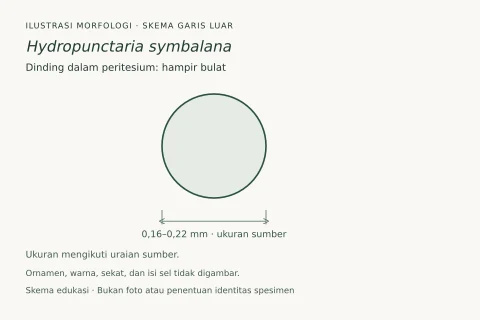
01 / Morfologi

Ciri dan struktur

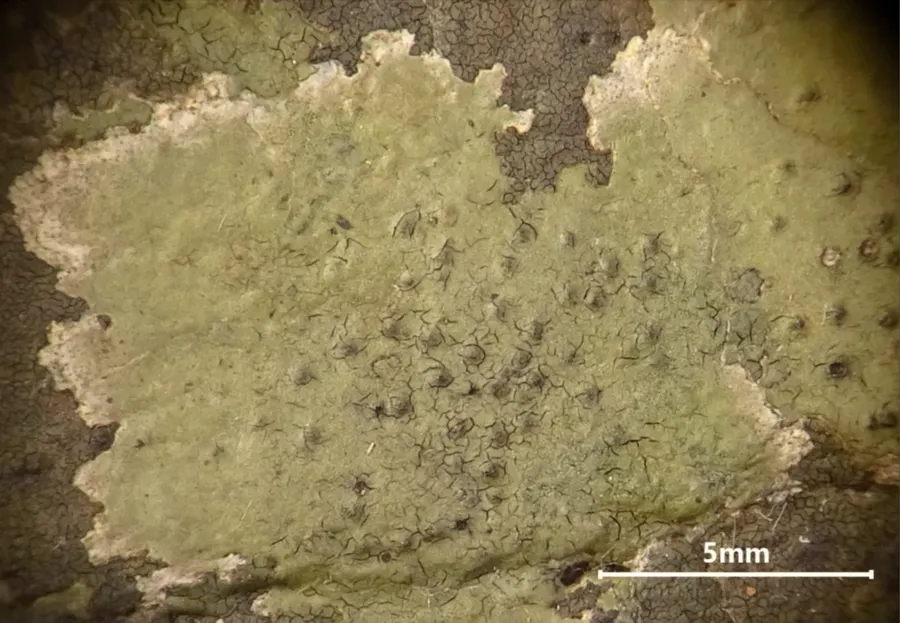
Hydropunctaria orae is a crustose lichen species with a thin to moderately thick body (thallus) measuring about 40–100 μm in thickness. The thallus appears dull mid-green to dark greenish-grey in colour. In thinner areas, the surface typically lacks cracks, while thicker regions may develop few to numerous cracks, though these rarely form completely discrete segments or "islands" () of thallus tissue. A distinctive characteristic of this species is its minutely roughened surface texture, created by low dots () about 20–40 μm wide. These punctae occasionally form small ridges measuring up to 80 by 30 μm. The punctae are either the same colour as the surrounding thallus or appear darker in specimens growing in shaded conditions. Examining the internal structure, the thallus consists of cells arranged in vertical columns. In the upper portion of the thallus, these cells measure roughly 20–40 by 16–33 μm, sometimes with slightly thickened cell walls. A protective outer layer () is present, with a surface layer about 5 μm thick that may contain dull green pigmentation that does not change colour when potassium hydroxide solution (K) is applied. The lower part of the thallus contains few or no living algal cells, with those present often containing large oil droplets. Densely pigmented and relatively discrete punctae project upward from the basal layer into the green , occasionally reaching the thallus surface. These contain dark reddish-brown pigment that turns dark greyish-brown when K is applied. Sometimes a colourless decomposed cell layer () up to 5 μm thick covers the surface, comprising collapsed and barely recognisable cell remains.

Sebagian uraian ditampilkan dalam bahasa sumber; terjemahannya belum tersedia atau belum lolos pemeriksaan.

Rujukan: [1]

Pengukuran mengikuti objek, spesimen atau kultur, dan metode yang disebutkan sumber. Baca uraian asli untuk konteks lengkap.

02 / Kehidupan

Habitat dan peran ekologis

Hydropunctaria orae occupies specific niches within coastal environments. It can be found growing on rock surfaces ranging from gently sloping to steep along the seashore, showing a particular preference for areas that receive slight moisture from rainfall. The species has also been documented growing on stones in freshwater streams in immediate proximity to the seashore. At the time of its original description, H. orae had a highly restricted known distribution, being confirmed from only two localities in the British Isles: one site in South Wales and another in southwestern Ireland. Since then, the species has been discovered in Fennoscandia, with a specimen collected in 2014 from Rennesøy, Rogaland county, in southwestern Norway. This Norwegian specimen was found growing on a shady rock wall subjected to freshwater seepage in a maritime ash (Fraxinus excelsior)-dominated woodland situated close to an exposed shoreline. The identity of this specimen was confirmed through DNA sequencing of the internal transcribed spacer region.

Sebagian uraian ditampilkan dalam bahasa sumber; terjemahannya belum tersedia atau belum lolos pemeriksaan.

Rujukan: [1]

Habitat atau konteks temuan
hutan
Substrat
Informasi belum tersedia pada sumber rilis ini.
Peran atau konteks
Pembentuk liken
Temukan hubungan serupa
03 / Siklus hidup

Reproduksi

The reproductive structures (perithecia) form low to moderately projecting, and occasionally rather prominent, warts in the thallus measuring 300–840 μm in diameter. These have rounded tops, rarely depressed, with inconspicuous openings (ostioles). Inside, the spore-producing sacs (asci) each contain 8 spores and measure about 43–52 by 21–26 μm. The perithecia have a well-developed protective covering (involucrellum) that merges with the dark basal tissue. The inner spore-producing chamber () measures 260–270 μm in diameter. The spores (ascospores) are oblong-ellipsoid in shape, , colourless, and filled with small oil droplets when mature. They measure approximately 145–175 μm long by 70–80 μm wide, with a length-to-width ratio of about 19–25:1.

Sebagian uraian ditampilkan dalam bahasa sumber; terjemahannya belum tersedia atau belum lolos pemeriksaan.

Rujukan: [1]

04 / Batas informasi

Catatan identitas dan cakupan

  • Nama diterima mengikuti Catalogue of Life Base2026-09-11; uraian mempertahankan konsep dan nama sumber aslinya.
  • Original geographic, specimen and life-cycle scope retained; source import awaits individual editorial review.
  • Impor dan terjemahan otomatis belum diperiksa editorial per profil. Struktur reproduktif yang disebutkan tidak membuktikan seluruh siklus hidup diketahui.
  • Pengukuran pada uraian mengikuti spesimen, kultur, dan metode sumber; angka tidak diperluas ke semua populasi.

Catatan distribusi dalam narasi mengikuti sumbernya. Dokumentasi spesimen atau foto mengikuti catatan sumber. Bukti wilayah Indonesia dan penilaian konservasi tidak disimpulkan dari gambar.

05 / Dokumentasi

Melihat dengan konteks

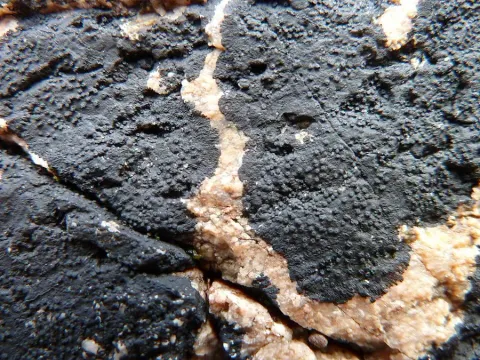
Dokumentasi Hydropunctaria orae dari Wikimedia Commons. The crustose rock-dwelling lichen Hydropunctaria orae; photographed in Norway Identifikasi mengikuti record berkas sumber.

Jenis
Fotografi
Kredit
JON T. KLEPSLAND
Lisensi
CC BY 4.0
Sumber media
Buka entri sumber

Gambar menunjukkan objek menurut identifikasi sumber, bukan verifikasi independen spesimen oleh Fungi. Tidak ada skala baru yang ditambahkan.

06 / Rujukan

Sumber profil

  1. [1] Hydropunctaria orae — Wikipedia (en)Bagian sumber: Frozen revision 1345943101
    Tanggal penghimpunan sumber: 2026-10-12
    Teks sumber: CC BY-SA4.0 · Wikipedia contributors
  2. [2] Catalogue of Life Base2026-09-11 — Hydropunctaria oraeBagian sumber: ColDP NameUsage.tsv ID 3N9PT; accepted species; source 2073
    Tanggal penghimpunan sumber: 2026-10-12
  3. [3] Dokumentasi visual — Hydropunctaria oraeBagian sumber: Individual media record; identification follows the source, not independent determination
    Tanggal penghimpunan sumber: 2026-10-12
    Media sumber: CC BY 4.0 · JON T. KLEPSLAND

Adaptasi teks: CC BY-SA 4.0. Wikipedia contributors — Hydropunctaria orae — Wikipedia (en)

Uraian asli dan riwayat sumber

Riwayat atau halaman sumber

Ringkasan sumber

Hydropunctaria orae is a species of saxicolous (rock-dwelling), crustose lichen in the family Verrucariaceae. It is a marine lichen. It forms thin, dull mid-green to dark greenish-grey crusts on coastal rock surfaces, particularly in areas that receive slight moisture from rainfall. Although difficult to distinguish from related species without DNA analysis, it can be identified by its green pigments and minutely roughened surface texture. Initially known only from two localities in the British Isles, the species was later discovered in southwestern Norway in 2014.

Revisi sumber

Morfologi sumber

Hydropunctaria orae is a crustose lichen species with a thin to moderately thick body (thallus) measuring about 40–100 μm in thickness. The thallus appears dull mid-green to dark greenish-grey in colour. In thinner areas, the surface typically lacks cracks, while thicker regions may develop few to numerous cracks, though these rarely form completely discrete segments or "islands" () of thallus tissue. A distinctive characteristic of this species is its minutely roughened surface texture, created by low dots () about 20–40 μm wide. These punctae occasionally form small ridges measuring up to 80 by 30 μm. The punctae are either the same colour as the surrounding thallus or appear darker in specimens growing in shaded conditions. Examining the internal structure, the thallus consists of cells arranged in vertical columns. In the upper portion of the thallus, these cells measure roughly 20–40 by 16–33 μm, sometimes with slightly thickened cell walls. A protective outer layer () is present, with a surface layer about 5 μm thick that may contain dull green pigmentation that does not change colour when potassium hydroxide solution (K) is applied. The lower part of the thallus contains few or no living algal cells, with those present often containing large oil droplets. Densely pigmented and relatively discrete punctae project upward from the basal layer into the green , occasionally reaching the thallus surface. These contain dark reddish-brown pigment that turns dark greyish-brown when K is applied. Sometimes a colourless decomposed cell layer () up to 5 μm thick covers the surface, comprising collapsed and barely recognisable cell remains.

Revisi sumber

Ekologi sumber

Hydropunctaria orae occupies specific niches within coastal environments. It can be found growing on rock surfaces ranging from gently sloping to steep along the seashore, showing a particular preference for areas that receive slight moisture from rainfall. The species has also been documented growing on stones in freshwater streams in immediate proximity to the seashore. At the time of its original description, H. orae had a highly restricted known distribution, being confirmed from only two localities in the British Isles: one site in South Wales and another in southwestern Ireland. Since then, the species has been discovered in Fennoscandia, with a specimen collected in 2014 from Rennesøy, Rogaland county, in southwestern Norway. This Norwegian specimen was found growing on a shady rock wall subjected to freshwater seepage in a maritime ash (Fraxinus excelsior)-dominated woodland situated close to an exposed shoreline. The identity of this specimen was confirmed through DNA sequencing of the internal transcribed spacer region.

Revisi sumber

Struktur reproduksi sumber

The reproductive structures (perithecia) form low to moderately projecting, and occasionally rather prominent, warts in the thallus measuring 300–840 μm in diameter. These have rounded tops, rarely depressed, with inconspicuous openings (ostioles). Inside, the spore-producing sacs (asci) each contain 8 spores and measure about 43–52 by 21–26 μm. The perithecia have a well-developed protective covering (involucrellum) that merges with the dark basal tissue. The inner spore-producing chamber () measures 260–270 μm in diameter. The spores (ascospores) are oblong-ellipsoid in shape, , colourless, and filled with small oil droplets when mature. They measure approximately 145–175 μm long by 70–80 μm wide, with a length-to-width ratio of about 19–25:1.

Revisi sumber

Rujukan halaman ini

Fungi. Hydropunctaria orae. Rilis data fungi-2026-10-12-expansion-2. https://fungi-atlas.mgadib.chatgpt.site/jamur/hydropunctaria-orae/.

Status: impor sumber; pemeriksaan editorial per profil belum selesai. Untuk klaim biologis, gunakan rujukan pada bagian terkait dan periksa konteks sumber aslinya.