01 / Morfologi

Ciri dan struktur

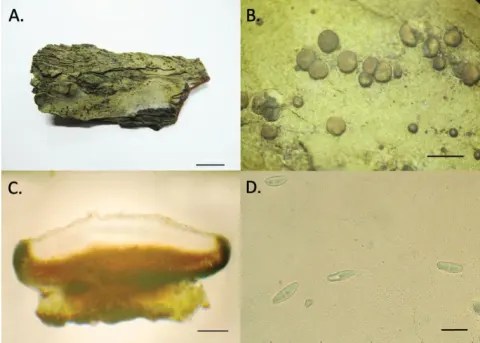
Lecania hydrophobica forms a thin, crust-like thallus that breaks into tiny dome-shaped only 0.15–0.45 mm wide. Each areole is two-toned, with a darker gray rim and a cream-to-ochre center, and the colony as a whole often looks faintly blistered or granulated. The surface repels water, an effect traced to countless "spaghetti" filaments less than 100 nanometers across that weave through the interior and give the sterile hyphae a (pimpled) appearance under high magnification. Internally the thallus is only loosely stratified: sparsely woven fungal threads sit directly beneath a very thin, biofilm-like cortex, and no differentiated outer skin () is present. The algal partner is a single-celled green alga with rounded cells 6–17 micrometers (μm) in diameter. Round apothecia (fruiting bodies) rise singly from the thallus, well spaced and one-half to nearly 1 mm across. Young are flat and reddish-brown, surrounded by a thick, doughnut-like rim that is coated with the same waxy filaments that waterproof the thallus. As the apothecia mature the rim thins, giving a false "" impression, and may eventually disappear, while the disc itself darkens to gray-brown, sometimes mottled, and can become distinctly lumpy. The lateral wall () is 60–100 μm thick, made of radiating, thick-walled hyphae that sparkle with internal crystals under polarized light; it shows no color change in iodine. Inside, a 60–120 μm tall hymenium contains tightly glued paraphyses that refuse to separate even in potassium hydroxide, and the is packed with the same crystals, golden-brown in transmitted light. The clear to pale yellow-brown can reach 150 μm in height and is likewise studded with crystals.

Sebagian uraian ditampilkan dalam bahasa sumber; terjemahannya belum tersedia atau belum lolos pemeriksaan.

Rujukan: [1]

Pengukuran mengikuti objek, spesimen atau kultur, dan metode yang disebutkan sumber. Baca uraian asli untuk konteks lengkap.

02 / Kehidupan

Habitat dan peran ekologis

Lecania hydrophobica is abundant on sheltered rock overhangs in the type locality, and is also known to occur further south – on southern Baranof Island, and on British Columbia's Calvert Island. It is one of six species of Lecania that has been documented in Alaska.

Sebagian uraian ditampilkan dalam bahasa sumber; terjemahannya belum tersedia atau belum lolos pemeriksaan.

Rujukan: [1]

Habitat atau konteks temuan
Informasi belum tersedia pada sumber rilis ini.
Substrat
Informasi belum tersedia pada sumber rilis ini.
Peran atau konteks
Pembentuk liken
Temukan hubungan serupa
03 / Siklus hidup

Reproduksi

The clear to pale yellow-brown can reach 150 μm in height and is likewise studded with crystals. Eight-spored, Bacidia-type asci—about 50 × 10 μm—are hard to distinguish because of the gummy , and many appear to be recycled into the growing tissue, so older hymenia ride atop earlier layers. Spores are one-septate and broadly ellipsoid, averaging 12–14 × 4–5 μm. Routine spot tests are negative, though the thallus shows a faint yellow glow under long-wave UV light, and thin-layer chromatography detects traces of atranorin and the rare pigment gangaleoidin. The combination of a hydrophobic, wax-filament thallus, crystal-rich apothecia, and an unusual secondary metabolite sets L. hydrophobica apart from other species in the genus.

Sebagian uraian ditampilkan dalam bahasa sumber; terjemahannya belum tersedia atau belum lolos pemeriksaan.

Rujukan: [1]

04 / Batas informasi

Catatan identitas dan cakupan

  • Nama diterima mengikuti Catalogue of Life Base2026-09-11; uraian mempertahankan konsep dan nama sumber aslinya.
  • Original geographic, specimen and life-cycle scope retained; source import awaits individual editorial review.
  • Impor dan terjemahan otomatis belum diperiksa editorial per profil. Struktur reproduktif yang disebutkan tidak membuktikan seluruh siklus hidup diketahui.
  • Pengukuran pada uraian mengikuti spesimen, kultur, dan metode sumber; angka tidak diperluas ke semua populasi.

Catatan distribusi dalam narasi mengikuti sumbernya. Dokumentasi spesimen atau foto mengikuti catatan sumber. Bukti wilayah Indonesia dan penilaian konservasi tidak disimpulkan dari gambar.

05 / Dokumentasi

Melihat dengan konteks

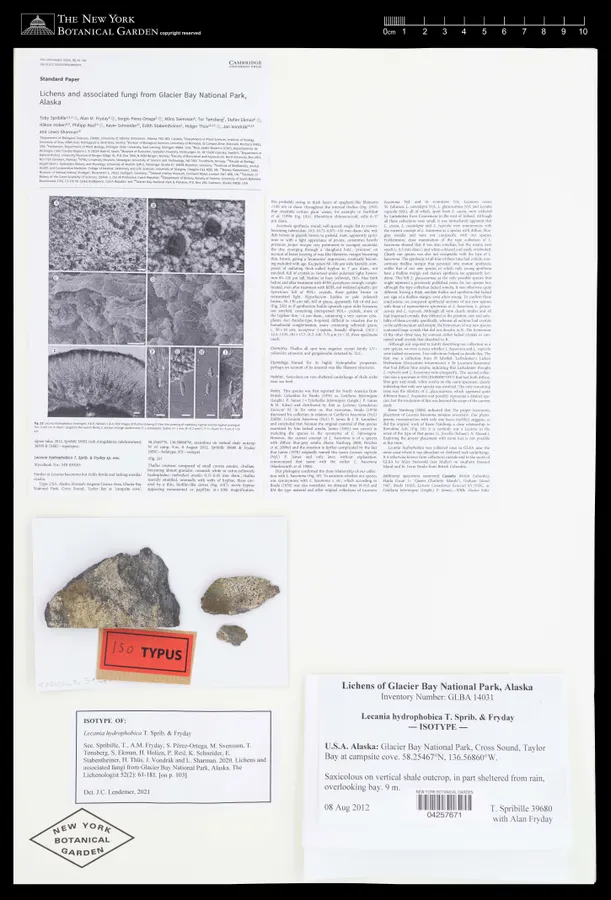
Voucher herbarium Lecania hydrophobica (04257671), The New York Botanical Garden. Identifikasi mengikuti record spesimen sumber. Foto bahan, kemasan, atau label herbarium sebagaimana tersedia pada record institusi; bukan foto lapangan atau penentuan spesimen independen.

Jenis
Voucher herbarium
Kredit
The New York Botanical Garden
Lisensi
CC BY 4.0
Sumber media
Buka entri sumber

Gambar menunjukkan objek menurut identifikasi sumber, bukan verifikasi independen spesimen oleh Fungi. Tidak ada skala baru yang ditambahkan.

06 / Rujukan

Sumber profil

  1. [1] Lecania hydrophobica — Wikipedia (en)Bagian sumber: Frozen revision 1313949249
    Tanggal penghimpunan sumber: 2026-10-12
    Teks sumber: CC BY-SA4.0 · Wikipedia contributors
  2. [2] Catalogue of Life Base2026-09-11 — Lecania hydrophobicaBagian sumber: ColDP NameUsage.tsv ID 9Z9TN; accepted species; source 2073
    Tanggal penghimpunan sumber: 2026-10-12
  3. [3] Dokumentasi visual — Lecania hydrophobicaBagian sumber: Individual media record; identification follows the source, not independent determination
    Tanggal penghimpunan sumber: 2026-10-12
    Media sumber: CC BY 4.0 · The New York Botanical Garden

Adaptasi teks: CC BY-SA 4.0. Wikipedia contributors — Lecania hydrophobica — Wikipedia (en)

Uraian asli dan riwayat sumber

Riwayat atau halaman sumber

Ringkasan sumber

Lecania hydrophobica is a species of crustose lichen in the family Ramalinaceae. This species was found in 2020 growing on shale cliffs in Alaska's Glacier Bay National Park. Its most distinctive feature is a hydrophobic surface that repels water, created by tiny wax-like filaments covering the lichen. The species forms small, dome-shaped patches with cream-colored centers and darker gray edges, and is known from coastal areas of Alaska and British Columbia.

Revisi sumber

Morfologi sumber

Lecania hydrophobica forms a thin, crust-like thallus that breaks into tiny dome-shaped only 0.15–0.45 mm wide. Each areole is two-toned, with a darker gray rim and a cream-to-ochre center, and the colony as a whole often looks faintly blistered or granulated. The surface repels water, an effect traced to countless "spaghetti" filaments less than 100 nanometers across that weave through the interior and give the sterile hyphae a (pimpled) appearance under high magnification. Internally the thallus is only loosely stratified: sparsely woven fungal threads sit directly beneath a very thin, biofilm-like cortex, and no differentiated outer skin () is present. The algal partner is a single-celled green alga with rounded cells 6–17 micrometers (μm) in diameter. Round apothecia (fruiting bodies) rise singly from the thallus, well spaced and one-half to nearly 1 mm across. Young are flat and reddish-brown, surrounded by a thick, doughnut-like rim that is coated with the same waxy filaments that waterproof the thallus. As the apothecia mature the rim thins, giving a false "" impression, and may eventually disappear, while the disc itself darkens to gray-brown, sometimes mottled, and can become distinctly lumpy. The lateral wall () is 60–100 μm thick, made of radiating, thick-walled hyphae that sparkle with internal crystals under polarized light; it shows no color change in iodine. Inside, a 60–120 μm tall hymenium contains tightly glued paraphyses that refuse to separate even in potassium hydroxide, and the is packed with the same crystals, golden-brown in transmitted light. The clear to pale yellow-brown can reach 150 μm in height and is likewise studded with crystals.

Revisi sumber

Ekologi sumber

Lecania hydrophobica is abundant on sheltered rock overhangs in the type locality, and is also known to occur further south – on southern Baranof Island, and on British Columbia's Calvert Island. It is one of six species of Lecania that has been documented in Alaska.

Revisi sumber

Struktur reproduksi sumber

The clear to pale yellow-brown can reach 150 μm in height and is likewise studded with crystals. Eight-spored, Bacidia-type asci—about 50 × 10 μm—are hard to distinguish because of the gummy , and many appear to be recycled into the growing tissue, so older hymenia ride atop earlier layers. Spores are one-septate and broadly ellipsoid, averaging 12–14 × 4–5 μm. Routine spot tests are negative, though the thallus shows a faint yellow glow under long-wave UV light, and thin-layer chromatography detects traces of atranorin and the rare pigment gangaleoidin. The combination of a hydrophobic, wax-filament thallus, crystal-rich apothecia, and an unusual secondary metabolite sets L. hydrophobica apart from other species in the genus.

Revisi sumber

Rujukan halaman ini

Fungi. Lecania hydrophobica. Rilis data fungi-2026-10-12-expansion-2. https://fungi-atlas.mgadib.chatgpt.site/jamur/lecania-hydrophobica/.

Status: impor sumber; pemeriksaan editorial per profil belum selesai. Untuk klaim biologis, gunakan rujukan pada bagian terkait dan periksa konteks sumber aslinya.