01 / Morfologi

Ciri dan struktur

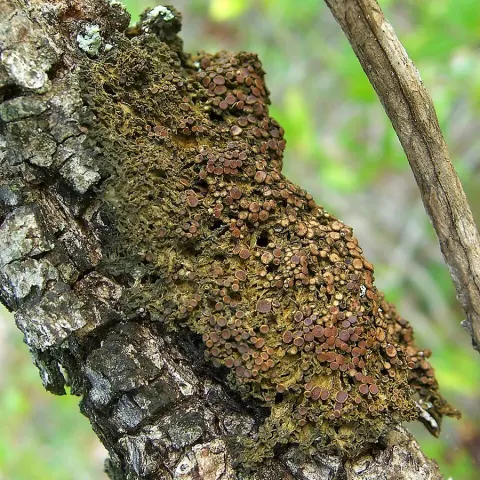
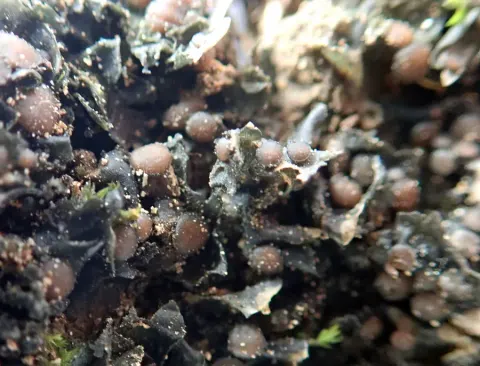
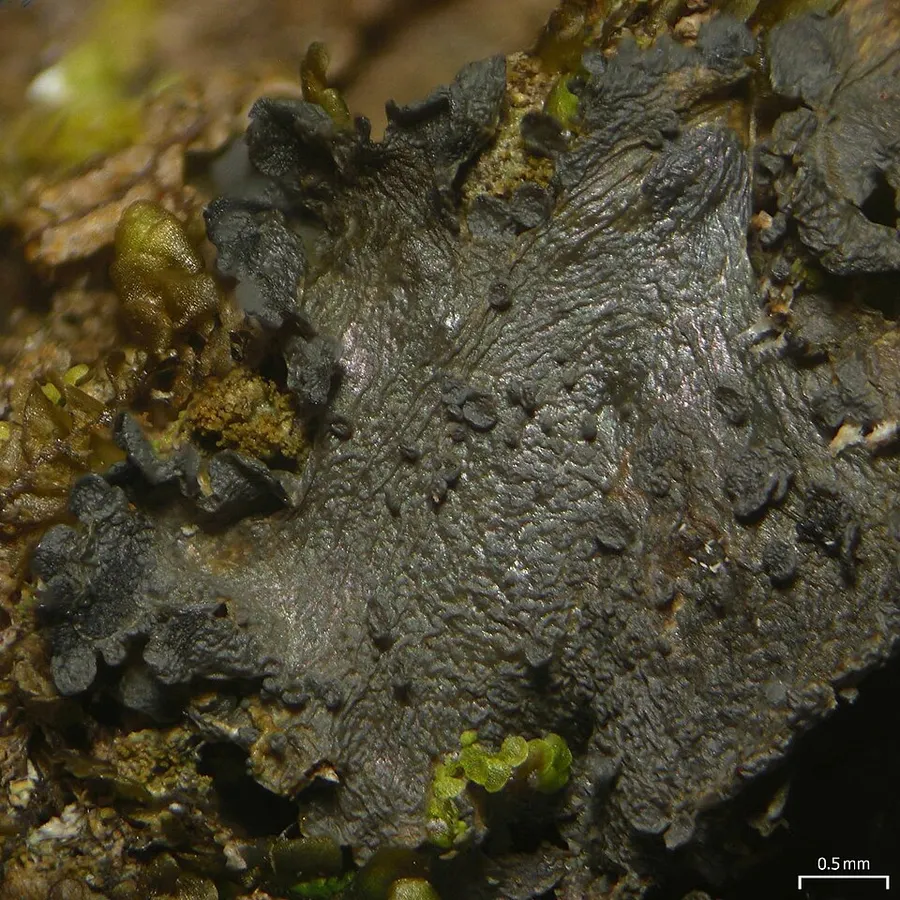
The thallus is foliose, lead-gray to occasionally brownish, and typically 1–8 cm across. It is made up of numerous spreading to somewhat erect, rounded that are 2–10 mm wide and paler on the underside. Both the upper and lower surfaces are distinctly and irregularly wrinkled. The lobe margins are usually entire, but often become isidiate. The isidia are abundant on the upper surface and along the margins, usually cylindrical to club-shaped, mostly simple but sometimes branched, and only occasionally scale-like (). The lichen is attached to its substrate by scattered tufts of white hairs on the lower surface. The lobes are typically about 100–250 (sometimes up to 300) μm thick and have a single-layered , with the cells of the upper cortex tending to be slightly larger than those of the lower cortex. Apothecia (fruiting bodies) are rare; when present, they are sessile on the upper surface, 0.5–2.0 mm wide, with a light- to reddish-brown and a margin that may be smooth or isidiate. The asci are cylindric to club-shaped () and contain eight ascospores, which are ellipsoid, 15–27 × 7–9 μm, usually with 3–5 transverse septa and occasionally a single longitudinal septum.

Sebagian uraian ditampilkan dalam bahasa sumber; terjemahannya belum tersedia atau belum lolos pemeriksaan.

Rujukan: [1]

Pengukuran mengikuti objek, spesimen atau kultur, dan metode yang disebutkan sumber. Baca uraian asli untuk konteks lengkap.

02 / Kehidupan

Habitat dan peran ekologis

Leptogium austroamericanum is widely distributed in Brazil, where it has been recorded from 15 states. It is abundant in the southeastern United States, where it occurs from the Gulf Coast northward to Maryland, Ohio, and Illinois, and westward to Missouri, eastern Oklahoma, and eastern Texas.

Sebagian uraian ditampilkan dalam bahasa sumber; terjemahannya belum tersedia atau belum lolos pemeriksaan.

Rujukan: [1]

Habitat atau konteks temuan
Informasi belum tersedia pada sumber rilis ini.
Substrat
Informasi belum tersedia pada sumber rilis ini.
Peran atau konteks
Pembentuk liken
Temukan hubungan serupa
03 / Siklus hidup

Reproduksi

The thallus is foliose, lead-gray to occasionally brownish, and typically 1–8 cm across. It is made up of numerous spreading to somewhat erect, rounded that are 2–10 mm wide and paler on the underside. Both the upper and lower surfaces are distinctly and irregularly wrinkled. The lobe margins are usually entire, but often become isidiate. The isidia are abundant on the upper surface and along the margins, usually cylindrical to club-shaped, mostly simple but sometimes branched, and only occasionally scale-like (). The lichen is attached to its substrate by scattered tufts of white hairs on the lower surface. The lobes are typically about 100–250 (sometimes up to 300) μm thick and have a single-layered , with the cells of the upper cortex tending to be slightly larger than those of the lower cortex.

Sebagian uraian ditampilkan dalam bahasa sumber; terjemahannya belum tersedia atau belum lolos pemeriksaan.

Rujukan: [1]

Sinonim menurut acuan taksonomi rilis: Leptogium caesium var. austroamericanum; Leptogium cyanescens var. austroamericanum
04 / Batas informasi

Catatan identitas dan cakupan

  • Nama diterima mengikuti Catalogue of Life Base2026-09-11; uraian mempertahankan konsep dan nama sumber aslinya.
  • Original geographic, specimen and life-cycle scope retained; source import awaits individual editorial review.
  • Impor dan terjemahan otomatis belum diperiksa editorial per profil. Struktur reproduktif yang disebutkan tidak membuktikan seluruh siklus hidup diketahui.
  • Pengukuran pada uraian mengikuti spesimen, kultur, dan metode sumber; angka tidak diperluas ke semua populasi.

Catatan distribusi dalam narasi mengikuti sumbernya. Dokumentasi spesimen atau foto mengikuti catatan sumber. Bukti wilayah Indonesia dan penilaian konservasi tidak disimpulkan dari gambar.

05 / Dokumentasi

Melihat dengan konteks

Dokumentasi Leptogium austroamericanum dari Wikimedia Commons. on Nyssa, Alligator River National Wildlife Refuge, North Carolina, 20140323 6250, pers. herb. Identifikasi mengikuti record berkas sumber.

Jenis
Fotografi
Kredit
Jason Hollinger
Lisensi
CC BY 2.0
Sumber media
Buka entri sumber

Gambar menunjukkan objek menurut identifikasi sumber, bukan verifikasi independen spesimen oleh Fungi. Tidak ada skala baru yang ditambahkan.

06 / Rujukan

Sumber profil

  1. [1] Leptogium austroamericanum — Wikipedia (en)Bagian sumber: Frozen revision 1344541369
    Tanggal penghimpunan sumber: 2026-10-12
    Teks sumber: CC BY-SA4.0 · Wikipedia contributors
  2. [2] Catalogue of Life Base2026-09-11 — Leptogium austroamericanumBagian sumber: ColDP NameUsage.tsv ID 3TPKD; accepted species; source 2073
    Tanggal penghimpunan sumber: 2026-10-12
  3. [3] Dokumentasi visual — Leptogium austroamericanumBagian sumber: Individual media record; identification follows the source, not independent determination
    Tanggal penghimpunan sumber: 2026-10-12
    Media sumber: CC BY 2.0 · Jason Hollinger

Adaptasi teks: CC BY-SA 4.0. Wikipedia contributors — Leptogium austroamericanum — Wikipedia (en)

Uraian asli dan riwayat sumber

Riwayat atau halaman sumber

Ringkasan sumber

Leptogium austroamericanum is a species of corticolous (bark-dwelling) foliose lichen in the family Collemataceae. It is recognized by its lead-gray, wrinkled lobes bearing abundant cylindrical isidia (small finger-like outgrowths). The species is widely distributed in Brazil and the southeastern United States, where it grows on bark.

Revisi sumber

Morfologi sumber

The thallus is foliose, lead-gray to occasionally brownish, and typically 1–8 cm across. It is made up of numerous spreading to somewhat erect, rounded that are 2–10 mm wide and paler on the underside. Both the upper and lower surfaces are distinctly and irregularly wrinkled. The lobe margins are usually entire, but often become isidiate. The isidia are abundant on the upper surface and along the margins, usually cylindrical to club-shaped, mostly simple but sometimes branched, and only occasionally scale-like (). The lichen is attached to its substrate by scattered tufts of white hairs on the lower surface. The lobes are typically about 100–250 (sometimes up to 300) μm thick and have a single-layered , with the cells of the upper cortex tending to be slightly larger than those of the lower cortex. Apothecia (fruiting bodies) are rare; when present, they are sessile on the upper surface, 0.5–2.0 mm wide, with a light- to reddish-brown and a margin that may be smooth or isidiate. The asci are cylindric to club-shaped () and contain eight ascospores, which are ellipsoid, 15–27 × 7–9 μm, usually with 3–5 transverse septa and occasionally a single longitudinal septum.

Revisi sumber

Ekologi sumber

Leptogium austroamericanum is widely distributed in Brazil, where it has been recorded from 15 states. It is abundant in the southeastern United States, where it occurs from the Gulf Coast northward to Maryland, Ohio, and Illinois, and westward to Missouri, eastern Oklahoma, and eastern Texas.

Revisi sumber

Struktur reproduksi sumber

The thallus is foliose, lead-gray to occasionally brownish, and typically 1–8 cm across. It is made up of numerous spreading to somewhat erect, rounded that are 2–10 mm wide and paler on the underside. Both the upper and lower surfaces are distinctly and irregularly wrinkled. The lobe margins are usually entire, but often become isidiate. The isidia are abundant on the upper surface and along the margins, usually cylindrical to club-shaped, mostly simple but sometimes branched, and only occasionally scale-like (). The lichen is attached to its substrate by scattered tufts of white hairs on the lower surface. The lobes are typically about 100–250 (sometimes up to 300) μm thick and have a single-layered , with the cells of the upper cortex tending to be slightly larger than those of the lower cortex.

Revisi sumber

Rujukan halaman ini

Fungi. Leptogium austroamericanum. Rilis data fungi-2026-10-12-expansion-2. https://fungi-atlas.mgadib.chatgpt.site/jamur/leptogium-austroamericanum/.

Status: impor sumber; pemeriksaan editorial per profil belum selesai. Untuk klaim biologis, gunakan rujukan pada bagian terkait dan periksa konteks sumber aslinya.