Ciri dan struktur
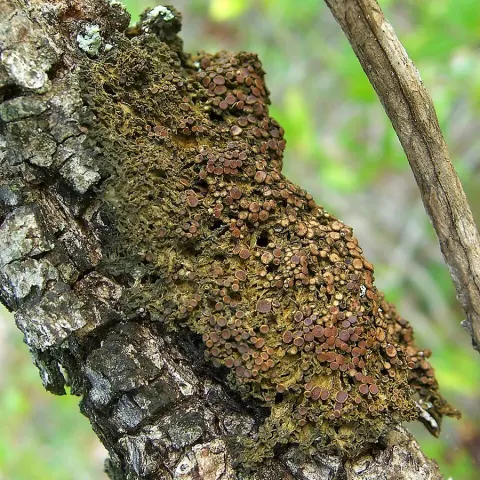
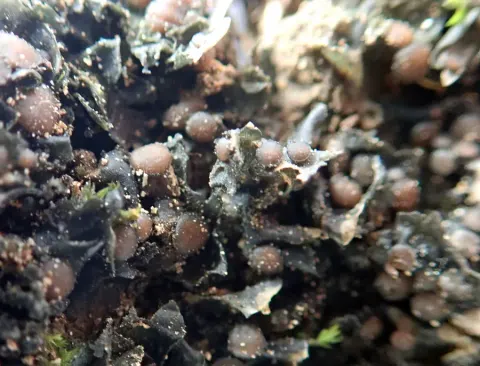
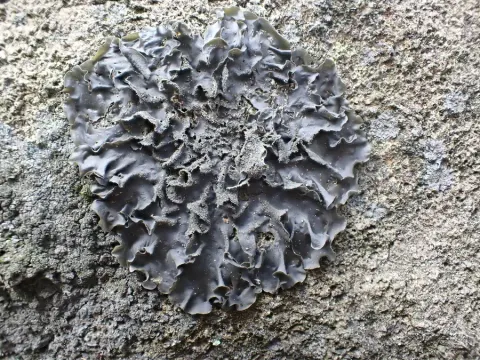
Leptogium burgessii forms relatively large, leafy thalli usually up to about 7–10 cm across, arranged as rounded tufts or rosettes that are often slightly raised in the centre. The thallus is divided into rounded, wavy lobes mostly 3–5 mm wide that overlap irregularly and are attached to the substrate at scattered points. When dry, the surface is bluish grey to dark blackish brown or blackish olive-green, with a dull, matt appearance; under low magnification it looks smooth to only slightly wrinkled. The lobe tips are rounded and slightly rolled inwards, and the margins are gently undulating. Numerous small secondary lobes ( or lacinules) with rounded tips arise both from the lobe edges and around the rims of the fruiting bodies, giving the margins a distinctly frilled outline. The thallus lacks . The lower surface is paler, grey to yellowish, and has a velvety texture due to a dense covering of short, cream-coloured hairs. These hairs, which are made up of only a few spherical cells, are abundant on the underside and may also occur near the apothecia on the upper surface; they anchor the lichen to the bark and are characteristic of the group of Leptogium species placed in section Mallotium. Fruiting bodies (apothecia) are fairly common. They are and slightly stalked, usually 1–4 mm in diameter, with a cup-shaped, red-brown to blackish-brown surrounded by a thick . The margin and the outer wall of the apothecium (the ) bear numerous small lobules, which remain free and do not form a complete collar around the disc. In vertical section the apothecia have a tall spore-bearing layer and a conspicuously thick outer zone composed of many layers of small, brick-like fungal cells ( tissue).
Habitat dan peran ekologis
In his 1840 account, Montagne reported Leptogium burgessii on the bark of trees in the woods of Las Mercedes on Tenerife in the Canary Islands, based on collections by Jean-Marie Despréaux, indicating a corticolous species of humid laurel forest. Within the Iberian Peninsula the species has been recorded only from a few localities in north-western Portugal. There it grows on mossy tree trunks and on moss-covered rocks inside dense, well-preserved Atlantic broadleaved forest under very humid, oceanic conditions. These stands host rich communities of cyanobacterial lichens in the Lobarion pulmonariae alliance, and L. burgessii often occurs with species such as Leptogium juressianum, Scytinium lichenoides, Lobaria pulmonaria, Nephroma parile and Pannaria conoplea. On the basis of earlier floristic work summarised by Aragón and co-authors, L. burgessii is regarded in Europe as an oceanic element with an Atlantic distribution from Macaronesia northwards to Norway, and there are scattered extra-European records from South America, East Africa, India and New Zealand. In Fennoscandia it is restricted to south-western Norway, where Haugan and co-authors reported 16 localities in the nemoral to boreonemoral zone and in the lowland belt of the coastal section, from about sea level up to 170 m, all in the counties Rogaland, Hordaland and Sogn og Fjordane.
- Habitat atau konteks temuan
- hutan
- Substrat
- Informasi belum tersedia pada sumber rilis ini.
- Peran atau konteks
- Pembentuk liken
Reproduksi
The lower surface is paler, grey to yellowish, and has a velvety texture due to a dense covering of short, cream-coloured hairs. These hairs, which are made up of only a few spherical cells, are abundant on the underside and may also occur near the apothecia on the upper surface; they anchor the lichen to the bark and are characteristic of the group of Leptogium species placed in section Mallotium. Fruiting bodies (apothecia) are fairly common. They are and slightly stalked, usually 1–4 mm in diameter, with a cup-shaped, red-brown to blackish-brown surrounded by a thick . The margin and the outer wall of the apothecium (the ) bear numerous small lobules, which remain free and do not form a complete collar around the disc.
Catatan identitas dan cakupan
- Nama diterima mengikuti Catalogue of Life Base2026-09-11; uraian mempertahankan konsep dan nama sumber aslinya.
- Original geographic, specimen and life-cycle scope retained; source import awaits individual editorial review.
- Impor dan terjemahan otomatis belum diperiksa editorial per profil. Struktur reproduktif yang disebutkan tidak membuktikan seluruh siklus hidup diketahui.
- Pengukuran pada uraian mengikuti spesimen, kultur, dan metode sumber; angka tidak diperluas ke semua populasi.
Catatan distribusi dalam narasi mengikuti sumbernya. Dokumentasi spesimen atau foto mengikuti catatan sumber. Bukti wilayah Indonesia dan penilaian konservasi tidak disimpulkan dari gambar.
Melihat dengan konteks
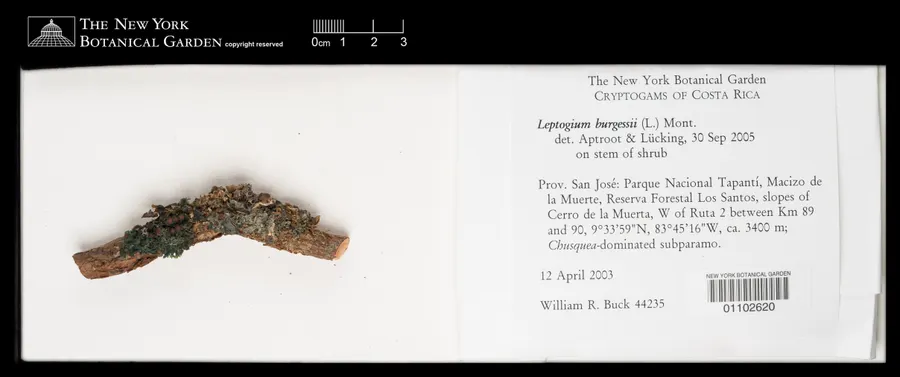
Voucher herbarium Leptogium burgessii (1102620), The New York Botanical Garden. Identifikasi mengikuti record spesimen sumber. Foto bahan, kemasan, atau label herbarium sebagaimana tersedia pada record institusi; bukan foto lapangan atau penentuan spesimen independen.
- Jenis
- Voucher herbarium
- Kredit
- The New York Botanical Garden
- Lisensi
- CC BY 4.0
- Sumber media
- Buka entri sumber
Sumber profil
- [1] Leptogium burgessii — Wikipedia (en)
- [2] Catalogue of Life Base2026-09-11 — Leptogium burgessii
- [3] Dokumentasi visual — Leptogium burgessii
Rujukan halaman ini
Fungi. Leptogium burgessii. Rilis data fungi-2026-10-12-expansion-2. https://fungi-atlas.mgadib.chatgpt.site/jamur/leptogium-burgessii/.
Status: impor sumber; pemeriksaan editorial per profil belum selesai. Untuk klaim biologis, gunakan rujukan pada bagian terkait dan periksa konteks sumber aslinya.