Ciri dan struktur
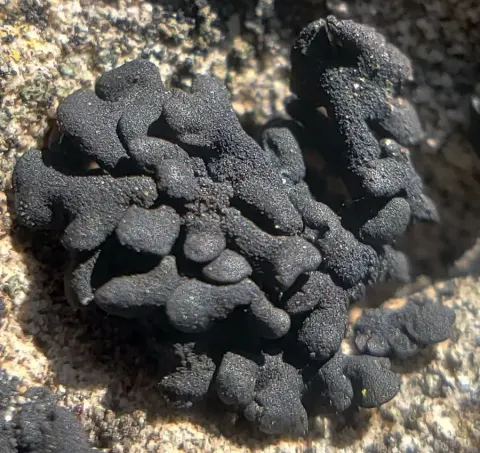
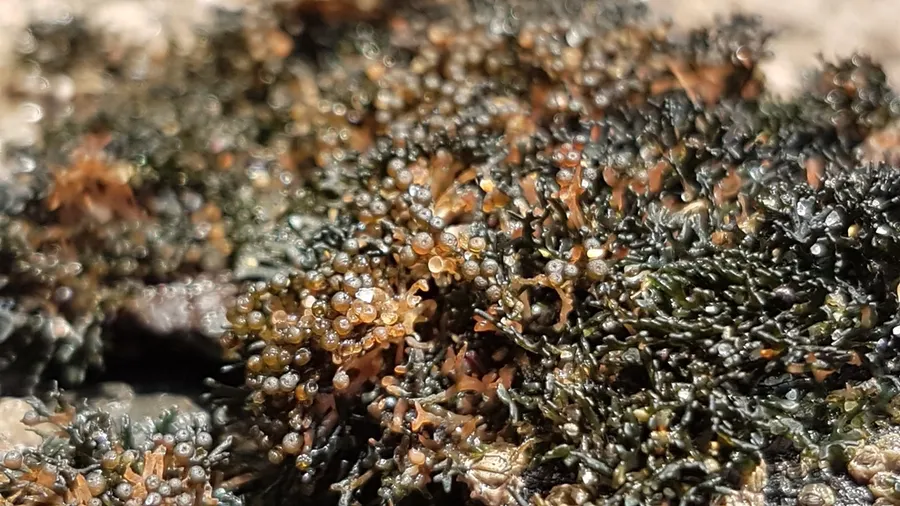
Lichina pygmaea is a small shrubby marine lichen that forms loose tufts, sometimes spreading into extensive mat-like patches, with thalli up to about 1 cm long. Its branches are flattened and usually divided in a hand-like () pattern, up to about 2 mm thick, though the tips may become more rounded. The thallus is dark brown-black to black and shiny, and when wet becomes gelatinous and rubbery; Lightfoot noted that it appears dark green when held to the light. The is well developed and made of several layers of rectangular cells, while the cyanobacterial cells are mainly concentrated beneath it in the medulla and subcortical layers. The apothecia (fruiting bodies) are roughly spherical, borne at the branch tips, and usually pore-like, reaching about 2 mm in diameter, and the ascospores are colourless, single-celled (aseptate), and 22–29 × 11–16 micrometres. Compared with the related L. confinis, it is typically larger, with distinctly flattened, repeatedly forking to palmately divided branches rather than cylindrical ones, and a more clearly developed cortex.
Habitat dan peran ekologis
Lichina pygmaea grows on maritime rock in the intertidal zone, especially on steep or vertical surfaces that are regularly washed by the tide. It is most frequent on sunny rock faces and may also occur on less steeply sloping shores where aspect and moisture conditions are favourable. The species is common on exposed and very exposed shores, occurs more sparsely on semi-exposed and fairly sheltered coasts, and is generally absent from sheltered shores where competition from fucoid algae becomes greater. In Britain and Ireland it typically forms a distinct band between the Hydropunctaria maura zone above and the barnacle–Patella vulgata zone below, often growing among barnacles, although its exact position varies regionally with shore exposure and steepness. In microbiome surveys from Brittany, L. pygmaea was treated as a lower-eulittoral species immersed for several hours each day, in contrast to L. confinis, which occupies the upper eulittoral and is usually exposed mainly to splashing and sea spray. The species is widespread on Atlantic coastlines, with a range extending from western and north-western Europe to north-western Africa; it is especially abundant on European coasts of the North Atlantic, including Britain and Ireland.
- Habitat atau konteks temuan
- Informasi belum tersedia pada sumber rilis ini.
- Substrat
- Informasi belum tersedia pada sumber rilis ini.
- Peran atau konteks
- Pembentuk liken
Reproduksi
The apothecia (fruiting bodies) are roughly spherical, borne at the branch tips, and usually pore-like, reaching about 2 mm in diameter, and the ascospores are colourless, single-celled (aseptate), and 22–29 × 11–16 micrometres. Compared with the related L. confinis, it is typically larger, with distinctly flattened, repeatedly forking to palmately divided branches rather than cylindrical ones, and a more clearly developed cortex.
Catatan identitas dan cakupan
- Nama diterima mengikuti Catalogue of Life Base2026-09-11; uraian mempertahankan konsep dan nama sumber aslinya.
- Original geographic, specimen and life-cycle scope retained; source import awaits individual editorial review.
- Impor dan terjemahan otomatis belum diperiksa editorial per profil. Struktur reproduktif yang disebutkan tidak membuktikan seluruh siklus hidup diketahui.
- Pengukuran pada uraian mengikuti spesimen, kultur, dan metode sumber; angka tidak diperluas ke semua populasi.
Catatan distribusi dalam narasi mengikuti sumbernya. Dokumentasi spesimen atau foto mengikuti catatan sumber. Bukti wilayah Indonesia dan penilaian konservasi tidak disimpulkan dari gambar.
Melihat dengan konteks
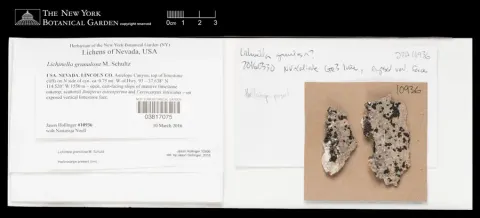
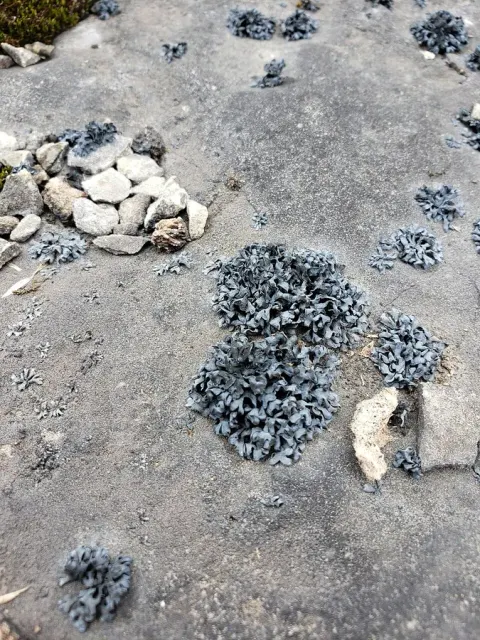
Dokumentasi Lichina pygmaea menurut asosiasi foto pada record takson iNaturalist. Kredit: anasacuta. Identitas mengikuti sumber; bukan penentuan spesimen independen.
- Jenis
- Fotografi
- Kredit
- (c) anasacuta, some rights reserved (CC BY), uploaded by anasacuta
- Lisensi
- CC BY 4.0
- Sumber media
- Buka entri sumber
Dokumentasi tambahan
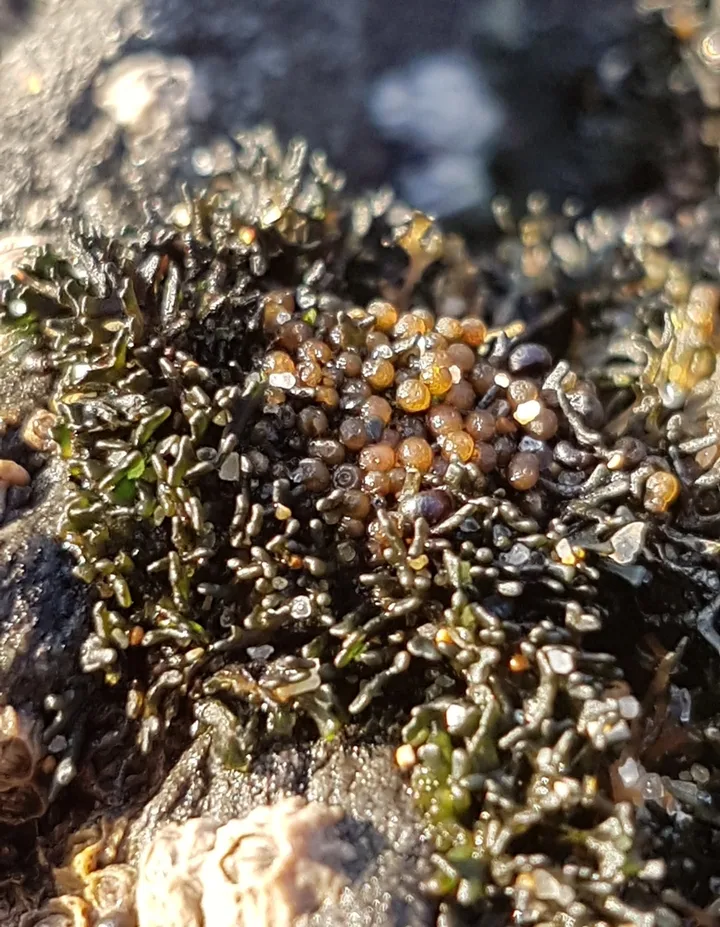
Foto yang diasosiasikan dengan Lichina pygmaea pada iNaturalist. Identifikasi mengikuti sumber; bukan penentuan spesimen independen.
Kredit dan penggunaan
(c) anasacuta, some rights reserved (CC BY), uploaded by anasacuta
Ukuran dan format gambar disesuaikan tanpa pemotongan, retus, atau penambahan skala. Lisensi sumber dipertahankan.
Sumber profil
- [1] Lichina pygmaea — Wikipedia (en)
- [2] Catalogue of Life Base2026-09-11 — Lichina pygmaea
- [3] Dokumentasi visual — Lichina pygmaea
- [4] Dokumentasi visual — Lichina pygmaea
Rujukan halaman ini
Fungi. Lichina pygmaea. Rilis data fungi-2026-10-12-expansion-2. https://fungi-atlas.mgadib.chatgpt.site/jamur/lichina-pygmaea/.
Status: impor sumber; pemeriksaan editorial per profil belum selesai. Untuk klaim biologis, gunakan rujukan pada bagian terkait dan periksa konteks sumber aslinya.