01 / Morfologi

Ciri dan struktur

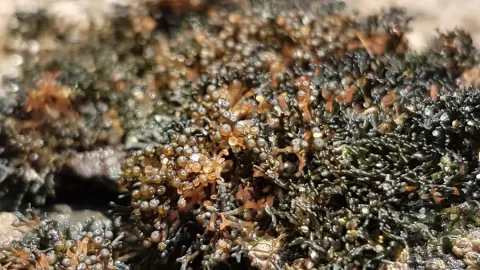
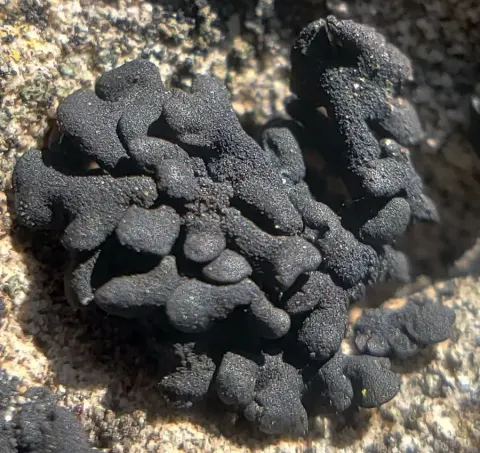
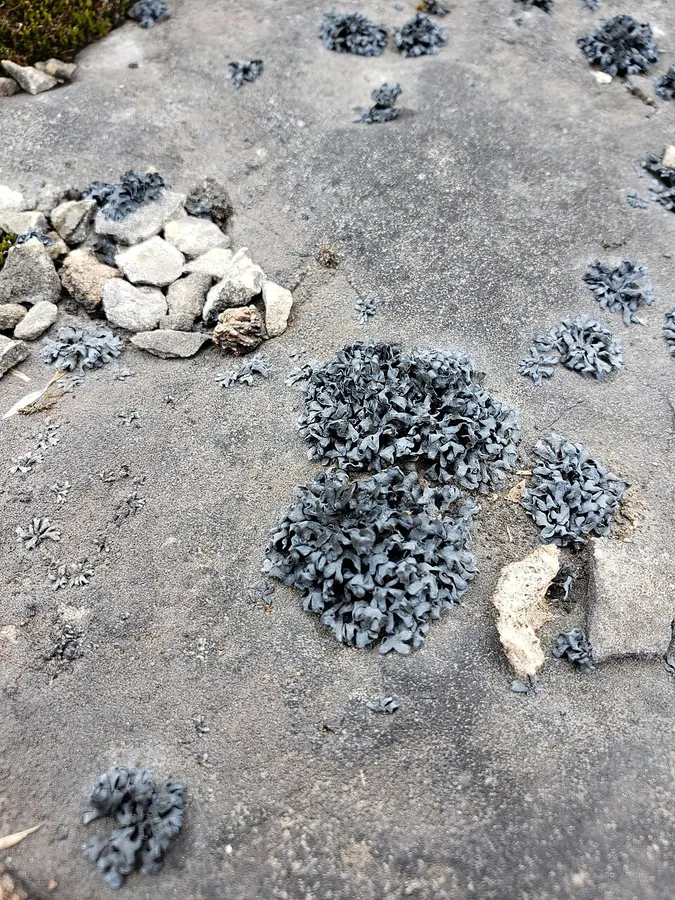
The thallus (lichen body) of Thyrea confusa is olive-black to black and often has a slightly frosted (), powdery-looking surface. Young thalli form small rosettes, but with age they become somewhat tufted or shrubby, developing into patches up to about 2 cm across. The lichen is divided into flattened, tongue-like 1–3 mm wide that are irregularly to dichotomously cut towards the tips. These lobes often carry numerous tiny, nearly spherical isidia—minute outgrowths that act as vegetative propagules—about 7–20 (rarely up to 30) micrometres (μm) in diameter. In vertical section the thallus is relatively thick for a crustose lichen, about 0.24–0.30 mm deep. The internal tissue is built from slender fungal hyphae 1–2.5 micrometres (μm) thick that run more or less parallel in the centre and form a loose network nearer the surface. The photosynthetic partner is a unicellular cyanobacterium belonging to the Chroococcales; its cells are 3–8 μm in diameter and occur singly rather than in chains. Fruiting bodies are small, dark , which are structures that function as apothecia (disc-like sexual fruiting bodies) but arise from organs that initially resemble pycnidia. They occur along the lobe margins or on the upper surface, are first immersed in the thallus and later slightly raised, and reach up to about 0.25 mm across. In section, the hymenium (spore-bearing layer) stains blue with iodine, indicating an amyloid reaction. The asci are cylindrical and produce eight spores each. These ascospores are colourless and ellipsoid in shape, small for the family, and typically measure between 8 and 12 μm long by 6 to 7 μm wide, though some specimens range slightly outside these dimensions.

Sebagian uraian ditampilkan dalam bahasa sumber; terjemahannya belum tersedia atau belum lolos pemeriksaan.

Rujukan: [1]

Pengukuran mengikuti objek, spesimen atau kultur, dan metode yang disebutkan sumber. Baca uraian asli untuk konteks lengkap.

02 / Kehidupan

Habitat dan peran ekologis

Thyrea confusa is known from calcareous rock faces in southern France. The type collection was made on limestone cliffs at Les Baumettes, Collet de Brousse in the Vaucluse, where the lichen grows in moist seepage zones on otherwise dry rock walls. Additional material has been collected near Mireval in the Hérault department, at about 50 m altitude, where it occurs on low-lying limestone outcrops and was previously distributed under the misapplied name Thyrea pulvinata in Vězda's exsiccata. Further records indicate that Thyrea confusa has a scattered but wide distribution across Eurasia and the Americas. In Eurasia it has been reported from saxicolous communities on calcareous outcrops in Golestan National Park in north-eastern Iran, from calcareous rock faces in the Iğdır region of eastern Turkey, from carbonate gullies in the Orenburg Nature Reserve in the Southern Urals, and from Collematetea cristati "black-zone" cyanobacterial lichen communities on damp limestone cliffs in the Dnister Canyon of western Ukraine. It has also been recorded on limestone outcrops in the southern Russian Far East (Primorye Territory and Sakhalin), where recent surveys list it among species newly reported for that region.

Sebagian uraian ditampilkan dalam bahasa sumber; terjemahannya belum tersedia atau belum lolos pemeriksaan.

Rujukan: [1]

Habitat atau konteks temuan
Informasi belum tersedia pada sumber rilis ini.
Substrat
Informasi belum tersedia pada sumber rilis ini.
Peran atau konteks
Pembentuk liken
Temukan hubungan serupa
03 / Siklus hidup

Reproduksi

The thallus (lichen body) of Thyrea confusa is olive-black to black and often has a slightly frosted (), powdery-looking surface. Young thalli form small rosettes, but with age they become somewhat tufted or shrubby, developing into patches up to about 2 cm across. The lichen is divided into flattened, tongue-like 1–3 mm wide that are irregularly to dichotomously cut towards the tips. These lobes often carry numerous tiny, nearly spherical isidia—minute outgrowths that act as vegetative propagules—about 7–20 (rarely up to 30) micrometres (μm) in diameter. Fruiting bodies are small, dark , which are structures that function as apothecia (disc-like sexual fruiting bodies) but arise from organs that initially resemble pycnidia.

Sebagian uraian ditampilkan dalam bahasa sumber; terjemahannya belum tersedia atau belum lolos pemeriksaan.

Rujukan: [1]

04 / Batas informasi

Catatan identitas dan cakupan

  • Nama diterima mengikuti Catalogue of Life Base2026-09-11; uraian mempertahankan konsep dan nama sumber aslinya.
  • Original geographic, specimen and life-cycle scope retained; source import awaits individual editorial review.
  • Impor dan terjemahan otomatis belum diperiksa editorial per profil. Struktur reproduktif yang disebutkan tidak membuktikan seluruh siklus hidup diketahui.
  • Pengukuran pada uraian mengikuti spesimen, kultur, dan metode sumber; angka tidak diperluas ke semua populasi.

Catatan distribusi dalam narasi mengikuti sumbernya. Dokumentasi spesimen atau foto mengikuti catatan sumber. Bukti wilayah Indonesia dan penilaian konservasi tidak disimpulkan dari gambar.

05 / Dokumentasi

Melihat dengan konteks

Dokumentasi Thyrea confusa dari Wikimedia Commons. Confused Limestone Lichen ( Thyrea confusa ) Identifikasi mengikuti record berkas sumber.

Jenis
Fotografi
Kredit
Patrick Jackson
Lisensi
CC BY 4.0
Sumber media
Buka entri sumber

Gambar menunjukkan objek menurut identifikasi sumber, bukan verifikasi independen spesimen oleh Fungi. Tidak ada skala baru yang ditambahkan.

06 / Rujukan

Sumber profil

  1. [1] Thyrea confusa — Wikipedia (en)Bagian sumber: Frozen revision 1348863537
    Tanggal penghimpunan sumber: 2026-10-12
    Teks sumber: CC BY-SA4.0 · Wikipedia contributors
  2. [2] Catalogue of Life Base2026-09-11 — Thyrea confusaBagian sumber: ColDP NameUsage.tsv ID 7C9FC; accepted species; source 2073
    Tanggal penghimpunan sumber: 2026-10-12
  3. [3] Dokumentasi visual — Thyrea confusaBagian sumber: Individual media record; identification follows the source, not independent determination
    Tanggal penghimpunan sumber: 2026-10-12
    Media sumber: CC BY 4.0 · Patrick Jackson

Adaptasi teks: CC BY-SA 4.0. Wikipedia contributors — Thyrea confusa — Wikipedia (en)

Uraian asli dan riwayat sumber

Riwayat atau halaman sumber

Ringkasan sumber

Thyrea confusa is a species of cyanolichen in the family Lichinaceae. The species was formally described in 1990 to provide a correct name for Mediterranean rock-dwelling lichens that had been previously misidentified under an incorrect species name. Thyrea confusa grows as dark, lobed patches on moist calcareous rock faces, typically in Mediterranean climates, and reproduces through both spores and tiny vegetative outgrowths that allow it to spread asexually. The species has a scattered but wide distribution across southern Europe, western Asia, and North America, occurring on limestone and other base-rich rock substrates where cyanolichen communities are common.

Revisi sumber

Morfologi sumber

The thallus (lichen body) of Thyrea confusa is olive-black to black and often has a slightly frosted (), powdery-looking surface. Young thalli form small rosettes, but with age they become somewhat tufted or shrubby, developing into patches up to about 2 cm across. The lichen is divided into flattened, tongue-like 1–3 mm wide that are irregularly to dichotomously cut towards the tips. These lobes often carry numerous tiny, nearly spherical isidia—minute outgrowths that act as vegetative propagules—about 7–20 (rarely up to 30) micrometres (μm) in diameter. In vertical section the thallus is relatively thick for a crustose lichen, about 0.24–0.30 mm deep. The internal tissue is built from slender fungal hyphae 1–2.5 micrometres (μm) thick that run more or less parallel in the centre and form a loose network nearer the surface. The photosynthetic partner is a unicellular cyanobacterium belonging to the Chroococcales; its cells are 3–8 μm in diameter and occur singly rather than in chains. Fruiting bodies are small, dark , which are structures that function as apothecia (disc-like sexual fruiting bodies) but arise from organs that initially resemble pycnidia. They occur along the lobe margins or on the upper surface, are first immersed in the thallus and later slightly raised, and reach up to about 0.25 mm across. In section, the hymenium (spore-bearing layer) stains blue with iodine, indicating an amyloid reaction. The asci are cylindrical and produce eight spores each. These ascospores are colourless and ellipsoid in shape, small for the family, and typically measure between 8 and 12 μm long by 6 to 7 μm wide, though some specimens range slightly outside these dimensions.

Revisi sumber

Ekologi sumber

Thyrea confusa is known from calcareous rock faces in southern France. The type collection was made on limestone cliffs at Les Baumettes, Collet de Brousse in the Vaucluse, where the lichen grows in moist seepage zones on otherwise dry rock walls. Additional material has been collected near Mireval in the Hérault department, at about 50 m altitude, where it occurs on low-lying limestone outcrops and was previously distributed under the misapplied name Thyrea pulvinata in Vězda's exsiccata. Further records indicate that Thyrea confusa has a scattered but wide distribution across Eurasia and the Americas. In Eurasia it has been reported from saxicolous communities on calcareous outcrops in Golestan National Park in north-eastern Iran, from calcareous rock faces in the Iğdır region of eastern Turkey, from carbonate gullies in the Orenburg Nature Reserve in the Southern Urals, and from Collematetea cristati "black-zone" cyanobacterial lichen communities on damp limestone cliffs in the Dnister Canyon of western Ukraine. It has also been recorded on limestone outcrops in the southern Russian Far East (Primorye Territory and Sakhalin), where recent surveys list it among species newly reported for that region.

Revisi sumber

Struktur reproduksi sumber

The thallus (lichen body) of Thyrea confusa is olive-black to black and often has a slightly frosted (), powdery-looking surface. Young thalli form small rosettes, but with age they become somewhat tufted or shrubby, developing into patches up to about 2 cm across. The lichen is divided into flattened, tongue-like 1–3 mm wide that are irregularly to dichotomously cut towards the tips. These lobes often carry numerous tiny, nearly spherical isidia—minute outgrowths that act as vegetative propagules—about 7–20 (rarely up to 30) micrometres (μm) in diameter. Fruiting bodies are small, dark , which are structures that function as apothecia (disc-like sexual fruiting bodies) but arise from organs that initially resemble pycnidia.

Revisi sumber

Rujukan halaman ini

Fungi. Thyrea confusa. Rilis data fungi-2026-10-12-expansion-2. https://fungi-atlas.mgadib.chatgpt.site/jamur/thyrea-confusa/.

Status: impor sumber; pemeriksaan editorial per profil belum selesai. Untuk klaim biologis, gunakan rujukan pada bagian terkait dan periksa konteks sumber aslinya.