01 / Morfologi

Ciri dan struktur

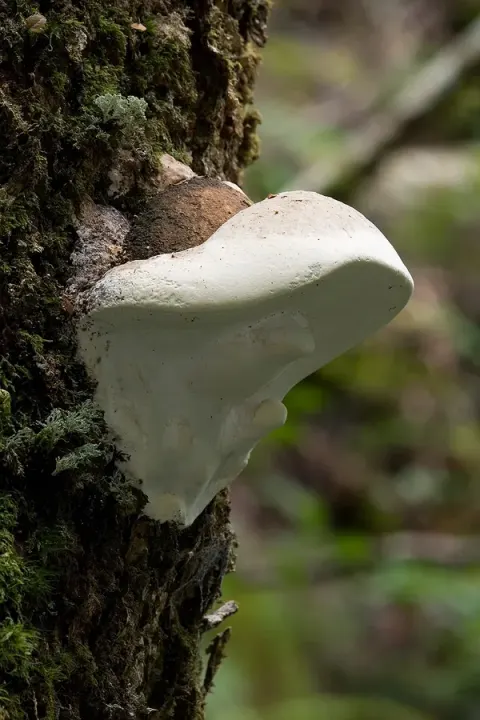
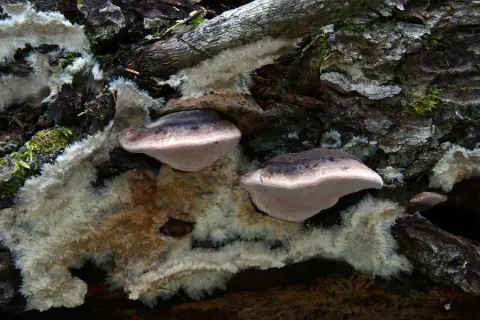
The perennial fruit bodies of N. serialiformis are effused-reflexed (that is, on a vertical surface that is partially lying flat on the substrate with the hymenium covering the upper surface, and partially pileate). In its upper part it has small caps that are often elongated along the growing surface, up to 20 mm or more in length, with a tough texture. The individual caps, which reach dimensions of up to 10 by 20 mm by 7 mm, have roughly horizontal upper surfaces that are velvety, and brownish with a narrow white margin. On the underside of the cap, the pore surface is initially white, but turns dirty brown as it matures. The individual pores are round and small, numbering from 3 to 4 per millimeter. The tubes are the same color as the pore surface, and up to 5 mm deep. The flesh is white and up to 1 mm thick. Fruit bodies are often infested with microlepidoptera species, which causes the pore surface to be powdery. Neoantrodia serialiformis has a dimitic hyphal system, meaning that predominantly two types of hyphae comprise the fruit body. The generative hyphae (relatively undifferentiated hyphae that can develop reproductive structures) are thin-walled, with clamp connections, and are 2–3 μm wide. The skeletal hyphae (thick-walled and long) predominate; they are hyaline (translucent), straight, and 2–5 μm in width. Cystidia are absent, and cystidioles (cells in the hymenium about the same size as the basidia, but remaining sterile) are inconspicuous. The basidia are club-shaped, four-spored, and have a clamp connection at their bases; they measure 12–18 by 4–6 μm. The thin-walled spores are ellipsoid to somewhat tapered at both ends, hyaline, inamyloid (non-staining in Melzer's reagent), and measure 4.5–5.5 by 2–2.3 μm.

Sebagian uraian ditampilkan dalam bahasa sumber; terjemahannya belum tersedia atau belum lolos pemeriksaan.

Rujukan: [1]

Pengukuran mengikuti objek, spesimen atau kultur, dan metode yang disebutkan sumber. Baca uraian asli untuk konteks lengkap.

02 / Kehidupan

Habitat dan peran ekologis

The fungus grows on lying oak logs in Pennsylvania, Maryland, Virginia, North Carolina, and Tennessee. However, owing to its similarity with Neoantrodia serialis, it is likely the two have been confused in the past, and so the true limits of its distribution are unclear. The authors suggests that it probably occurs in other south-eastern states of the US as well, and consider it "one of the most common polypore species in the eastern USA". N. serialiformis is sometimes found together with the much rarer Rhodofomitopsis oleracea, a grayish, strictly resupinate species.

Sebagian uraian ditampilkan dalam bahasa sumber; terjemahannya belum tersedia atau belum lolos pemeriksaan.

Rujukan: [1]

Habitat atau konteks temuan
Informasi belum tersedia pada sumber rilis ini.
Substrat
Informasi belum tersedia pada sumber rilis ini.
Peran atau konteks
Belum dikategorikan pada rilis ini.
Temukan hubungan serupa
03 / Siklus hidup

Reproduksi

Neoantrodia serialiformis has a dimitic hyphal system, meaning that predominantly two types of hyphae comprise the fruit body. The generative hyphae (relatively undifferentiated hyphae that can develop reproductive structures) are thin-walled, with clamp connections, and are 2–3 μm wide. The skeletal hyphae (thick-walled and long) predominate; they are hyaline (translucent), straight, and 2–5 μm in width. Cystidia are absent, and cystidioles (cells in the hymenium about the same size as the basidia, but remaining sterile) are inconspicuous. The basidia are club-shaped, four-spored, and have a clamp connection at their bases; they measure 12–18 by 4–6 μm. The thin-walled spores are ellipsoid to somewhat tapered at both ends, hyaline, inamyloid (non-staining in Melzer's reagent), and measure 4.5–5.5 by 2–2.3 μm.

Sebagian uraian ditampilkan dalam bahasa sumber; terjemahannya belum tersedia atau belum lolos pemeriksaan.

Rujukan: [1]

Sinonim menurut acuan taksonomi rilis: Antrodia serialiformis
04 / Batas informasi

Catatan identitas dan cakupan

  • Nama diterima mengikuti Catalogue of Life Base2026-09-11; uraian mempertahankan konsep dan nama sumber aslinya.
  • Original geographic, specimen and life-cycle scope retained; source import awaits individual editorial review.
  • Impor dan terjemahan otomatis belum diperiksa editorial per profil. Struktur reproduktif yang disebutkan tidak membuktikan seluruh siklus hidup diketahui.
  • Pengukuran pada uraian mengikuti spesimen, kultur, dan metode sumber; angka tidak diperluas ke semua populasi.

Catatan distribusi dalam narasi mengikuti sumbernya. Dokumentasi spesimen atau foto mengikuti catatan sumber. Bukti wilayah Indonesia dan penilaian konservasi tidak disimpulkan dari gambar.

05 / Dokumentasi

Melihat dengan konteks

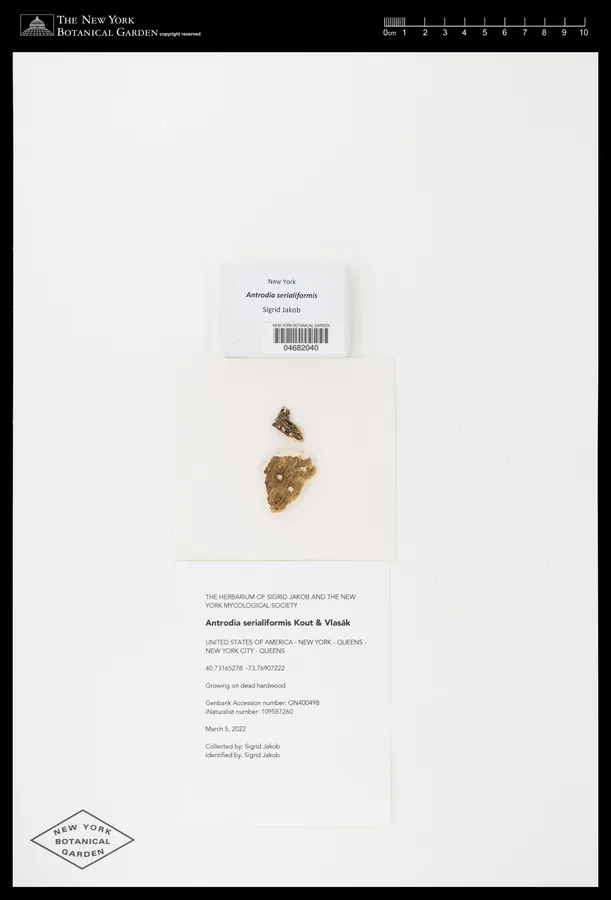
Voucher herbarium Antrodia serialiformis (04682040), The New York Botanical Garden. Identifikasi mengikuti record spesimen sumber. Foto bahan, kemasan, atau label herbarium sebagaimana tersedia pada record institusi; bukan foto lapangan atau penentuan spesimen independen.

Jenis
Voucher herbarium
Kredit
The New York Botanical Garden
Lisensi
CC BY 4.0
Sumber media
Buka entri sumber

Gambar menunjukkan objek menurut identifikasi sumber, bukan verifikasi independen spesimen oleh Fungi. Tidak ada skala baru yang ditambahkan.

06 / Rujukan

Sumber profil

  1. [1] Neoantrodia serialiformis — Wikipedia (en)Bagian sumber: Frozen revision 1338674657
    Tanggal penghimpunan sumber: 2026-10-12
    Teks sumber: CC BY-SA4.0 · Wikipedia contributors
  2. [2] Catalogue of Life Base2026-09-11 — Neoantrodia serialiformisBagian sumber: ColDP NameUsage.tsv ID 746KM; accepted species; source 2073
    Tanggal penghimpunan sumber: 2026-10-12
  3. [3] Dokumentasi visual — Antrodia serialiformisBagian sumber: Individual media record; identification follows the source, not independent determination
    Tanggal penghimpunan sumber: 2026-10-12
    Media sumber: CC BY 4.0 · The New York Botanical Garden

Adaptasi teks: CC BY-SA 4.0. Wikipedia contributors — Neoantrodia serialiformis — Wikipedia (en)

Uraian asli dan riwayat sumber

Riwayat atau halaman sumber

Ringkasan sumber

Neoantrodia serialiformis is a species of polypore fungus in the family Fomitopsidaceae. The fungus is resupinate, consisting of a fertile spore-bearing pore surface lying flat on the underside of decaying wood, although one or more fan-shaped overlapping caps may also be formed. Although quite common in the eastern United States, it was not recognized as a distinct species until 2009, owing to its resemblance to the closely related Neoantrodia serialis. Differences in ecology, spore size, and DNA sequences distinguish the two lookalikes.

Revisi sumber

Morfologi sumber

The perennial fruit bodies of N. serialiformis are effused-reflexed (that is, on a vertical surface that is partially lying flat on the substrate with the hymenium covering the upper surface, and partially pileate). In its upper part it has small caps that are often elongated along the growing surface, up to 20 mm or more in length, with a tough texture. The individual caps, which reach dimensions of up to 10 by 20 mm by 7 mm, have roughly horizontal upper surfaces that are velvety, and brownish with a narrow white margin. On the underside of the cap, the pore surface is initially white, but turns dirty brown as it matures. The individual pores are round and small, numbering from 3 to 4 per millimeter. The tubes are the same color as the pore surface, and up to 5 mm deep. The flesh is white and up to 1 mm thick. Fruit bodies are often infested with microlepidoptera species, which causes the pore surface to be powdery. Neoantrodia serialiformis has a dimitic hyphal system, meaning that predominantly two types of hyphae comprise the fruit body. The generative hyphae (relatively undifferentiated hyphae that can develop reproductive structures) are thin-walled, with clamp connections, and are 2–3 μm wide. The skeletal hyphae (thick-walled and long) predominate; they are hyaline (translucent), straight, and 2–5 μm in width. Cystidia are absent, and cystidioles (cells in the hymenium about the same size as the basidia, but remaining sterile) are inconspicuous. The basidia are club-shaped, four-spored, and have a clamp connection at their bases; they measure 12–18 by 4–6 μm. The thin-walled spores are ellipsoid to somewhat tapered at both ends, hyaline, inamyloid (non-staining in Melzer's reagent), and measure 4.5–5.5 by 2–2.3 μm.

Revisi sumber

Ekologi sumber

The fungus grows on lying oak logs in Pennsylvania, Maryland, Virginia, North Carolina, and Tennessee. However, owing to its similarity with Neoantrodia serialis, it is likely the two have been confused in the past, and so the true limits of its distribution are unclear. The authors suggests that it probably occurs in other south-eastern states of the US as well, and consider it "one of the most common polypore species in the eastern USA". N. serialiformis is sometimes found together with the much rarer Rhodofomitopsis oleracea, a grayish, strictly resupinate species.

Revisi sumber

Struktur reproduksi sumber

Neoantrodia serialiformis has a dimitic hyphal system, meaning that predominantly two types of hyphae comprise the fruit body. The generative hyphae (relatively undifferentiated hyphae that can develop reproductive structures) are thin-walled, with clamp connections, and are 2–3 μm wide. The skeletal hyphae (thick-walled and long) predominate; they are hyaline (translucent), straight, and 2–5 μm in width. Cystidia are absent, and cystidioles (cells in the hymenium about the same size as the basidia, but remaining sterile) are inconspicuous. The basidia are club-shaped, four-spored, and have a clamp connection at their bases; they measure 12–18 by 4–6 μm. The thin-walled spores are ellipsoid to somewhat tapered at both ends, hyaline, inamyloid (non-staining in Melzer's reagent), and measure 4.5–5.5 by 2–2.3 μm.

Revisi sumber

Rujukan halaman ini

Fungi. Neoantrodia serialiformis. Rilis data fungi-2026-10-12-expansion-2. https://fungi-atlas.mgadib.chatgpt.site/jamur/neoantrodia-serialiformis/.

Status: impor sumber; pemeriksaan editorial per profil belum selesai. Untuk klaim biologis, gunakan rujukan pada bagian terkait dan periksa konteks sumber aslinya.