01 / Morfologi

Ciri dan struktur

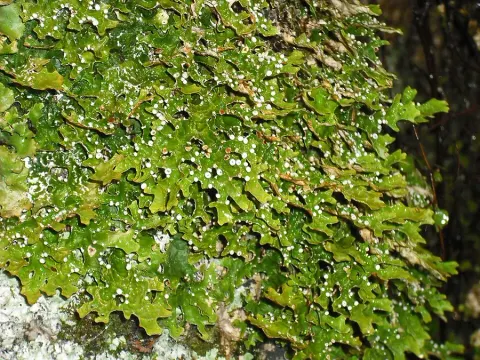
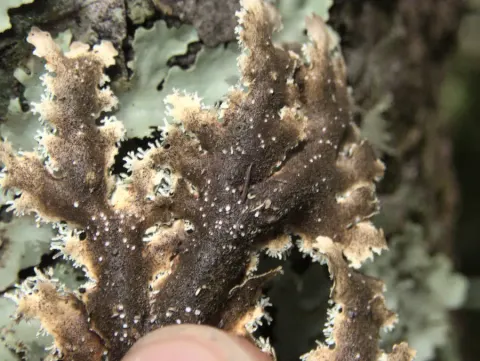
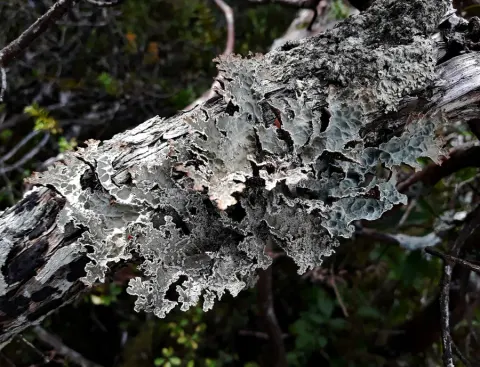
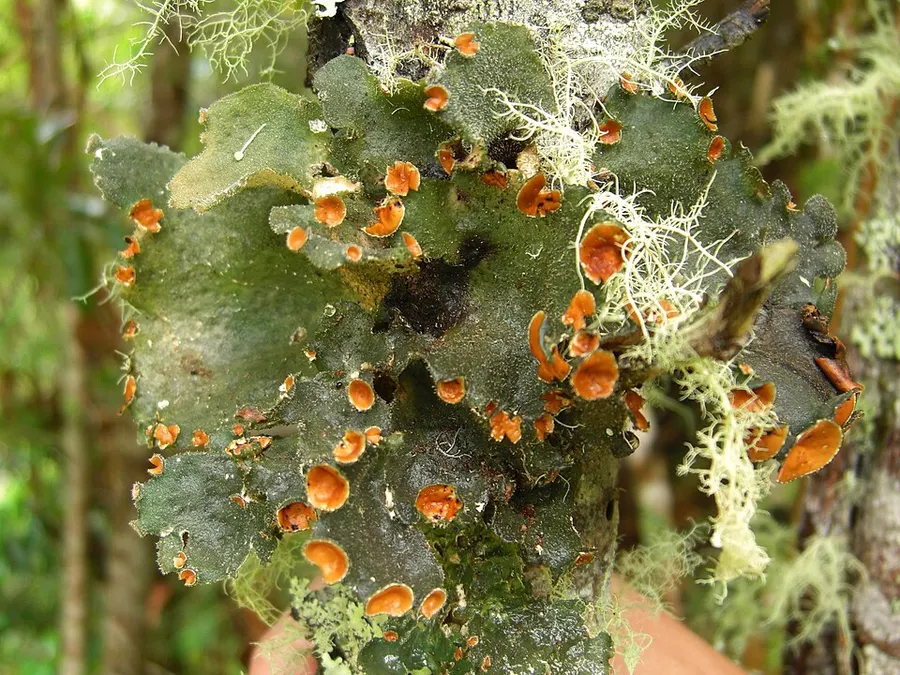
Pseudocyphellaria hirsuta is a foliose (leafy) lichen with a thallus that ranges from roughly circular to irregular in shape, typically measuring between 4 and 10 cm in diameter, though it can grow as large as 27 cm. The thallus attaches centrally to like twigs, bark, rocks, and soil, with its remaining free at the margins. These lobes are broadly rounded and can vary in size from 2 to 15 mm in diameter. The margins of the lobes are mostly smooth, slightly sinuous or shallowly folded, and can occasionally bear small, leaf-like structures known as . The lower surface of the thallus is often thickened and may have ridges or be slightly rolled, with a dense covering of hair-like structures. The upper surface of the thallus is typically dull grey to bluish-grey when wet, and shifts to pale buff-grey, brown, or olive when dry. It can be slightly wrinkled or pitted and is usually covered in short to long, silky white hairs. In some areas, these hairs are more sparse or only found at the margins, while in other parts, the surface may be almost smooth except at the edges. The beneath the hairs is somewhat leathery and can sometimes appear roughened. Pseudocyphellaria hirsuta does not produce soredia, isidia, or , which are common reproductive or structural features in other lichen species. Phyllidia are present occasionally, particularly along the margins, where they are irregular and densely covered in hairs. The medulla, or inner tissue layer, is white. The lower surface of the thallus is often wrinkled, with a pale buff to brownish colouration. It is typically covered in a soft, velvety layer of , a dense mat of fine hairs, which is whitish at the edges and browner towards the centre.

Sebagian uraian ditampilkan dalam bahasa sumber; terjemahannya belum tersedia atau belum lolos pemeriksaan.

Rujukan: [1]

Pengukuran mengikuti objek, spesimen atau kultur, dan metode yang disebutkan sumber. Baca uraian asli untuk konteks lengkap.

02 / Kehidupan

Habitat dan peran ekologis

Pseudocyphellaria hirsuta is primarily found in southern South America, with specimens recorded from Argentina and Chile. The species has a wide distribution within these countries, ranging from central Chile to Tierra del Fuego and Staten Island in Argentina. In Argentina, P. hirsuta has been collected from several provinces, including Neuquén, Río Negro, Chubut, and Tierra del Fuego. In Chile, it has been found in various locations from Valparaíso Province in the north to Magallanes Province in the south, including the island of Chiloé. This lichen species shows a preference for forested habitats, particularly those dominated by Nothofagus species. It has been frequently collected from Nothofagus dombeyi, N. obliqua, and N. pumilio. Other host trees include Araucaria, Austrocedrus, and Fuchsia magellanica. P. hirsuta has also been found growing on Berberis ilicifolia, particularly in the southernmost parts of its range. While primarily an epiphytic species growing on tree bark, P. hirsuta has also been observed growing on rocks, soil, and stumps, especially in deforested areas or on rocky, forestless slopes. It occurs in various forest types, including Araucaria-Nothofagus mixed forests and Austrocedrus forests.

Sebagian uraian ditampilkan dalam bahasa sumber; terjemahannya belum tersedia atau belum lolos pemeriksaan.

Rujukan: [1]

Habitat atau konteks temuan
hutan
Substrat
Informasi belum tersedia pada sumber rilis ini.
Peran atau konteks
Pembentuk liken
Temukan hubungan serupa
03 / Siklus hidup

Reproduksi

Pseudocyphellaria hirsuta does not produce soredia, isidia, or , which are common reproductive or structural features in other lichen species. Phyllidia are present occasionally, particularly along the margins, where they are irregular and densely covered in hairs. The medulla, or inner tissue layer, is white. The lower surface of the thallus is often wrinkled, with a pale buff to brownish colouration. It is typically covered in a soft, velvety layer of , a dense mat of fine hairs, which is whitish at the edges and browner towards the centre. Scattered across this surface are small, yellow structures called pseudocyphellae, which are slightly sunken and appear as tiny warts without a defined border.

Sebagian uraian ditampilkan dalam bahasa sumber; terjemahannya belum tersedia atau belum lolos pemeriksaan.

Rujukan: [1]

Sinonim menurut acuan taksonomi rilis: Cyanisticta hirsuta; Sticta hirsuta; Stictina hirsuta
04 / Batas informasi

Catatan identitas dan cakupan

  • Nama diterima mengikuti Catalogue of Life Base2026-09-11; uraian mempertahankan konsep dan nama sumber aslinya.
  • Original geographic, specimen and life-cycle scope retained; source import awaits individual editorial review.
  • Impor dan terjemahan otomatis belum diperiksa editorial per profil. Struktur reproduktif yang disebutkan tidak membuktikan seluruh siklus hidup diketahui.
  • Pengukuran pada uraian mengikuti spesimen, kultur, dan metode sumber; angka tidak diperluas ke semua populasi.

Catatan distribusi dalam narasi mengikuti sumbernya. Dokumentasi spesimen atau foto mengikuti catatan sumber. Bukti wilayah Indonesia dan penilaian konservasi tidak disimpulkan dari gambar.

05 / Dokumentasi

Melihat dengan konteks

Dokumentasi Pseudocyphellaria hirsuta dari Wikimedia Commons. For more information about this, see the observation page at Mushroom Observer. Identifikasi mengikuti record berkas sumber.

Jenis
Fotografi
Kredit
This image was created by user Jason Hollinger (jason) at Mushroom Observer , a source for mycological images. You can contact this user here .
Sumber media
Buka entri sumber

Gambar menunjukkan objek menurut identifikasi sumber, bukan verifikasi independen spesimen oleh Fungi. Tidak ada skala baru yang ditambahkan.

06 / Rujukan

Sumber profil

  1. [1] Pseudocyphellaria hirsuta — Wikipedia (en)Bagian sumber: Frozen revision 1293432344
    Tanggal penghimpunan sumber: 2026-10-12
    Teks sumber: CC BY-SA4.0 · Wikipedia contributors
  2. [2] Catalogue of Life Base2026-09-11 — Pseudocyphellaria hirsutaBagian sumber: ColDP NameUsage.tsv ID 4NVJJ; accepted species; source 2073
    Tanggal penghimpunan sumber: 2026-10-12
  3. [3] Dokumentasi visual — Pseudocyphellaria hirsutaBagian sumber: Individual media record; identification follows the source, not independent determination
    Tanggal penghimpunan sumber: 2026-10-12
    Media sumber: CC BY-SA 3.0 · This image was created by user Jason Hollinger (jason) at Mushroom Observer , a source for mycological images. You can contact this user here .

Adaptasi teks: CC BY-SA 4.0. Wikipedia contributors — Pseudocyphellaria hirsuta — Wikipedia (en)

Uraian asli dan riwayat sumber

Riwayat atau halaman sumber

Ringkasan sumber

Pseudocyphellaria hirsuta is a species of foliose lichen in the family Peltigeraceae. First described in 1835, it has undergone several taxonomic revisions over nearly two centuries. The lichen forms a flat, leaf-like structure (thallus) that can grow up to 27 cm in diameter, typically appearing grey or brown and covered in fine hairs. It is characterised by small pore-like structures called pseudocyphellae on its lower surface, which can be yellow or, less commonly, white. P. hirsuta grows mainly on trees in forested areas, particularly those dominated by southern beech (Nothofagus) species, but can also be found on rocks, soil, and stumps.

Revisi sumber

Morfologi sumber

Pseudocyphellaria hirsuta is a foliose (leafy) lichen with a thallus that ranges from roughly circular to irregular in shape, typically measuring between 4 and 10 cm in diameter, though it can grow as large as 27 cm. The thallus attaches centrally to like twigs, bark, rocks, and soil, with its remaining free at the margins. These lobes are broadly rounded and can vary in size from 2 to 15 mm in diameter. The margins of the lobes are mostly smooth, slightly sinuous or shallowly folded, and can occasionally bear small, leaf-like structures known as . The lower surface of the thallus is often thickened and may have ridges or be slightly rolled, with a dense covering of hair-like structures. The upper surface of the thallus is typically dull grey to bluish-grey when wet, and shifts to pale buff-grey, brown, or olive when dry. It can be slightly wrinkled or pitted and is usually covered in short to long, silky white hairs. In some areas, these hairs are more sparse or only found at the margins, while in other parts, the surface may be almost smooth except at the edges. The beneath the hairs is somewhat leathery and can sometimes appear roughened. Pseudocyphellaria hirsuta does not produce soredia, isidia, or , which are common reproductive or structural features in other lichen species. Phyllidia are present occasionally, particularly along the margins, where they are irregular and densely covered in hairs. The medulla, or inner tissue layer, is white. The lower surface of the thallus is often wrinkled, with a pale buff to brownish colouration. It is typically covered in a soft, velvety layer of , a dense mat of fine hairs, which is whitish at the edges and browner towards the centre.

Revisi sumber

Ekologi sumber

Pseudocyphellaria hirsuta is primarily found in southern South America, with specimens recorded from Argentina and Chile. The species has a wide distribution within these countries, ranging from central Chile to Tierra del Fuego and Staten Island in Argentina. In Argentina, P. hirsuta has been collected from several provinces, including Neuquén, Río Negro, Chubut, and Tierra del Fuego. In Chile, it has been found in various locations from Valparaíso Province in the north to Magallanes Province in the south, including the island of Chiloé. This lichen species shows a preference for forested habitats, particularly those dominated by Nothofagus species. It has been frequently collected from Nothofagus dombeyi, N. obliqua, and N. pumilio. Other host trees include Araucaria, Austrocedrus, and Fuchsia magellanica. P. hirsuta has also been found growing on Berberis ilicifolia, particularly in the southernmost parts of its range. While primarily an epiphytic species growing on tree bark, P. hirsuta has also been observed growing on rocks, soil, and stumps, especially in deforested areas or on rocky, forestless slopes. It occurs in various forest types, including Araucaria-Nothofagus mixed forests and Austrocedrus forests.

Revisi sumber

Struktur reproduksi sumber

Pseudocyphellaria hirsuta does not produce soredia, isidia, or , which are common reproductive or structural features in other lichen species. Phyllidia are present occasionally, particularly along the margins, where they are irregular and densely covered in hairs. The medulla, or inner tissue layer, is white. The lower surface of the thallus is often wrinkled, with a pale buff to brownish colouration. It is typically covered in a soft, velvety layer of , a dense mat of fine hairs, which is whitish at the edges and browner towards the centre. Scattered across this surface are small, yellow structures called pseudocyphellae, which are slightly sunken and appear as tiny warts without a defined border.

Revisi sumber

Rujukan halaman ini

Fungi. Pseudocyphellaria hirsuta. Rilis data fungi-2026-10-12-expansion-2. https://fungi-atlas.mgadib.chatgpt.site/jamur/pseudocyphellaria-hirsuta/.

Status: impor sumber; pemeriksaan editorial per profil belum selesai. Untuk klaim biologis, gunakan rujukan pada bagian terkait dan periksa konteks sumber aslinya.