Ciri dan struktur
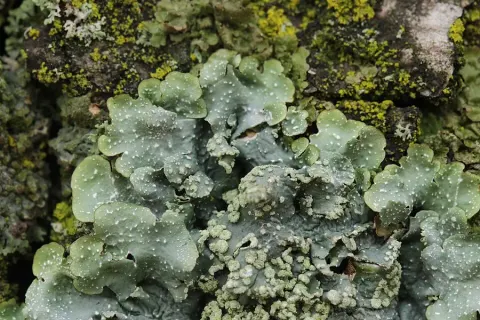
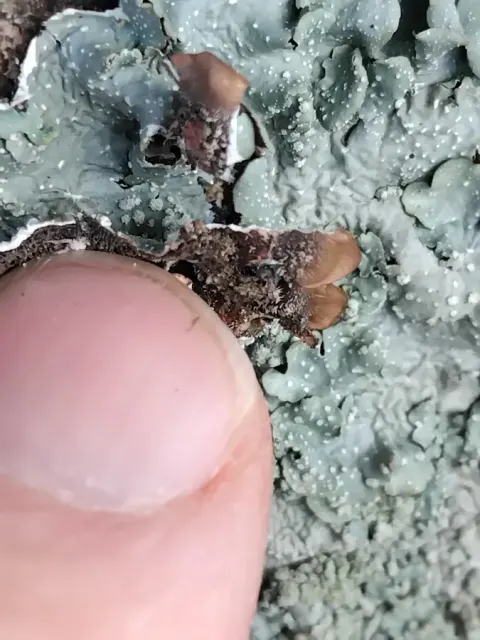
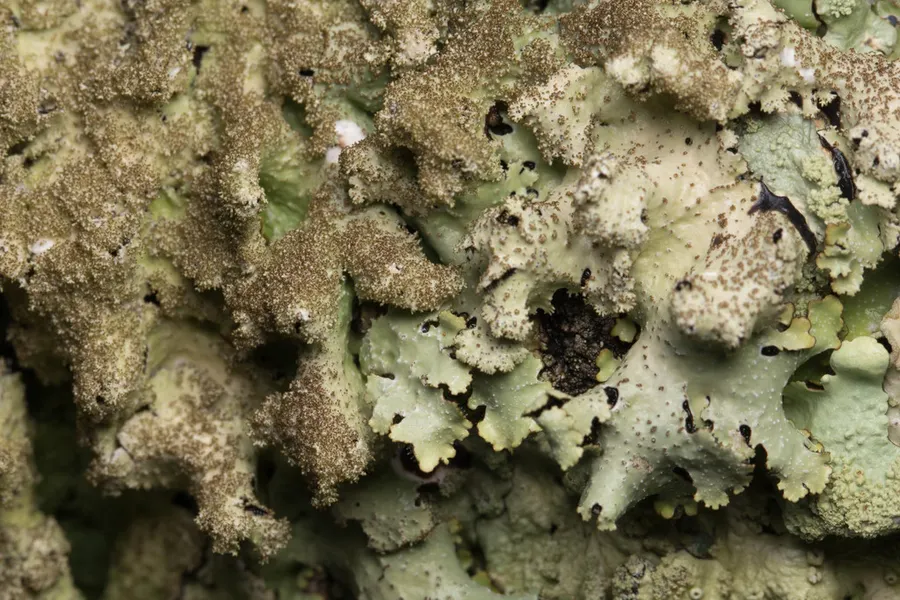
The thallus of Punctelia rudecta ranges in color from dark greenish-gray to almost blue-gray; it tends to be more gray-greenish when fresh, and more brown-yellowish when dry. The thallus has a relatively tight attachment to its substrate. The lobes comprising the thallus are mostly 3 – 8 mm wide, and are more or less covered with cylindrical to branched isidia; the isidia are typically more numerous towards the center of the thallus. Sometimes the isidia can become so dense that they form mounds, obscuring the lobes underneath. Both the margins of the lobes and the tips of the isidia have a brown tinge. The lichen, when it has a bluish-green coloration and dense isidia, can be readily spotted from a distance. White pseudocyphellae are usually prominent on the tips of the lobes. The lower surface of the thallus is tan, with pale rhizines. Apothecia are uncommon. If present, they are up to 4 mm in diameter, with a brown hymenium and thin margin rolled inward. The ascospores measure 12.8–16 by 8–9.6 μm, and are ellipsoid in shape. They lack septa, and are smooth, thin-walled, and hyaline. The photobiont partner is the green alga species Trebouxia anticipata. Standard chemical tests can be used to help identify Punctelia rudecta. In the medulla, these results are PD-, K-, KC+ red, and C+ red. The last of these tests indicates the presence of lecanoric acid. The cortex contains atranorin, which results in a yellow K+ reaction.
Habitat dan peran ekologis
Punctelia rudecta has a temperate distribution in North America. Although the range maps included in some popular North American lichen field guides suggest that it does not occur in the tropical climate of southern Florida, it was recorded in Fakahatchee Strand Preserve State Park in 2011. It is occasionally recorded from western North America, but it is much less frequently encountered there. It grows on bark of all kinds, or on shaded rocks. Irwin Brodo calls it "one of the most common eastern isidiate foliose lichens", while Erin Tripp and James Lendemer express similar sentiments about its prevalence, describing it as "arguably the weediest macrolichen east of the Mississippi River". In its range it grows in all types of forests, and at all elevations. The lichen occurs in most Canadian provinces (Manitoba, New Brunswick, Nova Scotia, Ontario, Prince Edward Island, Quebec, and Saskatchewan). It has a national conservation status of "secure", and is "secure" or "apparently secure" in all provinces except Saskatchewan, where its status is "critically imperiled". In Mexico, it has been reported from the Distrito Federal, Chiapas, Veracruz, Jalisco, Baja California, Chihuahua, Durango and Sonora.
- Habitat atau konteks temuan
- hutan
- Substrat
- kulit kayu
- Peran atau konteks
- Pembentuk liken
Reproduksi
The thallus of Punctelia rudecta ranges in color from dark greenish-gray to almost blue-gray; it tends to be more gray-greenish when fresh, and more brown-yellowish when dry. The thallus has a relatively tight attachment to its substrate. The lobes comprising the thallus are mostly 3 – 8 mm wide, and are more or less covered with cylindrical to branched isidia; the isidia are typically more numerous towards the center of the thallus. Sometimes the isidia can become so dense that they form mounds, obscuring the lobes underneath. Both the margins of the lobes and the tips of the isidia have a brown tinge. The lichen, when it has a bluish-green coloration and dense isidia, can be readily spotted from a distance.
Catatan identitas dan cakupan
- Nama diterima mengikuti Catalogue of Life Base2026-09-11; uraian mempertahankan konsep dan nama sumber aslinya.
- Original geographic, specimen and life-cycle scope retained; source import awaits individual editorial review.
- Impor dan terjemahan otomatis belum diperiksa editorial per profil. Struktur reproduktif yang disebutkan tidak membuktikan seluruh siklus hidup diketahui.
- Pengukuran pada uraian mengikuti spesimen, kultur, dan metode sumber; angka tidak diperluas ke semua populasi.
Catatan distribusi dalam narasi mengikuti sumbernya. Dokumentasi spesimen atau foto mengikuti catatan sumber. Bukti wilayah Indonesia dan penilaian konservasi tidak disimpulkan dari gambar.
Melihat dengan konteks
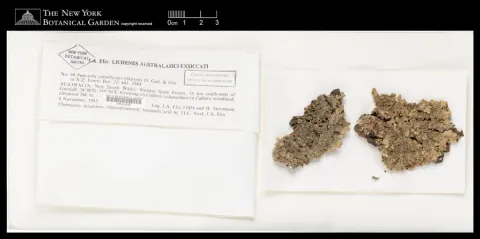
Dokumentasi Punctelia rudecta menurut asosiasi foto pada record takson iNaturalist. Kredit: Ken-ichi Ueda. Identitas mengikuti sumber; bukan penentuan spesimen independen.
- Jenis
- Fotografi
- Kredit
- (c) Ken-ichi Ueda, some rights reserved (CC BY), uploaded by Ken-ichi Ueda
- Lisensi
- CC BY 4.0
- Sumber media
- Buka entri sumber
Dokumentasi tambahan
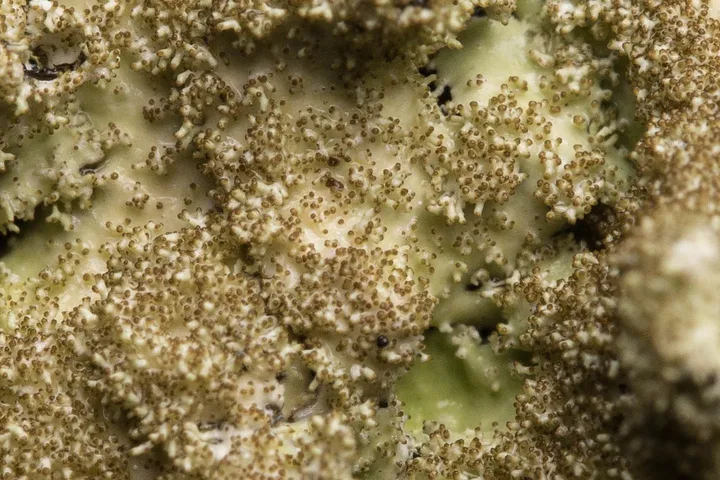
Foto yang diasosiasikan dengan Punctelia rudecta pada iNaturalist. Identifikasi mengikuti sumber; bukan penentuan spesimen independen.
Kredit dan penggunaan
(c) Ken-ichi Ueda, some rights reserved (CC BY), uploaded by Ken-ichi Ueda
Ukuran dan format gambar disesuaikan tanpa pemotongan, retus, atau penambahan skala. Lisensi sumber dipertahankan.
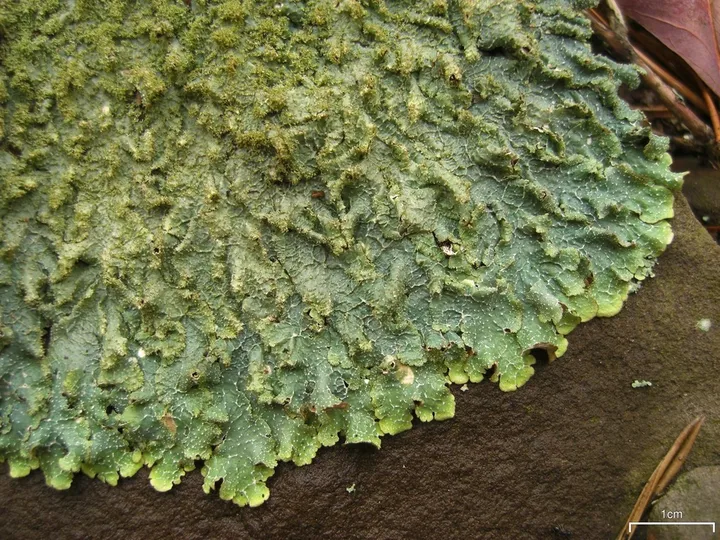
Foto yang diasosiasikan dengan Punctelia rudecta pada iNaturalist. Identifikasi mengikuti sumber; bukan penentuan spesimen independen.
Kredit dan penggunaan
(c) Jason Hollinger, some rights reserved (CC BY)
Ukuran dan format gambar disesuaikan tanpa pemotongan, retus, atau penambahan skala. Lisensi sumber dipertahankan.
Sumber profil
- [1] Punctelia rudecta — Wikipedia (en)
- [2] Catalogue of Life Base2026-09-11 — Punctelia rudecta
- [3] Dokumentasi visual — Punctelia rudecta
- [4] Dokumentasi visual — Punctelia rudecta
- [5] Dokumentasi visual — Punctelia rudecta
Rujukan halaman ini
Fungi. Punctelia rudecta. Rilis data fungi-2026-10-12-expansion-2. https://fungi-atlas.mgadib.chatgpt.site/jamur/punctelia-rudecta/.
Status: impor sumber; pemeriksaan editorial per profil belum selesai. Untuk klaim biologis, gunakan rujukan pada bagian terkait dan periksa konteks sumber aslinya.