Ciri dan struktur
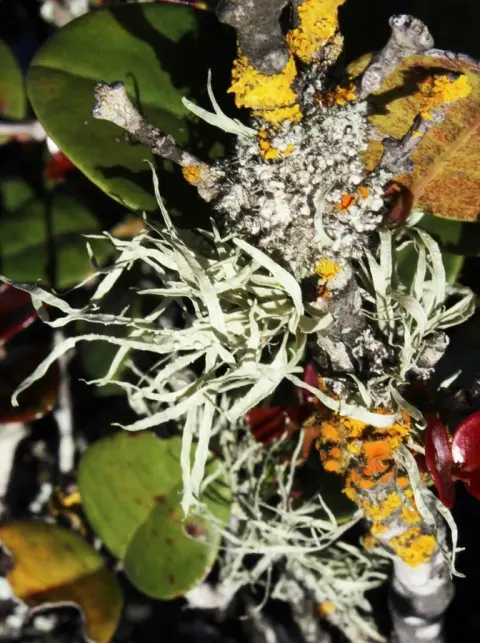
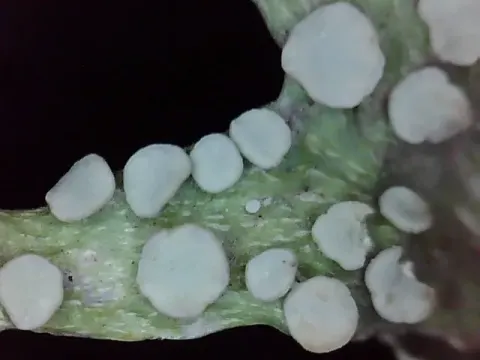
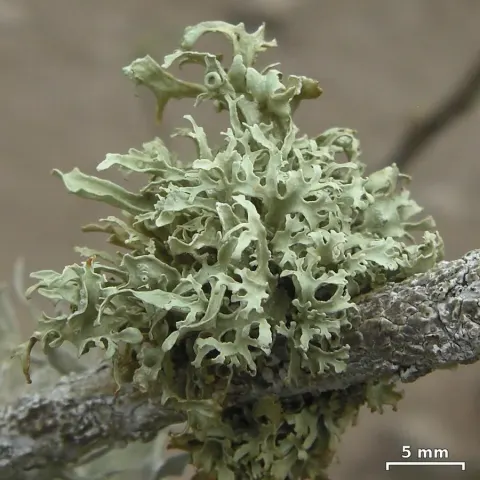
Ramalina azorica has a dull, shrubby thallus that clusters into dense groups of 5–25 branches. These branches originate from a commonly dark, often blackish base, and can extend up to 11 cm in length. They are oriented upright to hanging and have a greenish to yellowish-grey hue. The thallus is somewhat fragile and shows a high degree of variability in its branching patterns. Some branches resemble antlers, while others are denser and become cylindrical towards the tips. The surface of these branches is wrinkled, featuring (cartilage-like) strands that rise to the surface to form lines known as pseudocyphellae—areas where the is partially absent, revealing the underlying layer. In cross-section, the are flattened and can be distinctly contorted in a cork-screw-like fashion. They typically have a diameter of up to about 5 mm, although they are often much slimmer. This species does not produce soredia, which are small, powdery propagules used for asexual reproduction. Reproductive structures called apothecia appear along the margins of the branches. These are 2–4 mm in diameter and can be flat to convex in shape. The within these structures are divided by a single septum, are clear (hyaline), and range from straight to slightly curved, measuring 8.8–12 μm long and 3.3–4.4 μm wide. Additionally, pycnidia—small fruiting bodies that release asexual spores—are located near the margins of the branches and are pale in colour. Chemically, the medulla (the innermost layer of the thallus) does not react to common chemical spot tests (C−, K−, Pd−), but it does fluoresce white under ultraviolet light, indicating the presence of divaricatic acid and another unknown pigment.
Habitat dan peran ekologis
Ramalina azorica is found exclusively on the Azores islands of Pico, Terceira, Faial, and São Miguel. This species typically grows on coastal rocks and the lava of walls bordering coastal fields, where it occurs in local abundance.
- Habitat atau konteks temuan
- Informasi belum tersedia pada sumber rilis ini.
- Substrat
- Informasi belum tersedia pada sumber rilis ini.
- Peran atau konteks
- Pembentuk liken
Reproduksi
In cross-section, the are flattened and can be distinctly contorted in a cork-screw-like fashion. They typically have a diameter of up to about 5 mm, although they are often much slimmer. This species does not produce soredia, which are small, powdery propagules used for asexual reproduction. Reproductive structures called apothecia appear along the margins of the branches. These are 2–4 mm in diameter and can be flat to convex in shape. The within these structures are divided by a single septum, are clear (hyaline), and range from straight to slightly curved, measuring 8.8–12 μm long and 3.3–4.4 μm wide. Additionally, pycnidia—small fruiting bodies that release asexual spores—are located near the margins of the branches and are pale in colour.
Catatan identitas dan cakupan
- Nama diterima mengikuti Catalogue of Life Base2026-09-11; uraian mempertahankan konsep dan nama sumber aslinya.
- Original geographic, specimen and life-cycle scope retained; source import awaits individual editorial review.
- Impor dan terjemahan otomatis belum diperiksa editorial per profil. Struktur reproduktif yang disebutkan tidak membuktikan seluruh siklus hidup diketahui.
- Pengukuran pada uraian mengikuti spesimen, kultur, dan metode sumber; angka tidak diperluas ke semua populasi.
Catatan distribusi dalam narasi mengikuti sumbernya. Dokumentasi spesimen atau foto mengikuti catatan sumber. Bukti wilayah Indonesia dan penilaian konservasi tidak disimpulkan dari gambar.
Melihat dengan konteks
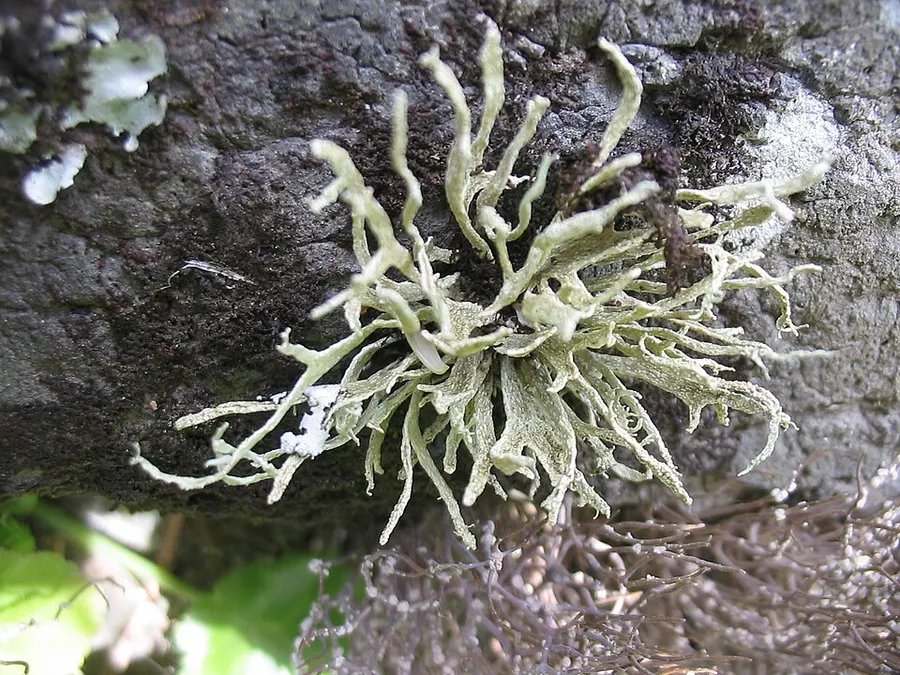
Dokumentasi Ramalina azorica dari Wikimedia Commons. Ramalina azorica auf Flores Azoren, zwischen Faja Grande und Ponta Delgada, auf etwa 400 Metern. An einer trockenen Felswand. Die Flechte war etwa 5 cm hoch. Identifikasi mengikuti record berkas sumber.
- Jenis
- Fotografi
- Kredit
- Christian Hummert ( Ixitixel )
- Lisensi
- CC BY-SA 3.0
- Sumber media
- Buka entri sumber
Sumber profil
- [1] Ramalina azorica — Wikipedia (en)
- [2] Catalogue of Life Base2026-09-11 — Ramalina azorica
- [3] Dokumentasi visual — Ramalina azorica
Rujukan halaman ini
Fungi. Ramalina azorica. Rilis data fungi-2026-10-12-expansion-2. https://fungi-atlas.mgadib.chatgpt.site/jamur/ramalina-azorica/.
Status: impor sumber; pemeriksaan editorial per profil belum selesai. Untuk klaim biologis, gunakan rujukan pada bagian terkait dan periksa konteks sumber aslinya.