01 / Morfologi

Ciri dan struktur

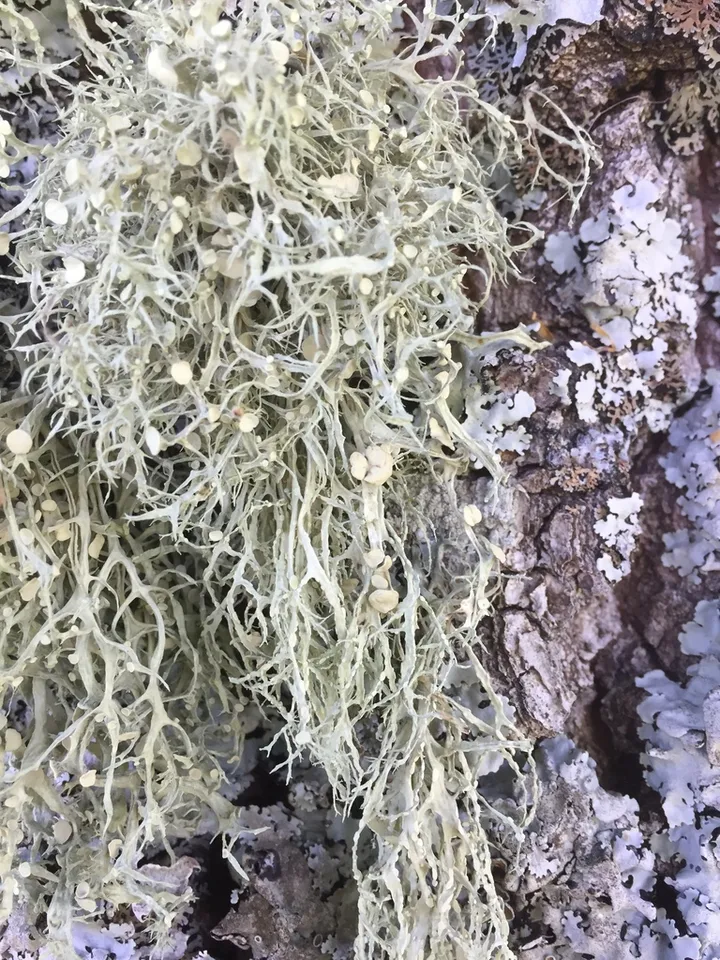
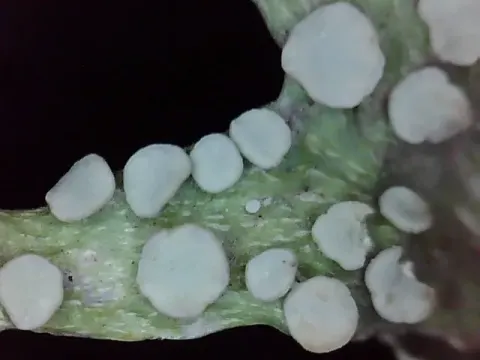
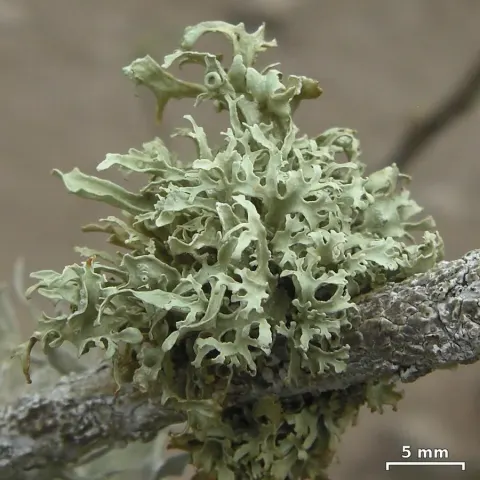
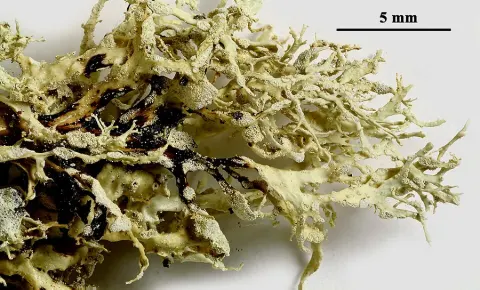
Ramalina calicaris is a fruticose (shrubby) lichen with a greenish grey thallus, anchored to the substrate by a basal holdfast. Thalli are often tufted when young, but may become longer and more pendent with age, reaching about 15–20 cm in length in some accounts. The branches (laciniae) are typically strap-shaped and relatively sparingly branched. They are often distinctly channelled (canaliculate) and commonly about 2–3 mm wide, though broader forms have been reported. The surface is described as smooth to weakly wrinkled, and thalli may appear stiff and spiky when dry. Small pores (pseudocyphellae) penetrate the surface; these range from dot-like to spindle-shaped and may be few or numerous depending on the specimen. Apothecia (spore-producing structures) are usually frequent and in form, typically positioned at or near the tips of the branches, though they can also occur along the margins. They may develop on bends of angled branches and can sometimes show a short spur-like projection. The disc has been described as pale pink-ochre with a thin . The spore-bearing structures (asci) each contain eight spores and have an apical tip whose iodine-staining pattern matches the Bacidia type. Ascospores are hyaline and 1-septate, with reported sizes around 10–16 × 5–7 μm. The photosynthetic partner () is a green alga. Spot tests on the medulla have been reported as negative (K−, C−, KC−, P−, UV−), with some regional treatments summarizing this as K−/C−. Chemically, the cortex contains usnic acid, while the medulla is variably reported as lacking additional substances or containing compounds of the sekikaic acid complex (including sekikaic and homosekikaic acids).

Sebagian uraian ditampilkan dalam bahasa sumber; terjemahannya belum tersedia atau belum lolos pemeriksaan.

Rujukan: [1]

Pengukuran mengikuti objek, spesimen atau kultur, dan metode yang disebutkan sumber. Baca uraian asli untuk konteks lengkap.

02 / Kehidupan

Habitat dan peran ekologis

Ramalina calicaris is primarily corticolous (bark-dwelling), typically growing on branches and twigs rather than on trunks. It is most often associated with trees and shrubs with relatively nutrient-rich bark, and is reported as occurring frequently in coastal settings in parts of its European range. Aptroot and de Bruyn (2011) described it as occurring mostly in coastal regions in Europe but emphasized that, unlike several other Ramalina species, it is not a maritime lichen; they also suggested that its frequent occurrence on small twigs, possibly in the canopy, may contribute to under-recording. In Italy it is recorded mainly from deciduous trees (more rarely conifers), with occurrences reported especially on branches in humid beech forests, though some older records have been flagged as needing confirmation. In Britain and Ireland, the species is mapped and assessed as Least Concern within that framework, and it is described as most frequent in western districts, with more easterly records considered local. Italian records span multiple regions, but distribution reporting has been complicated by historical misidentifications, with at least one earlier regional report explicitly attributed to confusion with other taxa.

Sebagian uraian ditampilkan dalam bahasa sumber; terjemahannya belum tersedia atau belum lolos pemeriksaan.

Rujukan: [1]

Habitat atau konteks temuan
hutan
Substrat
kayu
Peran atau konteks
Pembentuk liken
Temukan hubungan serupa
03 / Siklus hidup

Reproduksi

Apothecia (spore-producing structures) are usually frequent and in form, typically positioned at or near the tips of the branches, though they can also occur along the margins. They may develop on bends of angled branches and can sometimes show a short spur-like projection. The disc has been described as pale pink-ochre with a thin . The spore-bearing structures (asci) each contain eight spores and have an apical tip whose iodine-staining pattern matches the Bacidia type. Ascospores are hyaline and 1-septate, with reported sizes around 10–16 × 5–7 μm.

Sebagian uraian ditampilkan dalam bahasa sumber; terjemahannya belum tersedia atau belum lolos pemeriksaan.

Rujukan: [1]

Sinonim menurut acuan taksonomi rilis: Evernia calicaris; Evernia calicaris var. canaliculata; Lichen calicaris; Lichen rostratus; Lobaria calicaris; Lobaria calicaris var. dilacerata; Parmelia fastigiata var. calicaris; Parmelia fraxinea var. calicaris; Physcia fastigiata var. calicaris; Platisma calicare; Platysma calicare; Ramalina calicaris f. canaliculata; Ramalina calicaris subsp. canaliculata; Ramalina calicaris subvar. canaliculata; Ramalina calicaris subvar. subampliata; Ramalina calicaris subvar. subfastigiata; Ramalina calicaris var. canaliculata; Ramalina calicaris var. subampliata; Ramalina calicaris var. subfastigiata; Ramalina canaliculata; Ramalina fastigiata f. calicaris; Ramalina fastigiata var. subampliata; Ramalina fraxinea f. calicaris; Ramalina fraxinea subf. calicaris; Ramalina fraxinea subsp. canaliculata; Ramalina fraxinea var. calicaris; Ramalina polymorpha calicaris; Ramalina polymorpha var. calicaris; Ramalina subampliata
04 / Batas informasi

Catatan identitas dan cakupan

  • Nama diterima mengikuti Catalogue of Life Base2026-09-11; uraian mempertahankan konsep dan nama sumber aslinya.
  • Original geographic, specimen and life-cycle scope retained; source import awaits individual editorial review.
  • Impor dan terjemahan otomatis belum diperiksa editorial per profil. Struktur reproduktif yang disebutkan tidak membuktikan seluruh siklus hidup diketahui.
  • Pengukuran pada uraian mengikuti spesimen, kultur, dan metode sumber; angka tidak diperluas ke semua populasi.

Catatan distribusi dalam narasi mengikuti sumbernya. Dokumentasi spesimen atau foto mengikuti catatan sumber. Bukti wilayah Indonesia dan penilaian konservasi tidak disimpulkan dari gambar.

05 / Dokumentasi

Melihat dengan konteks

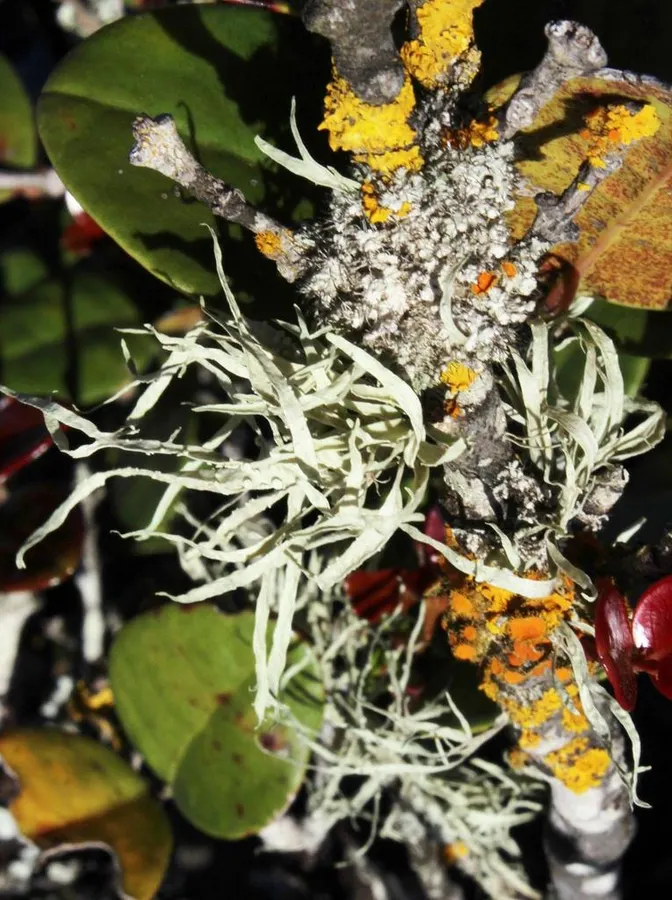
Dokumentasi Ramalina calicaris menurut asosiasi foto pada record takson iNaturalist. Kredit: Tony Rebelo. Identitas mengikuti sumber; bukan penentuan spesimen independen.

Jenis
Fotografi
Kredit
(c) Tony Rebelo, some rights reserved (CC BY-SA), uploaded by Tony Rebelo
Sumber media
Buka entri sumber

Gambar menunjukkan objek menurut identifikasi sumber, bukan verifikasi independen spesimen oleh Fungi. Tidak ada skala baru yang ditambahkan.

Dokumentasi tambahan

06 / Rujukan

Sumber profil

  1. [1] Ramalina calicaris — Wikipedia (en)Bagian sumber: Frozen revision 1338938548
    Tanggal penghimpunan sumber: 2026-10-12
    Teks sumber: CC BY-SA4.0 · Wikipedia contributors
  2. [2] Catalogue of Life Base2026-09-11 — Ramalina calicarisBagian sumber: ColDP NameUsage.tsv ID 6WRDT; accepted species; source 2073
    Tanggal penghimpunan sumber: 2026-10-12
  3. [3] Dokumentasi visual — Ramalina calicarisBagian sumber: Identitas mengikuti sumber dokumentasi; bukan penentuan spesimen independen.
    Tanggal penghimpunan sumber: 2026-10-17
    Media sumber: CC BY-SA 4.0 · (c) Tony Rebelo, some rights reserved (CC BY-SA), uploaded by Tony Rebelo
  4. [4] Dokumentasi visual — Ramalina calicarisBagian sumber: Identitas mengikuti sumber dokumentasi; bukan penentuan spesimen independen.
    Tanggal penghimpunan sumber: 2026-10-17
    Teks sumber: CC BY 4.0 · (c) Andre Hosper, some rights reserved (CC BY), uploaded by Andre Hosper

Adaptasi teks: CC BY-SA 4.0. Wikipedia contributors — Ramalina calicaris — Wikipedia (en)

Uraian asli dan riwayat sumber

Riwayat atau halaman sumber

Ringkasan sumber

Ramalina calicaris is a species of fruticose, bark-dwelling lichen-forming fungus in the family Ramalinaceae. The lichen forms tufted to hanging, greenish-grey shrubby growth anchored by a holdfast at the base, with branches that are often distinctly channelled and strap-shaped, typically 2–3 mm wide and reaching 15–20 cm in length. Its reproductive structures are frequently produced, appearing as pale pink-ochre borne at the tips or margins of the branches, often on bends of angled branches with short spur-like projections.

Revisi sumber

Morfologi sumber

Ramalina calicaris is a fruticose (shrubby) lichen with a greenish grey thallus, anchored to the substrate by a basal holdfast. Thalli are often tufted when young, but may become longer and more pendent with age, reaching about 15–20 cm in length in some accounts. The branches (laciniae) are typically strap-shaped and relatively sparingly branched. They are often distinctly channelled (canaliculate) and commonly about 2–3 mm wide, though broader forms have been reported. The surface is described as smooth to weakly wrinkled, and thalli may appear stiff and spiky when dry. Small pores (pseudocyphellae) penetrate the surface; these range from dot-like to spindle-shaped and may be few or numerous depending on the specimen. Apothecia (spore-producing structures) are usually frequent and in form, typically positioned at or near the tips of the branches, though they can also occur along the margins. They may develop on bends of angled branches and can sometimes show a short spur-like projection. The disc has been described as pale pink-ochre with a thin . The spore-bearing structures (asci) each contain eight spores and have an apical tip whose iodine-staining pattern matches the Bacidia type. Ascospores are hyaline and 1-septate, with reported sizes around 10–16 × 5–7 μm. The photosynthetic partner () is a green alga. Spot tests on the medulla have been reported as negative (K−, C−, KC−, P−, UV−), with some regional treatments summarizing this as K−/C−. Chemically, the cortex contains usnic acid, while the medulla is variably reported as lacking additional substances or containing compounds of the sekikaic acid complex (including sekikaic and homosekikaic acids).

Revisi sumber

Ekologi sumber

Ramalina calicaris is primarily corticolous (bark-dwelling), typically growing on branches and twigs rather than on trunks. It is most often associated with trees and shrubs with relatively nutrient-rich bark, and is reported as occurring frequently in coastal settings in parts of its European range. Aptroot and de Bruyn (2011) described it as occurring mostly in coastal regions in Europe but emphasized that, unlike several other Ramalina species, it is not a maritime lichen; they also suggested that its frequent occurrence on small twigs, possibly in the canopy, may contribute to under-recording. In Italy it is recorded mainly from deciduous trees (more rarely conifers), with occurrences reported especially on branches in humid beech forests, though some older records have been flagged as needing confirmation. In Britain and Ireland, the species is mapped and assessed as Least Concern within that framework, and it is described as most frequent in western districts, with more easterly records considered local. Italian records span multiple regions, but distribution reporting has been complicated by historical misidentifications, with at least one earlier regional report explicitly attributed to confusion with other taxa.

Revisi sumber

Struktur reproduksi sumber

Apothecia (spore-producing structures) are usually frequent and in form, typically positioned at or near the tips of the branches, though they can also occur along the margins. They may develop on bends of angled branches and can sometimes show a short spur-like projection. The disc has been described as pale pink-ochre with a thin . The spore-bearing structures (asci) each contain eight spores and have an apical tip whose iodine-staining pattern matches the Bacidia type. Ascospores are hyaline and 1-septate, with reported sizes around 10–16 × 5–7 μm.

Revisi sumber

Rujukan halaman ini

Fungi. Ramalina calicaris. Rilis data fungi-2026-10-12-expansion-2. https://fungi-atlas.mgadib.chatgpt.site/jamur/ramalina-calicaris/.

Status: impor sumber; pemeriksaan editorial per profil belum selesai. Untuk klaim biologis, gunakan rujukan pada bagian terkait dan periksa konteks sumber aslinya.