Ciri dan struktur
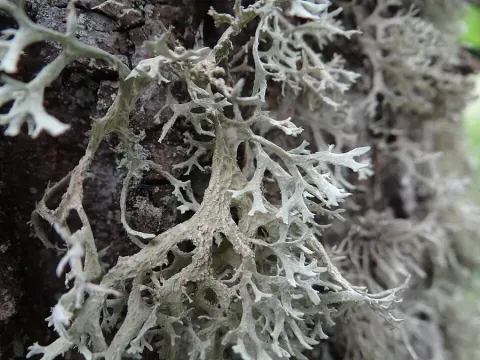
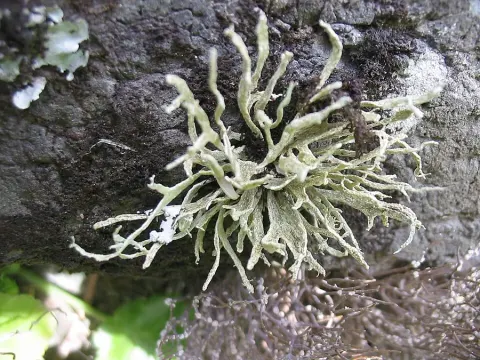
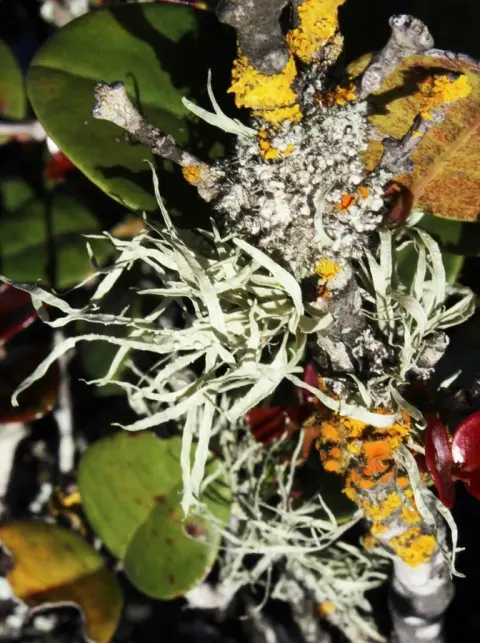
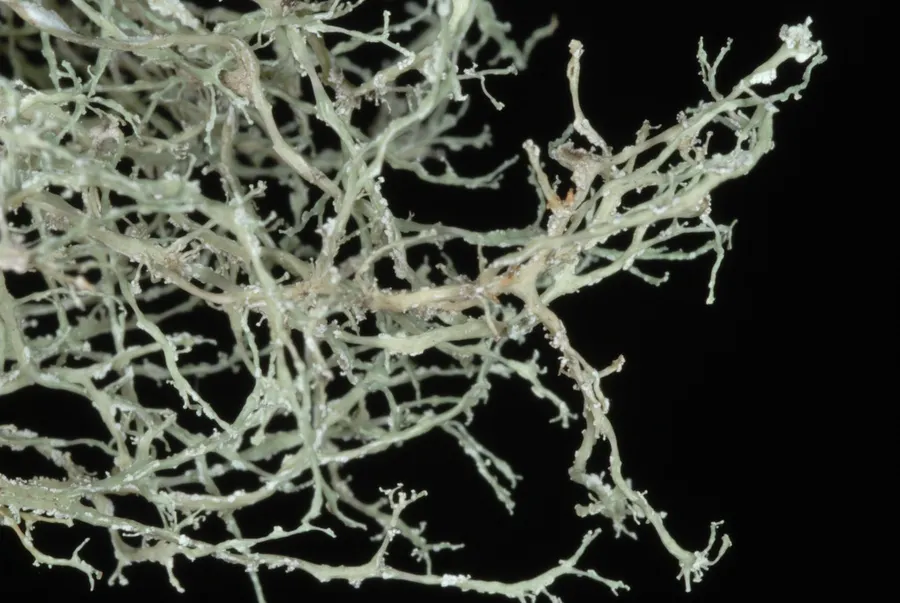
Ramalina peruviana has a thallus whose colour ranges from a grey-green to yellow-green hue, forming tufted, erect to slightly hanging clusters that can extend from 2 to 6 cm in length, and up to about 3 cm high. The branching of this lichen is intricate, varying from nearly symmetrical divisions () to more irregular formations, with measuring between 0.15 and 1.3 mm in width. These branches may present as flat, nearly round (subterete), or round () in cross-section, and can sometimes twist slightly, ending in sharp tips. The tissue (i.e., in cartilage-like central core of the branches) of Ramalina peruviana is not cracked. The cortex measures 15–20 μm thick. The surface texture of Ramalina peruviana can be either or shiny and varies from smooth to wrinkled (), with pseudocyphellae—small, porous areas that allow gas exchange—occasionally present. The base of the lichen, or holdfast, may be clearly defined or spread out, especially in denser colonies. One of the distinguishing features of this species is the presence of soralia, which are small structures that produce powdery reproductive particles. These soralia are dot-like () and can be found along the edges or at the tips of the branches, often giving rise to tiny fibrils. The soredia measure 35–50 μm in diameter. Reproductive structures known as apothecia are rarely observed in Ramalina peruviana; if present, they are located on the margins or sides of the thallus. When they occur, the apothecia have ranging from 0.4 to 2.7 mm in diameter, which can be concave to flat and sometimes notched. The are slender and spindle-shaped (), typically measuring 14.5–17 by 3–6 μm and can be straight or slightly curved.
Habitat dan peran ekologis
The distribution of Ramalina peruviana extends into subtropical and warm temperate locations. Although typically corticolous (bark-dwelling), it is also known to occasionally grow on rocks (saxicolous), and was once recorded on a wooden fence post. In addition to its country of origin in Peru, the lichen has also been recorded from Africa, Australia, several Pacific Islands, Tristan da Cunha, and Saint Helena. Other South American countries that have recorded the presence of Ramalina peruviana are Brazil, Chile, Ecuador, and Uruguay. It occurs in several of the Cape Verde islands. Its distribution in North America extends north to the southern United States, including central Texas, Georgia, and Florida. Its East African range includes Kenya, Tanzania, and Uganda. It is also known from Morocco, where it was documented under the name Ramalina crispans. Although present in New Zealand, it is relatively uncommon. Nearby Pacific locations such as Chatham, Manawatāwhi / Three Kings, Kermadec Islands, and Cook Islands also host this species. In Australia, its grows exclusively corticously, and is most commonly found on the mangrove species Ceriops tagal and Rhizophora stylosa. The environmental conditions in these mangrove communities – including high temperatures, high light intensity, and low humidity – are thought to be ideal for the growth of the lichen.
- Habitat atau konteks temuan
- Informasi belum tersedia pada sumber rilis ini.
- Substrat
- Informasi belum tersedia pada sumber rilis ini.
- Peran atau konteks
- Pembentuk liken
Reproduksi
The surface texture of Ramalina peruviana can be either or shiny and varies from smooth to wrinkled (), with pseudocyphellae—small, porous areas that allow gas exchange—occasionally present. The base of the lichen, or holdfast, may be clearly defined or spread out, especially in denser colonies. One of the distinguishing features of this species is the presence of soralia, which are small structures that produce powdery reproductive particles. These soralia are dot-like () and can be found along the edges or at the tips of the branches, often giving rise to tiny fibrils. The soredia measure 35–50 μm in diameter. Reproductive structures known as apothecia are rarely observed in Ramalina peruviana; if present, they are located on the margins or sides of the thallus.
Catatan identitas dan cakupan
- Nama diterima mengikuti Catalogue of Life Base2026-09-11; uraian mempertahankan konsep dan nama sumber aslinya.
- Original geographic, specimen and life-cycle scope retained; source import awaits individual editorial review.
- Impor dan terjemahan otomatis belum diperiksa editorial per profil. Struktur reproduktif yang disebutkan tidak membuktikan seluruh siklus hidup diketahui.
- Pengukuran pada uraian mengikuti spesimen, kultur, dan metode sumber; angka tidak diperluas ke semua populasi.
Catatan distribusi dalam narasi mengikuti sumbernya. Dokumentasi spesimen atau foto mengikuti catatan sumber. Bukti wilayah Indonesia dan penilaian konservasi tidak disimpulkan dari gambar.
Melihat dengan konteks
Dokumentasi Ramalina peruviana menurut asosiasi foto pada record takson iNaturalist. Kredit: Douglas Goldman. Identitas mengikuti sumber; bukan penentuan spesimen independen.
- Jenis
- Fotografi
- Kredit
- (c) Douglas Goldman, some rights reserved (CC BY-SA), uploaded by Douglas Goldman
- Lisensi
- CC BY-SA 4.0
- Sumber media
- Buka entri sumber
Dokumentasi tambahan
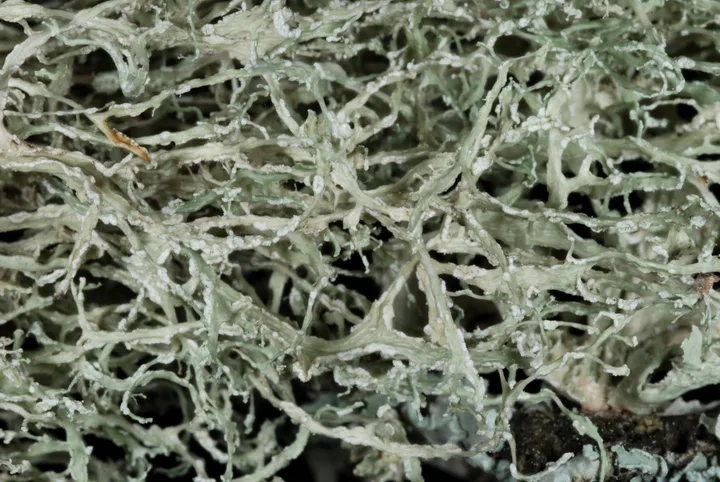
Foto yang diasosiasikan dengan Ramalina peruviana pada iNaturalist. Identifikasi mengikuti sumber; bukan penentuan spesimen independen.
Kredit dan penggunaan
(c) Douglas Goldman, some rights reserved (CC BY-SA), uploaded by Douglas Goldman
Ukuran dan format gambar disesuaikan tanpa pemotongan, retus, atau penambahan skala. Lisensi sumber dipertahankan.
Sumber profil
- [1] Ramalina peruviana — Wikipedia (en)
- [2] Catalogue of Life Base2026-09-11 — Ramalina peruviana
- [3] Dokumentasi visual — Ramalina peruviana
- [4] Dokumentasi visual — Ramalina peruviana
Rujukan halaman ini
Fungi. Ramalina peruviana. Rilis data fungi-2026-10-12-expansion-2. https://fungi-atlas.mgadib.chatgpt.site/jamur/ramalina-peruviana/.
Status: impor sumber; pemeriksaan editorial per profil belum selesai. Untuk klaim biologis, gunakan rujukan pada bagian terkait dan periksa konteks sumber aslinya.