01 / Morfologi

Ciri dan struktur

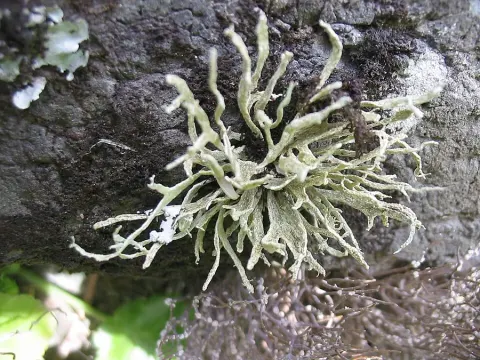
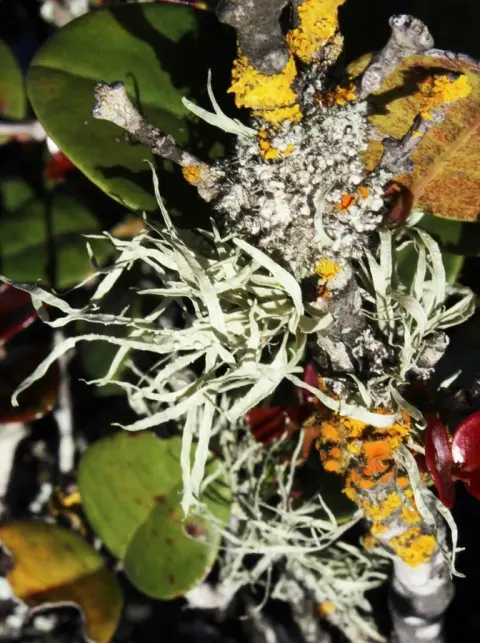
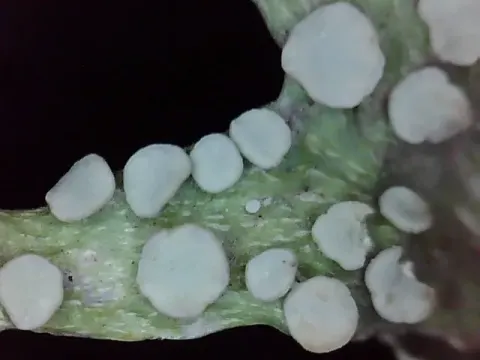
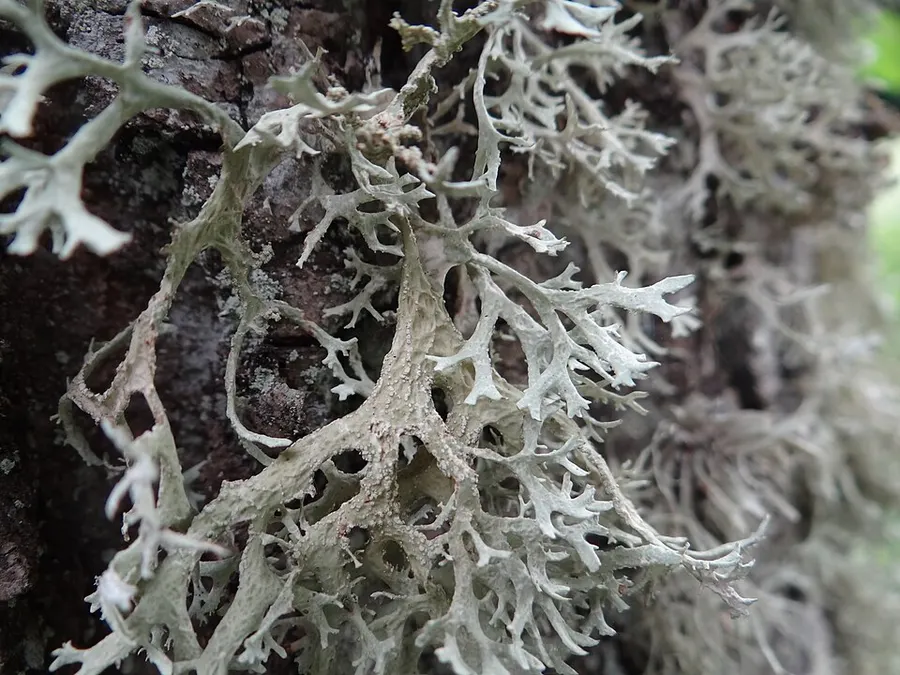
Ramalina pollinaria has a thallus that is pale green to pale yellow, with lengths ranging from 1–2 cm, occasionally reaching up to 5 cm. The thallus is composed of discrete or forms dense mats. Its lobes are flattened and measure about 3 mm broad at the base, quickly branching into numerous finer branches. These branches can be partially , measuring 1–2 mm in diameter, or more flattened with undulating, deeply incised, or notched margins. The surface of the lichen is smooth and shiny, giving it a appearance. Internally, the medulla is dense and not hollow, with a cartilaginous subcortex. The lichen's soralia are mostly found near the tips of the branches but can sometimes appear along the edges or surfaces of the branches. These structures originate from degenerating regions of the , initially presenting as excavated soralia that irregularly spread and often resemble lips at the branch apices. Soredia are fine and measure 30–45 μm in diameter. Apothecia (fruiting bodies) have not been observed in this species. The medulla and soralia show negative reactions to chemical spot tests (C−, K−, KC−, Pd−). However, under ultraviolet light, they may show a faint blue-white or pale violet-grey fluorescence. This lichen contains usnic acid as its primary secondary metabolite (lichen product), sometimes accompanied by an evernic acid complex. In the East Asian lookalikes, R. sekika is chemically distinct by sekikaic-series compounds (often with salazinic acid), whereas R. pollinaria/R. yasudae lack sekikaic acid; the authors noted no evidence of mixed evernic acid and sekikaic acid strains within a single species.

Sebagian uraian ditampilkan dalam bahasa sumber; terjemahannya belum tersedia atau belum lolos pemeriksaan.

Rujukan: [1]

Pengukuran mengikuti objek, spesimen atau kultur, dan metode yang disebutkan sumber. Baca uraian asli untuk konteks lengkap.

02 / Kehidupan

Habitat dan peran ekologis

As circumscribed by Gasparyan et al. (2017), Ramalina pollinaria is mainly a Eurasian species, with confirmed specimens from Sweden, the Netherlands, Belarus, Russia and Armenia. It tolerates a broad ecological niche yet is nowhere particularly common, growing at a wide range of elevations on the bark and old wood of various broad-leaved trees (e.g., Acer platanoides, Carpinus betulus, Fagus orientalis, Quercus robur, Tilia cordata, Robinia) as well as on different rock types. Records from South America and Australia have been referred to other taxa (R. chilena, R. unilateralis); African reports remain unverified; and the authors could not confirm any North American records, with most such material instead attributable to R. labiosorediata. A regional survey of Ramalina in the Hengduan Mountains reported material identified as Ramalina pollinaria from Sichuan and Yunnan, including collections on Quercus and Sorbus bark and one saxicolous specimen, at elevations of about 2,900–3,800 m.

Sebagian uraian ditampilkan dalam bahasa sumber; terjemahannya belum tersedia atau belum lolos pemeriksaan.

Rujukan: [1]

Habitat atau konteks temuan
Informasi belum tersedia pada sumber rilis ini.
Substrat
Informasi belum tersedia pada sumber rilis ini.
Peran atau konteks
Pembentuk liken
Temukan hubungan serupa
03 / Siklus hidup

Reproduksi

The lichen's soralia are mostly found near the tips of the branches but can sometimes appear along the edges or surfaces of the branches. These structures originate from degenerating regions of the , initially presenting as excavated soralia that irregularly spread and often resemble lips at the branch apices. Soredia are fine and measure 30–45 μm in diameter. Apothecia (fruiting bodies) have not been observed in this species.

Sebagian uraian ditampilkan dalam bahasa sumber; terjemahannya belum tersedia atau belum lolos pemeriksaan.

Rujukan: [1]

Sinonim menurut acuan taksonomi rilis: Lichen pollinarius; Lichen squarrosus humilis; Parmelia pollinaria; Ramalina fraxinea var. pollinaria; Ramalina humilis; Ramalina pollinaria f. humilis; Ramalina pollinaria lenormandii; Ramalina pollinaria var. humilis; Ramalina polymorpha var. humilis; Ramalina squarrosa f. humilis
04 / Batas informasi

Catatan identitas dan cakupan

  • Nama diterima mengikuti Catalogue of Life Base2026-09-11; uraian mempertahankan konsep dan nama sumber aslinya.
  • Original geographic, specimen and life-cycle scope retained; source import awaits individual editorial review.
  • Impor dan terjemahan otomatis belum diperiksa editorial per profil. Struktur reproduktif yang disebutkan tidak membuktikan seluruh siklus hidup diketahui.
  • Pengukuran pada uraian mengikuti spesimen, kultur, dan metode sumber; angka tidak diperluas ke semua populasi.

Catatan distribusi dalam narasi mengikuti sumbernya. Dokumentasi spesimen atau foto mengikuti catatan sumber. Bukti wilayah Indonesia dan penilaian konservasi tidak disimpulkan dari gambar.

05 / Dokumentasi

Melihat dengan konteks

Dokumentasi Ramalina pollinaria dari Wikimedia Commons. Ramalina pollinaria (location:Slovakia, Vyšné Ružbachy, park) Identifikasi mengikuti record berkas sumber.

Jenis
Fotografi
Kredit
Jerzy Opioła
Sumber media
Buka entri sumber

Gambar menunjukkan objek menurut identifikasi sumber, bukan verifikasi independen spesimen oleh Fungi. Tidak ada skala baru yang ditambahkan.

06 / Rujukan

Sumber profil

  1. [1] Ramalina pollinaria — Wikipedia (en)Bagian sumber: Frozen revision 1353396403
    Tanggal penghimpunan sumber: 2026-10-12
    Teks sumber: CC BY-SA4.0 · Wikipedia contributors
  2. [2] Catalogue of Life Base2026-09-11 — Ramalina pollinariaBagian sumber: ColDP NameUsage.tsv ID 4RBHK; accepted species; source 2073
    Tanggal penghimpunan sumber: 2026-10-12
  3. [3] Dokumentasi visual — Ramalina pollinariaBagian sumber: Individual media record; identification follows the source, not independent determination
    Tanggal penghimpunan sumber: 2026-10-12
    Media sumber: CC BY-SA 4.0 · Jerzy Opioła

Adaptasi teks: CC BY-SA 4.0. Wikipedia contributors — Ramalina pollinaria — Wikipedia (en)

Uraian asli dan riwayat sumber

Riwayat atau halaman sumber

Ringkasan sumber

Ramalina pollinaria is a Eurasian, rock- and bark-dwelling fruticose lichen in the family Ramalinaceae. This lichen forms pale green to yellowish branching structures that grow 1–5 cm long and produce powdery reproductive particles called soredia. It was originally discovered in Sweden in 1795 and was noted by early botanists as valuable for producing dyes, yielding light-green colours on silk and brown shades on wool. The species grows on both tree bark and rocks across Europe and Asia, though it is not particularly common in any location.

Revisi sumber

Morfologi sumber

Ramalina pollinaria has a thallus that is pale green to pale yellow, with lengths ranging from 1–2 cm, occasionally reaching up to 5 cm. The thallus is composed of discrete or forms dense mats. Its lobes are flattened and measure about 3 mm broad at the base, quickly branching into numerous finer branches. These branches can be partially , measuring 1–2 mm in diameter, or more flattened with undulating, deeply incised, or notched margins. The surface of the lichen is smooth and shiny, giving it a appearance. Internally, the medulla is dense and not hollow, with a cartilaginous subcortex. The lichen's soralia are mostly found near the tips of the branches but can sometimes appear along the edges or surfaces of the branches. These structures originate from degenerating regions of the , initially presenting as excavated soralia that irregularly spread and often resemble lips at the branch apices. Soredia are fine and measure 30–45 μm in diameter. Apothecia (fruiting bodies) have not been observed in this species. The medulla and soralia show negative reactions to chemical spot tests (C−, K−, KC−, Pd−). However, under ultraviolet light, they may show a faint blue-white or pale violet-grey fluorescence. This lichen contains usnic acid as its primary secondary metabolite (lichen product), sometimes accompanied by an evernic acid complex. In the East Asian lookalikes, R. sekika is chemically distinct by sekikaic-series compounds (often with salazinic acid), whereas R. pollinaria/R. yasudae lack sekikaic acid; the authors noted no evidence of mixed evernic acid and sekikaic acid strains within a single species.

Revisi sumber

Ekologi sumber

As circumscribed by Gasparyan et al. (2017), Ramalina pollinaria is mainly a Eurasian species, with confirmed specimens from Sweden, the Netherlands, Belarus, Russia and Armenia. It tolerates a broad ecological niche yet is nowhere particularly common, growing at a wide range of elevations on the bark and old wood of various broad-leaved trees (e.g., Acer platanoides, Carpinus betulus, Fagus orientalis, Quercus robur, Tilia cordata, Robinia) as well as on different rock types. Records from South America and Australia have been referred to other taxa (R. chilena, R. unilateralis); African reports remain unverified; and the authors could not confirm any North American records, with most such material instead attributable to R. labiosorediata. A regional survey of Ramalina in the Hengduan Mountains reported material identified as Ramalina pollinaria from Sichuan and Yunnan, including collections on Quercus and Sorbus bark and one saxicolous specimen, at elevations of about 2,900–3,800 m.

Revisi sumber

Struktur reproduksi sumber

The lichen's soralia are mostly found near the tips of the branches but can sometimes appear along the edges or surfaces of the branches. These structures originate from degenerating regions of the , initially presenting as excavated soralia that irregularly spread and often resemble lips at the branch apices. Soredia are fine and measure 30–45 μm in diameter. Apothecia (fruiting bodies) have not been observed in this species.

Revisi sumber

Rujukan halaman ini

Fungi. Ramalina pollinaria. Rilis data fungi-2026-10-12-expansion-2. https://fungi-atlas.mgadib.chatgpt.site/jamur/ramalina-pollinaria/.

Status: impor sumber; pemeriksaan editorial per profil belum selesai. Untuk klaim biologis, gunakan rujukan pada bagian terkait dan periksa konteks sumber aslinya.