01 / Morfologi

Ciri dan struktur

Tylophoron hibernicum forms a thin, felty crust on bark. The thallus is pale grayish white (sometimes bluish white and only rarely creamy), lacks a true , and is usually no more than about 0.3 mm thick. It produces many rounded sporodochia about 0.4–1 mm across; these are typically white to cream, and may have a faint pinkish or orange tint when fresh, often fading to white in herbarium material. The photosynthetic partner () is the filamentous green alga Trentepohlia. A brown, cottony margin () may be present and can be several millimeters wide. The sporodochia produce hyaline conidia (asexual spores) that are either nonseptate or one-septate; one-septate conidia are often pinched at the septum. Sexual fruiting bodies are uncommon, but when present they are small, , and topped by a well-developed black (a powdery spore mass typical of lichens). The ascospores are dark brown, one-septate, and have a darker band around the middle. Pycnidia have been reported rarely, producing slender, thread-like . Standard chemical spot tests show a weak C+ (red) reaction on the thallus, with K− and KC+ (red). Under ultraviolet light the thallus is usually UV− but some specimens are UV+ (orange). Thin-layer chromatography detected lecanoric acid in all examined specimens, with lichexanthone in some collections; earlier reports of schizopeltic acid were interpreted as likely contamination from the host lichen in mixed material. In southeastern North America, apothecia are seldom seen, and collections are typically recognized by the Trentepohlia photobiont, pale sporodochia with fragile conidia, and the presence of lecanoric acid.

Sebagian uraian ditampilkan dalam bahasa sumber; terjemahannya belum tersedia atau belum lolos pemeriksaan.

Rujukan: [1]

Pengukuran mengikuti objek, spesimen atau kultur, dan metode yang disebutkan sumber. Baca uraian asli untuk konteks lengkap.

02 / Kehidupan

Habitat dan peran ekologis

Tylophoron hibernicum is corticolous, growing on the bark of trees in humid forests. The type material was collected in Ireland on a lichen growing in a sheltered recess on an old oak, and subsequent specimens have been documented from several widely separated regions. Confirmed collections include the western Pyrenees (France and Spain), the Galápagos (on multiple islands, mostly in humid highland settings but sometimes in transition or dry-zone sites), Hawaii, southern Florida, and tropical Africa (Democratic Republic of the Congo). Recorded substrates include a range of tree hosts, from oaks in Europe to various native or introduced trees in tropical localities. In 2017, it was recorded for the first time in Russia, from material collected in the northwestern Caucasus from the Krasnodar region.

Sebagian uraian ditampilkan dalam bahasa sumber; terjemahannya belum tersedia atau belum lolos pemeriksaan.

Rujukan: [1]

Habitat atau konteks temuan
hutan
Substrat
Informasi belum tersedia pada sumber rilis ini.
Peran atau konteks
Pembentuk liken
Temukan hubungan serupa
03 / Siklus hidup

Reproduksi

Tylophoron hibernicum forms a thin, felty crust on bark. The thallus is pale grayish white (sometimes bluish white and only rarely creamy), lacks a true , and is usually no more than about 0.3 mm thick. It produces many rounded sporodochia about 0.4–1 mm across; these are typically white to cream, and may have a faint pinkish or orange tint when fresh, often fading to white in herbarium material. The photosynthetic partner () is the filamentous green alga Trentepohlia. A brown, cottony margin () may be present and can be several millimeters wide. The sporodochia produce hyaline conidia (asexual spores) that are either nonseptate or one-septate; one-septate conidia are often pinched at the septum.

Sebagian uraian ditampilkan dalam bahasa sumber; terjemahannya belum tersedia atau belum lolos pemeriksaan.

Rujukan: [1]

Sinonim menurut acuan taksonomi rilis: Blarneya hibernica
04 / Batas informasi

Catatan identitas dan cakupan

  • Nama diterima mengikuti Catalogue of Life Base2026-09-11; uraian mempertahankan konsep dan nama sumber aslinya.
  • Original geographic, specimen and life-cycle scope retained; source import awaits individual editorial review.
  • Impor dan terjemahan otomatis belum diperiksa editorial per profil. Struktur reproduktif yang disebutkan tidak membuktikan seluruh siklus hidup diketahui.
  • Pengukuran pada uraian mengikuti spesimen, kultur, dan metode sumber; angka tidak diperluas ke semua populasi.

Catatan distribusi dalam narasi mengikuti sumbernya. Dokumentasi spesimen atau foto mengikuti catatan sumber. Bukti wilayah Indonesia dan penilaian konservasi tidak disimpulkan dari gambar.

05 / Dokumentasi

Melihat dengan konteks

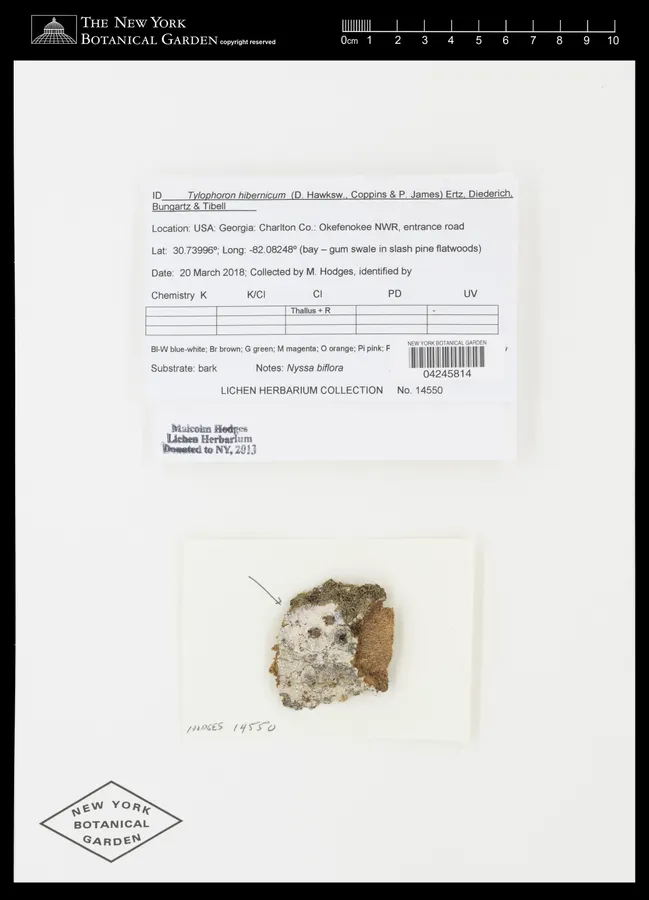
Voucher herbarium Tylophoron hibernicum (04245814), The New York Botanical Garden. Identifikasi mengikuti record spesimen sumber. Foto bahan, kemasan, atau label herbarium sebagaimana tersedia pada record institusi; bukan foto lapangan atau penentuan spesimen independen.

Jenis
Voucher herbarium
Kredit
The New York Botanical Garden
Lisensi
CC BY 4.0
Sumber media
Buka entri sumber

Gambar menunjukkan objek menurut identifikasi sumber, bukan verifikasi independen spesimen oleh Fungi. Tidak ada skala baru yang ditambahkan.

06 / Rujukan

Sumber profil

  1. [1] Tylophoron hibernicum — Wikipedia (en)Bagian sumber: Frozen revision 1334904911
    Tanggal penghimpunan sumber: 2026-10-12
    Teks sumber: CC BY-SA4.0 · Wikipedia contributors
  2. [2] Catalogue of Life Base2026-09-11 — Tylophoron hibernicumBagian sumber: ColDP NameUsage.tsv ID 7CZY3; accepted species; source 2073
    Tanggal penghimpunan sumber: 2026-10-12
  3. [3] Dokumentasi visual — Tylophoron hibernicumBagian sumber: Individual media record; identification follows the source, not independent determination
    Tanggal penghimpunan sumber: 2026-10-12
    Media sumber: CC BY 4.0 · The New York Botanical Garden

Adaptasi teks: CC BY-SA 4.0. Wikipedia contributors — Tylophoron hibernicum — Wikipedia (en)

Uraian asli dan riwayat sumber

Riwayat atau halaman sumber

Ringkasan sumber

Tylophoron hibernicum is a species of crustose lichen in the family Arthoniaceae. The species forms a thin, pale greyish-white crust dotted with small, rounded that produce asexual spores. Originally described in 1979 as Blarneya hibernica based on Irish specimens, it was transferred to Tylophoron in 2011 following molecular and morphological studies that demonstrated Blarneya was nested within that genus. This bark-dwelling lichen grows on trees in humid forests and has a scattered pantropical to warm-temperate distribution, with confirmed records from Ireland, the Pyrenees, the Galápagos Islands, Hawaii, and tropical Africa.

Revisi sumber

Morfologi sumber

Tylophoron hibernicum forms a thin, felty crust on bark. The thallus is pale grayish white (sometimes bluish white and only rarely creamy), lacks a true , and is usually no more than about 0.3 mm thick. It produces many rounded sporodochia about 0.4–1 mm across; these are typically white to cream, and may have a faint pinkish or orange tint when fresh, often fading to white in herbarium material. The photosynthetic partner () is the filamentous green alga Trentepohlia. A brown, cottony margin () may be present and can be several millimeters wide. The sporodochia produce hyaline conidia (asexual spores) that are either nonseptate or one-septate; one-septate conidia are often pinched at the septum. Sexual fruiting bodies are uncommon, but when present they are small, , and topped by a well-developed black (a powdery spore mass typical of lichens). The ascospores are dark brown, one-septate, and have a darker band around the middle. Pycnidia have been reported rarely, producing slender, thread-like . Standard chemical spot tests show a weak C+ (red) reaction on the thallus, with K− and KC+ (red). Under ultraviolet light the thallus is usually UV− but some specimens are UV+ (orange). Thin-layer chromatography detected lecanoric acid in all examined specimens, with lichexanthone in some collections; earlier reports of schizopeltic acid were interpreted as likely contamination from the host lichen in mixed material. In southeastern North America, apothecia are seldom seen, and collections are typically recognized by the Trentepohlia photobiont, pale sporodochia with fragile conidia, and the presence of lecanoric acid.

Revisi sumber

Ekologi sumber

Tylophoron hibernicum is corticolous, growing on the bark of trees in humid forests. The type material was collected in Ireland on a lichen growing in a sheltered recess on an old oak, and subsequent specimens have been documented from several widely separated regions. Confirmed collections include the western Pyrenees (France and Spain), the Galápagos (on multiple islands, mostly in humid highland settings but sometimes in transition or dry-zone sites), Hawaii, southern Florida, and tropical Africa (Democratic Republic of the Congo). Recorded substrates include a range of tree hosts, from oaks in Europe to various native or introduced trees in tropical localities. In 2017, it was recorded for the first time in Russia, from material collected in the northwestern Caucasus from the Krasnodar region.

Revisi sumber

Struktur reproduksi sumber

Tylophoron hibernicum forms a thin, felty crust on bark. The thallus is pale grayish white (sometimes bluish white and only rarely creamy), lacks a true , and is usually no more than about 0.3 mm thick. It produces many rounded sporodochia about 0.4–1 mm across; these are typically white to cream, and may have a faint pinkish or orange tint when fresh, often fading to white in herbarium material. The photosynthetic partner () is the filamentous green alga Trentepohlia. A brown, cottony margin () may be present and can be several millimeters wide. The sporodochia produce hyaline conidia (asexual spores) that are either nonseptate or one-septate; one-septate conidia are often pinched at the septum.

Revisi sumber

Rujukan halaman ini

Fungi. Tylophoron hibernicum. Rilis data fungi-2026-10-12-expansion-2. https://fungi-atlas.mgadib.chatgpt.site/jamur/tylophoron-hibernicum/.

Status: impor sumber; pemeriksaan editorial per profil belum selesai. Untuk klaim biologis, gunakan rujukan pada bagian terkait dan periksa konteks sumber aslinya.